Maris Pamela, Blomme Arnaud, Palacios Ana Perez, Costanza Brunella, Bellahcène Akeila, Bianchi Elettra, Gofflot Stephanie, Drion Pierre, Trombino Giovanna Elvi, Di Valentin Emmanuel, Cusumano Pino G, Maweja Sylvie, Jerusalem Guy, Delvenne Philippe, Lifrange Eric, Castronovo Vincent, Turtoi Andrei
Metastasis Research Laboratory, GIGA-Cancer, University of Liège, Liège, Belgium.
Department of Pathology, University Hospital Liège, University of Liège, Liège, Belgium.
PLoS Med. 2015 Sep 1;12(9):e1001871. doi: 10.1371/journal.pmed.1001871. eCollection 2015 Sep.
Breast cancer is a leading malignancy affecting the female population worldwide. Most morbidity is caused by metastases that remain incurable to date. TGF-β1 has been identified as a key driving force behind metastatic breast cancer, with promising therapeutic implications.
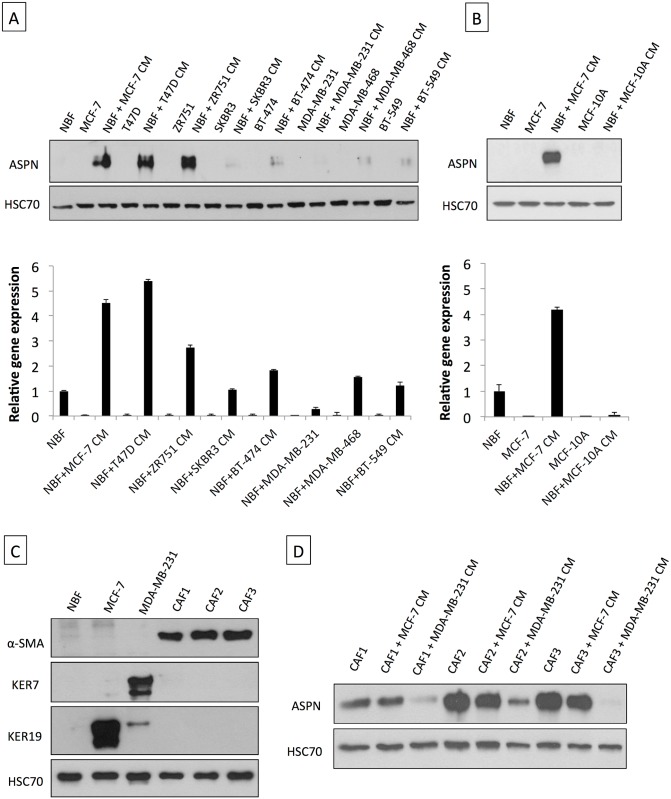
Employing immunohistochemistry (IHC) analysis, we report, to our knowledge for the first time, that asporin is overexpressed in the stroma of most human breast cancers and is not expressed in normal breast tissue. In vitro, asporin is secreted by breast fibroblasts upon exposure to conditioned medium from some but not all human breast cancer cells. While hormone receptor (HR) positive cells cause strong asporin expression, triple-negative breast cancer (TNBC) cells suppress it. Further, our findings show that soluble IL-1β, secreted by TNBC cells, is responsible for inhibiting asporin in normal and cancer-associated fibroblasts. Using recombinant protein, as well as a synthetic peptide fragment, we demonstrate the ability of asporin to inhibit TGF-β1-mediated SMAD2 phosphorylation, epithelial to mesenchymal transition, and stemness in breast cancer cells. In two in vivo murine models of TNBC, we observed that tumors expressing asporin exhibit significantly reduced growth (2-fold; p = 0.01) and metastatic properties (3-fold; p = 0.045). A retrospective IHC study performed on human breast carcinoma (n = 180) demonstrates that asporin expression is lowest in TNBC and HER2+ tumors, while HR+ tumors have significantly higher asporin expression (4-fold; p = 0.001). Assessment of asporin expression and patient outcome (n = 60; 10-y follow-up) shows that low protein levels in the primary breast lesion significantly delineate patients with bad outcome regardless of the tumor HR status (area under the curve = 0.87; 95% CI 0.78-0.96; p = 0.0001). Survival analysis, based on gene expression (n = 375; 25-y follow-up), confirmed that low asporin levels are associated with a reduced likelihood of survival (hazard ratio = 0.58; 95% CI 0.37-0.91; p = 0.017). Although these data highlight the potential of asporin to serve as a prognostic marker, confirmation of the clinical value would require a prospective study on a much larger patient cohort.
Our data show that asporin is a stroma-derived inhibitor of TGF-β1 and a tumor suppressor in breast cancer. High asporin expression is significantly associated with less aggressive tumors, stratifying patients according to the clinical outcome. Future pre-clinical studies should consider options for increasing asporin expression in TNBC as a promising strategy for targeted therapy.
乳腺癌是影响全球女性人群的主要恶性肿瘤。大多数发病是由至今仍无法治愈的转移灶引起的。转化生长因子-β1(TGF-β1)已被确定为转移性乳腺癌背后的关键驱动力,具有潜在的治疗意义。
通过免疫组织化学(IHC)分析,据我们所知,我们首次报告在大多数人类乳腺癌的基质中,阿spor蛋白过度表达,而在正常乳腺组织中不表达。在体外,当暴露于部分而非全部人类乳腺癌细胞的条件培养基时,乳腺成纤维细胞会分泌阿spor蛋白。虽然激素受体(HR)阳性细胞会导致阿spor蛋白强烈表达,但三阴性乳腺癌(TNBC)细胞会抑制其表达。此外,我们的研究结果表明,TNBC细胞分泌的可溶性白细胞介素-1β(IL-1β)负责抑制正常及癌相关成纤维细胞中的阿spor蛋白。使用重组蛋白以及合成肽片段,我们证明了阿spor蛋白能够抑制TGF-β1介导的SMAD2磷酸化、上皮-间质转化以及乳腺癌细胞的干性。在两种TNBC的体内小鼠模型中,我们观察到表达阿spor蛋白的肿瘤生长显著减缓(2倍;p = 0.01),转移特性也显著降低(3倍;p = 0.045)。对180例人类乳腺癌进行的回顾性IHC研究表明,阿spor蛋白在TNBC和HER2+肿瘤中的表达最低,而HR+肿瘤中的阿spor蛋白表达显著更高(4倍;p = 0.001)。对阿spor蛋白表达与患者预后(n = 60;10年随访)的评估显示,原发性乳腺病变中低蛋白水平显著区分出预后不良的患者,无论肿瘤的HR状态如何(曲线下面积 = 0.87;95%置信区间0.78 - 0.96;p = 0.0001)。基于基因表达(n = 375;25年随访)的生存分析证实,低阿spor蛋白水平与生存可能性降低相关(风险比 = 0.58;95%置信区间0.37 - 0.91;p = 0.017)。尽管这些数据突出了阿spor蛋白作为预后标志物的潜力,但要确认其临床价值还需要对更大规模的患者队列进行前瞻性研究。
我们的数据表明,阿spor蛋白是一种源自基质的TGF-β1抑制剂,也是乳腺癌中的肿瘤抑制因子。高阿spor蛋白表达与侵袭性较低的肿瘤显著相关,可根据临床结果对患者进行分层。未来的临床前研究应考虑将提高TNBC中阿spor蛋白表达作为一种有前景的靶向治疗策略。