Lyonga Emilia Enjema, Toukam Michel, Nkenfou Celine, Gonsu Hortense Kamga, Assoumou Marie-Claire Okomo, Mesembe Martha Tongo, Eyoh Agnes Bedie, Ikomey George Mondinde, Ndze Valantine Ngum, Koulla-Shiro Sinata
Department of Microbiology, Haematology, Parasitology and Infectious Diseases, Faculty of Medicine and Biomedical Sciences, University of Yaoundé 1, Yaoundé, Cameroon ; Centre for the Study and Control of Communicable Diseases, Faculty of Medicine and Biomedical Sciences, University of Yaoundé 1, Yaoundé, Cameroon.
Department of Microbiology, Haematology, Parasitology and Infectious Diseases, Faculty of Medicine and Biomedical Sciences, University of Yaoundé 1, Yaoundé, Cameroon.
Pan Afr Med J. 2015 Jun 9;21:105. doi: 10.11604/pamj.2015.21.105.5469. eCollection 2015.
It is estimated that 150 million urinary tract infections (UTIs) occur yearly worldwide, resulting in more than 6 billion dollar in direct healthcare cost. The etiology of UTIs is predictable, with Escherichia coli, an Enterobacteriaceae being the principal pathogen. Quinolones are usually the drug of choice. In this study, we report the resistance pattern of Enterobacteriaceae isolates from UTIs to quinolones among in-patients and out-patients at the Yaoundé Reference Hospital in Cameroon.
A cross-sectional descriptive study was carried out for a ten-month period. Consecutive clean-catch mid-stream urine samples were collected from 207 in and out-patients. Identification was done using the Api 20E, and susceptibility testing using the Kirby Bauer's disc diffusion method and the MIC was done using the E-test.
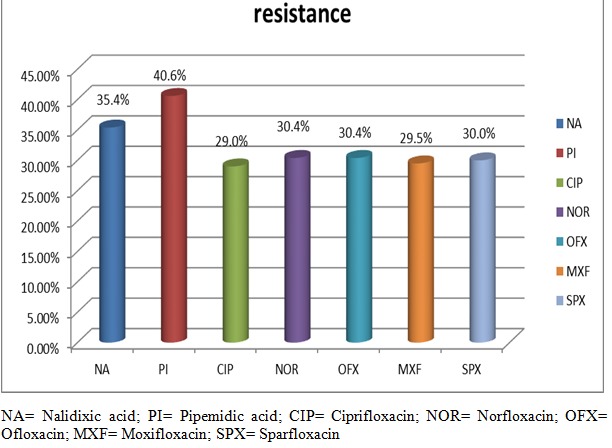
Out of the 207 isolates, 58(28.0%) were found to be resistant to all the quinolones used in the study. The resistances observed by species were in the order: Enterobacter 4(30.8%); Klebsiella 19(29.7%); Escherichia 25 (29.4%); Proteus 2(11.8%); Serratia 4(25.0%). Quinolone resistance for Escherichia was 42.9% for In-Patients (IP) and 16.3% for Out-Patient (OP) (P-value=0.006); Klebsiella 35.9% for IP and 20% for OP; Proteus 11.1% for IP and 12.5% for OP; Serratia 18.2% for IP and 40% for OP; Enterobacter 22.2 for IP and 50% for OP.
High resistance rates to quinolones were observed not only for in-patients but also for out-patients with urinary tract enterobacterial infections. These findings demonstrate the importance of antibiotics susceptibility testing in improving quinolones prescription practices in Cameroon.
据估计,全球每年发生1.5亿例尿路感染(UTI),直接医疗费用超过60亿美元。尿路感染的病因是可预测的,肠杆菌科的大肠杆菌是主要病原体。喹诺酮类药物通常是首选药物。在本研究中,我们报告了喀麦隆雅温得参考医院住院患者和门诊患者中尿路感染分离出的肠杆菌科细菌对喹诺酮类药物的耐药模式。
进行了为期十个月的横断面描述性研究。从207名住院患者和门诊患者中连续收集清洁中段尿样本。使用Api 20E进行鉴定,使用 Kirby Bauer 纸片扩散法进行药敏试验,使用E-test测定最低抑菌浓度(MIC)。
在207株分离菌株中,发现58株(28.0%)对研究中使用的所有喹诺酮类药物耐药。按菌种观察到的耐药情况依次为:肠杆菌属4株(30.8%);克雷伯菌属19株(29.7%);大肠杆菌25株(29.4%);变形杆菌属2株(11.8%);沙雷菌属4株(25.0%)。大肠杆菌对喹诺酮类药物的耐药率住院患者(IP)为42.9%,门诊患者(OP)为16.3%(P值=0.006);克雷伯菌属住院患者为35.9%,门诊患者为20%;变形杆菌属住院患者为11.1%,门诊患者为12.5%;沙雷菌属住院患者为18.2%,门诊患者为40%;肠杆菌属住院患者为22.2%,门诊患者为50%。
在患有尿路肠杆菌感染的住院患者和门诊患者中均观察到对喹诺酮类药物的高耐药率。这些发现表明了抗生素药敏试验在改善喀麦隆喹诺酮类药物处方实践中的重要性。