Slaug Björn, Schilling Oliver, Iwarsson Susanne, Carlsson Gunilla
Department of Health Sciences, Faculty of Medicine, Lund University, Box 157 SE-221 00, Lund, Sweden.
Department of Psychological Ageing Research, Institute of Psychology, University of Heidelberg, Heidelberg, Germany.
BMC Public Health. 2015 Sep 2;15:834. doi: 10.1186/s12889-015-2185-4.
Making the built environment accessible for all regardless of functional capacity is an important goal for public health efforts. Considerable impediments to achieving this goal suggest the need for valid measurements of acccessibility and for greater attention to the complexity of person-environment fit issues. To address these needs, this study aimed to provide a methodological platform, useful for further research and instrument development within accessibility research. This was accomplished by the construction of a typology of problematic person-environment fit constellations, utilizing an existing methodology developed to assess and analyze accessibility problems in the built environment.
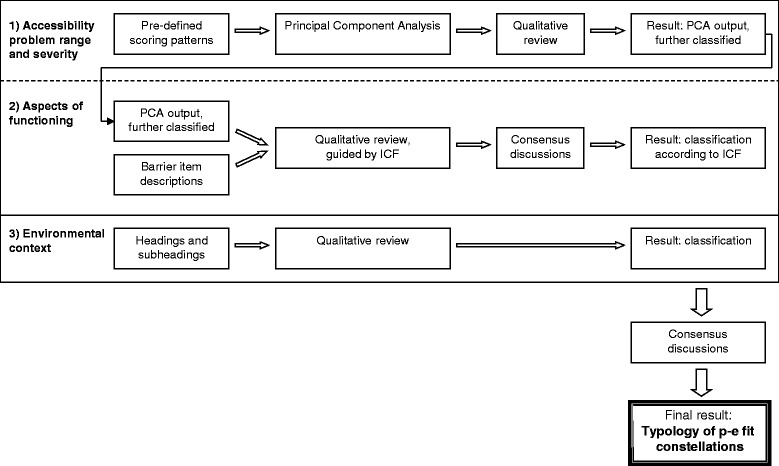
By means of qualitative review and statistical methods we classified the person-environment fit components covered by an existing application which targets housing accessibility: the Housing Enabler (HE) instrument. The International Classification of Functioning, Disability and Health (ICF) was used as a conceptual framework. Qualitative classification principles were based on conceptual similarities and for quantitative analysis of similarities, Principal Component Analysis was carried out.
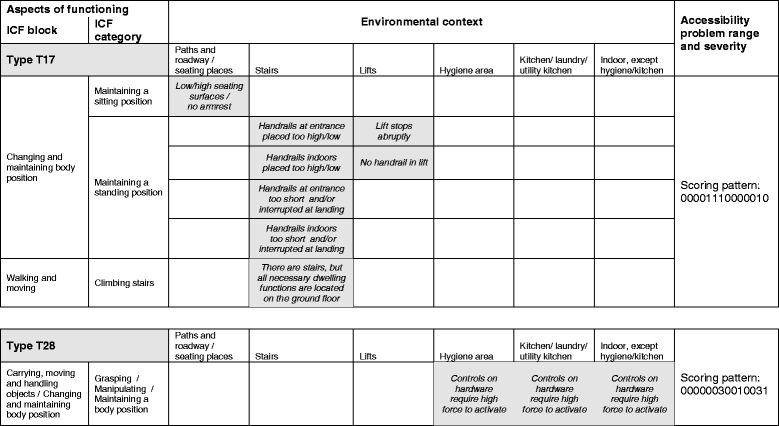
We present a typology of problematic person-environment fit constellations classified along three dimensions: 1) accessibility problem range and severity 2) aspects of functioning 3) environmental context. As a result of the classification of the HE components, 48 typical person-environment fit constellations were recognised.
The main contribution of this study is the proposed typology of person-environment fit constellations. The typology provides a methodological platform for the identification and quantification of problematic person-environment fit constellations. Its link to the globally accepted ICF classification system facilitates communication within the scientific and health care practice communities. The typology also highlights how relations between aspects of functioning and physical environmental barriers generate typical accessibility problems, and thereby furnishes a reference point for research oriented to how the built environment may be designed to be supportive for activity, participation and health.
使建成环境对所有人都无障碍,无论其功能能力如何,这是公共卫生工作的一个重要目标。实现这一目标存在相当多的障碍,这表明需要对无障碍性进行有效的测量,并更加关注人与环境适配问题的复杂性。为满足这些需求,本研究旨在提供一个方法平台,有助于在无障碍研究中进行进一步的研究和工具开发。这是通过构建有问题的人与环境适配组合类型来实现的,利用现有的一种方法来评估和分析建成环境中的无障碍问题。
通过定性审查和统计方法,我们对现有针对住房无障碍性的应用工具——住房促进者(HE)工具所涵盖的人与环境适配组件进行了分类。国际功能、残疾和健康分类(ICF)被用作概念框架。定性分类原则基于概念上的相似性,为了对相似性进行定量分析,进行了主成分分析。
我们提出了一种有问题的人与环境适配组合类型,它沿着三个维度进行分类:1)无障碍问题的范围和严重程度;2)功能方面;3)环境背景。对HE组件进行分类的结果是,识别出了48种典型的人与环境适配组合。
本研究的主要贡献是所提出的人与环境适配组合类型。该类型为识别和量化有问题的人与环境适配组合提供了一个方法平台。它与全球公认的ICF分类系统的联系促进了科学和医疗实践社区内部的交流。该类型还突出了功能方面与物理环境障碍之间的关系如何产生典型的无障碍问题,从而为旨在研究如何设计建成环境以支持活动、参与和健康的研究提供了一个参考点。