Zhou Yi-Biao, Wang Qi-Xing, Liang Song, Gong Yu-Han, Yang Mei-Xiao, Chen Yue, Nie Shi-Jiao, Nan Lei, Yang Ai-Hui, Liao Qiang, Yang Yang, Song Xiu-Xia, Jiang Qing-Wu
Department of Epidemiology, School of Public Health, Fudan University, 138 Yi Xue Yuan Road, Shanghai, 200032, China.
Key Laboratory of Public Health Safety, Fudan University, Ministry of Education, Shanghai, China.
Infect Dis Poverty. 2015 Sep 2;4:38. doi: 10.1186/s40249-015-0073-x.
Previous studies have shown inconsistent or even contradictory results for some risk factors associated with HIV infection among drug users, and these may be partially explained by geographical variations.
Data were collected from 11 methadone clinics in the Liangshan Yi Autonomous Prefecture from 2004 to 2012. A non-spatial logistical regression model and a geographically weighted logistic regression model were fitted to analyze the association between HIV infection and specific factors at the individual level.
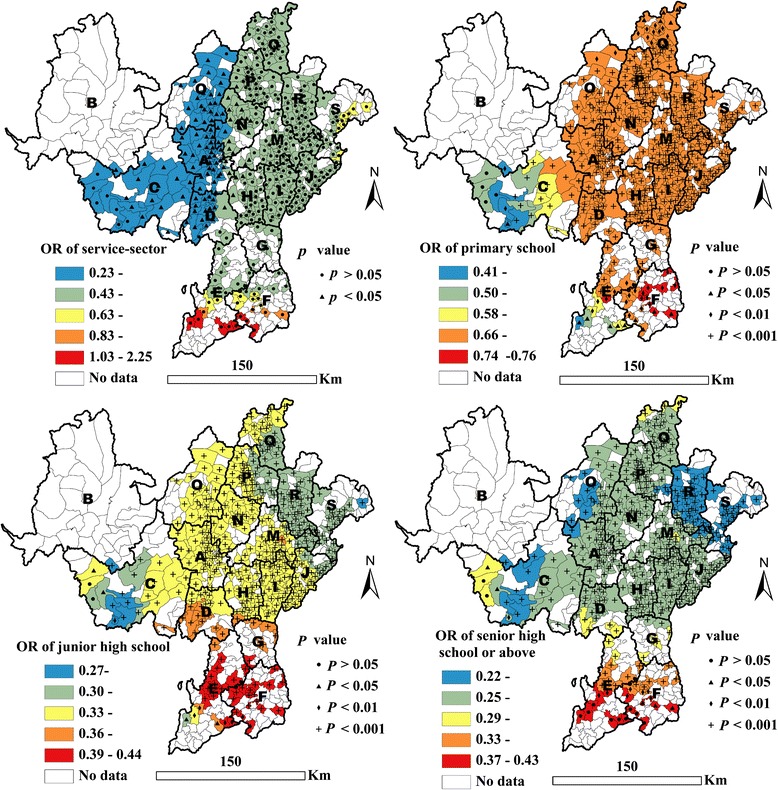
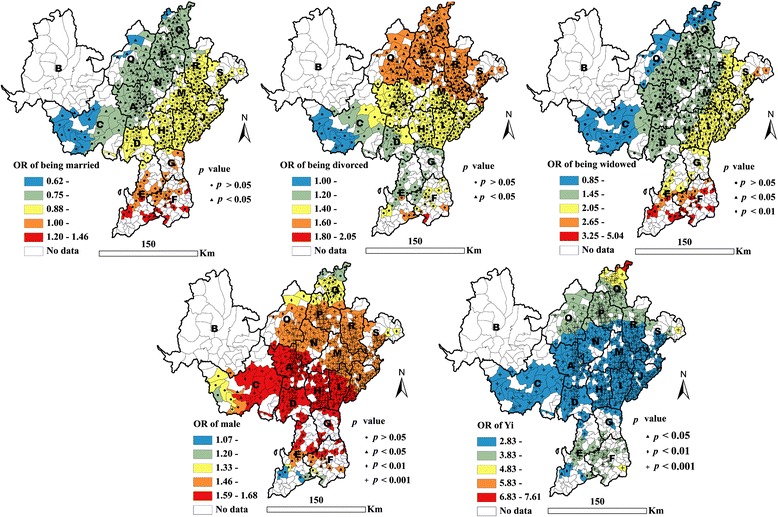
This study enrolled 6,458 patients. The prevalence of HIV infection was 25.1 %. The non-spatial model indicated that being divorced was positively associated with HIV infection. The spatial model also showed that being divorced was positively associated with HIV infection, but only for 49.4 % of individuals residing in some northern counties. The non-spatial model suggested that service sector work was negatively associated with HIV infection. However, the spatial model indicated that service work was associated with HIV infection, but only for 23.0 % of patients living in some western counties. The non-spatial model did not show that being married was associated with HIV infection in our study field, but the spatial model indicated that being married was negatively associated with HIV infection for 12.0 % of individuals living in some western counties. For other factors, the non-spatial and spatial models showed similar results.
The spatial model may be useful for improving understanding of geographical heterogeneity in the relationship between HIV infection and individual factors. Spatial heterogeneity may be useful for tailoring intervention strategies for local regions, which can consequently result in a more efficient allocation of limited resources toward the control of HIV transmission.
先前的研究表明,吸毒者中一些与艾滋病毒感染相关的风险因素的结果不一致甚至相互矛盾,这些可能部分归因于地理差异。
收集了2004年至2012年凉山彝族自治州11家美沙酮诊所的数据。采用非空间逻辑回归模型和地理加权逻辑回归模型,在个体层面分析艾滋病毒感染与特定因素之间的关联。
本研究纳入6458例患者。艾滋病毒感染率为25.1%。非空间模型表明,离婚与艾滋病毒感染呈正相关。空间模型也显示,离婚与艾滋病毒感染呈正相关,但仅适用于居住在一些北部县的49.4%的个体。非空间模型表明,服务业工作与艾滋病毒感染呈负相关。然而,空间模型表明,服务业工作与艾滋病毒感染有关,但仅适用于居住在一些西部县的23.0%的患者。在我们的研究领域,非空间模型未显示婚姻状况与艾滋病毒感染有关,但空间模型表明,对于居住在一些西部县的12.0%的个体,已婚与艾滋病毒感染呈负相关。对于其他因素,非空间模型和空间模型显示出相似的结果。
空间模型可能有助于更好地理解艾滋病毒感染与个体因素之间关系的地理异质性。空间异质性可能有助于为当地量身定制干预策略,从而更有效地将有限资源分配用于控制艾滋病毒传播。