Yang Shujuan, Yang Chao, Liao Qiang, Zhai Wenwen, Yu Gang, Xiao Lin, Wang Qixing, Gong Yuhan, Zhang Suhua, Yao Yongna, Wang Ke, Wang Ju, Bian Shaochao, Liu Qian
Department of Health Related Social and Behavioral Science, West China School of Public Health, Sichuan University, Chengdu, China.
Department of Epidemiology and Statistics, School of Public Health, Southwest Medical University, Luzhou, China.
PLoS One. 2017 Sep 7;12(9):e0183418. doi: 10.1371/journal.pone.0183418. eCollection 2017.
Yi people make up about 50% of the population in Liangshan Prefecture, Sichuan Province, China, but accounted for 88.07% of new HIV cases in the prefecture from 2011 to 2013. This study evaluated HIV prevalence in pregnant women of Liangshan Prefecture using HIV sentinel surveillance (HSS) data over the period of 2009 to 2015.
Xichang, Zhaojue County, and Butuo County were selected as HSS sites. We investigated the temporal trends in HIV prevalence in these areas, and the association between demographic and behavioral characteristics and risk of HIV infection.
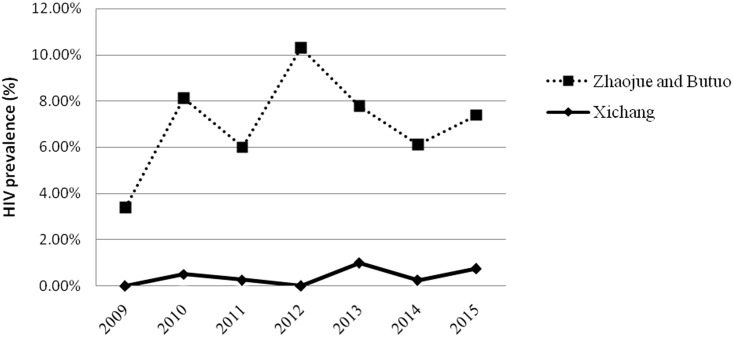
Data on a total of 2797 pregnant women in Xichang and 3983 pregnant women in Zhaojue and Butuo was collected for the period 2009 to 2015. There was a fluctuating HIV prevalence among pregnant women of Xichang, with a rate of 0.75% in 2015 (χ2trend = 2.27, P = 0.13). HIV prevalence among pregnant women of Zhaojue and Butuo was consistently high, varying between 3.4% (9/267, 2011) and 10.3% (82/796, 2012) over the period of 2010 to 2015 (χ2trend = 0.12, P = 0.73). In Xichang, we found that Yi ethnicity (OR = 11.37, 95% CI = 2.92-44.25) and a husband who used drugs (OR = 32.13, 95% CI = 5.33-193.67) were significantly associated with HIV risk in pregnant women. For Zhaojue and Butuo, we observed that pregnant women had a higher risk of HIV infection when they were over 30 years old (OR = 1.72, 95% CI = 1.17-2.52), when they had a higher number of previous births, when their husbands had a history of migrating for work (OR = 1.56, 95% CI = 1.16-2.08), and when they had a history of other sexually transmitted infections (OR = 2.19, 95% CI = 1.16-2.08). Compared to those with a primary school education or below, pregnant women with a secondary or high school education level had a lower risk of HIV infection (OR = 0.28, 95% CI = 0.09-0.89).
Our results indicate that there is a serious HIV epidemic among pregnant Yi women, especially for those with less education, more past births, or a husband with a history of out-migrating for work or STD infection.
彝族人口约占中国四川省凉山州总人口的50%,但在2011年至2013年期间,该州新增艾滋病病毒(HIV)病例中彝族占88.07%。本研究利用2009年至2015年期间的HIV哨点监测(HSS)数据评估了凉山州孕妇中的HIV流行情况。
选取西昌市、昭觉县和布拖县作为HSS监测点。我们调查了这些地区HIV流行情况的时间趋势,以及人口统计学和行为特征与HIV感染风险之间的关联。
2009年至2015年期间,共收集了西昌市2797名孕妇以及昭觉县和布拖县3983名孕妇的数据。西昌市孕妇的HIV流行率呈波动变化,2015年为0.75%(χ²趋势 = 2.27,P = 0.13)。昭觉县和布拖县孕妇的HIV流行率一直较高,在2010年至2015年期间,流行率在3.4%(2011年,9/267)至10.3%(2012年,82/796)之间波动(χ²趋势 = 0.12,P = 0.73)。在西昌市,我们发现彝族(比值比[OR] = 11.37,95%置信区间[CI] = 2.92 - 44.25)以及丈夫有吸毒史(OR = 32.13,95% CI = 5.33 - 193.67)与孕妇感染HIV的风险显著相关。对于昭觉县和布拖县,我们观察到孕妇年龄超过30岁(OR = 1.72,95% CI = 1.17 - 2.52)、既往生育次数较多、丈夫有外出务工史(OR = 1.56,95% CI = 1.16 - 2.08)以及有其他性传播感染史(OR = 2.19,95% CI = 1.16 - 2.08)时,感染HIV的风险较高。与小学及以下文化程度的孕妇相比,初中或高中文化程度的孕妇感染HIV的风险较低(OR = 0.28,95% CI = 0.09 - 0.89)。
我们的结果表明,彝族孕妇中存在严重的HIV流行情况,尤其是那些文化程度较低、既往生育次数较多、丈夫有外出务工史或性传播感染史的孕妇。