Fichorova Raina N, Chen Pai-Lien, Morrison Charles S, Doncel Gustavo F, Mendonca Kevin, Kwok Cynthia, Chipato Tsungai, Salata Robert, Mauck Christine
Laboratory of Genital Tract Biology, Department of Obstetrics, Gynecology and Reproductive Biology, Brigham and Women's Hospital, Harvard Medical School, Boston, Massachusetts, USA
FHI 360, Durham, North Carolina, USA.
mBio. 2015 Sep 1;6(5):e00221-15. doi: 10.1128/mBio.00221-15.
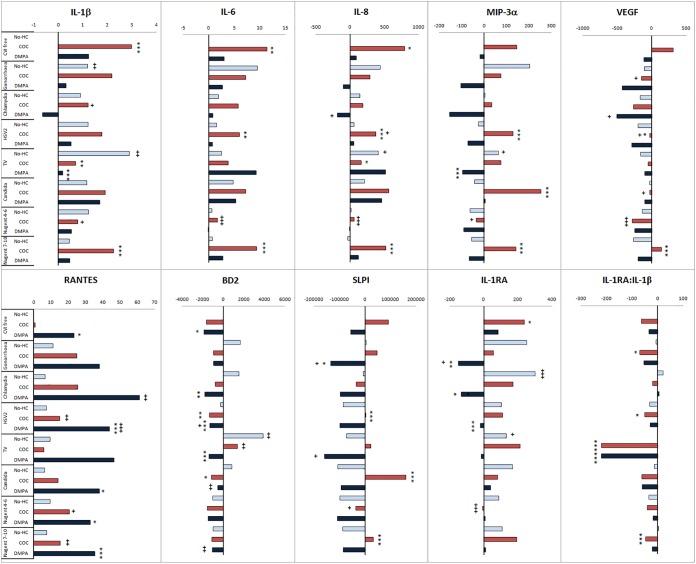
Particular types of hormonal contraceptives (HCs) and genital tract infections have been independently associated with risk of HIV-1 acquisition. We examined whether immunity in women using injectable depot medroxyprogesterone acetate (DMPA), combined oral contraceptives (COC), or no HCs differs by the presence of cervicovaginal infections. Immune mediators were quantified in cervical swabs from 832 HIV-uninfected reproductive-age Ugandans and Zimbabweans. Bacterial infections and HIV were diagnosed by PCR, genital herpes serostatus by enzyme-linked immunosorbent assay (ELISA), altered microflora by Nugent score, and Trichomonas vaginalis and Candida albicans infection by wet mount. Generalized linear models utilizing Box-Cox-Power transformation examined associations between levels of mediators, infection status, and HCs. In no-HC users, T. vaginalis was associated with broadest spectrum of aberrant immunity (higher interleukin 1β [IL-1β], IL-8, macrophage inflammatory protein 3α [MIP-3α], β-defensin 2 [BD2], and IL-1 receptor antigen [IL-1RA]). In women with a normal Nugent score and no genital infection, compared to the no-HC group, COC users showed higher levels of IL-1β, IL-6, IL-8, and IL-1RA, while DMPA users showed higher levels of RANTES and lower levels of BD2, both associated with HIV seroconversion. These effects of COC were blunted in the presence of gonorrhea, chlamydia, trichomoniasis, candidiasis, and an abnormal Nugent score; however, RANTES was increased among COC users with herpes, chlamydia, and abnormal Nugent scores. The effect of DMPA was exacerbated by lower levels of IL-1RA in gonorrhea, chlamydia, or herpes, SLPI in gonorrhea, and IL-1β, MIP-3α, and IL-1RA/IL1β ratio in trichomoniasis. Thus, the effects of HC on cervical immunity depend on the genital tract microenvironment, and a weakened mucosal barrier against HIV may be a combined resultant of genital tract infections and HC use.
In this article, we show that in young reproductive-age women most vulnerable to HIV, hormonal contraceptives are associated with altered cervical immunity in a manner dependent on the presence of genital tract infections. Through altered immunity, hormones may predispose women to bacterial and viral pathogens; conversely, a preexisting specific infection or disturbed vaginal microbiota may suppress the immune activation by levonorgestrel or exacerbate the suppressed immunity by DMPA, thus increasing HIV risk by their cumulative action. Clinical studies assessing the effects of contraception on HIV susceptibility and mucosal immunity may generate disparate results in populations that differ by microbiota background or prevalence of undiagnosed genital tract infections. A high prevalence of asymptomatic infections among HC users that remain undiagnosed and untreated raises even more concerns in light of their combined effects on biomarkers of HIV risk. The molecular mechanisms of the vaginal microbiome's simultaneous interactions with hormones and HIV remain to be elucidated.
特定类型的激素避孕药(HCs)和生殖道感染已分别与获得HIV-1的风险相关。我们研究了使用注射用醋酸甲羟孕酮(DMPA)、复方口服避孕药(COC)或未使用HCs的女性的免疫情况是否因宫颈阴道感染的存在而有所不同。对832名未感染HIV的乌干达和津巴布韦育龄妇女的宫颈拭子中的免疫介质进行了定量分析。通过聚合酶链反应(PCR)诊断细菌感染和HIV,通过酶联免疫吸附测定(ELISA)诊断生殖器疱疹血清学状态,通过 Nugent评分诊断微生物群改变,通过湿片法诊断阴道毛滴虫和白色念珠菌感染。利用Box-Cox幂变换的广义线性模型研究了介质水平、感染状态和HCs之间的关联。在未使用HCs的女性中,阴道毛滴虫与最广泛的异常免疫谱相关(白细胞介素1β[IL-1β]、IL-8、巨噬细胞炎性蛋白3α[MIP-3α]、β-防御素2[BD2]和IL-1受体拮抗剂[IL-1RA]水平较高)。在 Nugent评分正常且无生殖器感染的女性中,与未使用HCs组相比,使用COC的女性IL-1β、IL-6、IL-8和IL-1RA水平较高,而使用DMPA的女性调节激活正常T细胞表达和分泌的趋化因子(RANTES)水平较高,BD2水平较低,两者均与HIV血清转化相关。在存在淋病、衣原体感染、滴虫病、念珠菌病和 Nugent评分异常的情况下,COC的这些作用减弱;然而,在患有疱疹、衣原体感染和 Nugent评分异常的COC使用者中,RANTES水平升高。在淋病、衣原体感染或疱疹中IL-1RA水平较低、在淋病中分泌性白细胞蛋白酶抑制剂(SLPI)水平较低以及在滴虫病中IL-1β、MIP-3α和IL-1RA/IL1β比值较低,会加剧DMPA的作用。因此,HC对宫颈免疫的影响取决于生殖道微环境,而针对HIV的黏膜屏障减弱可能是生殖道感染和使用HCs共同作用的结果。
在本文中,我们表明,在最易感染HIV的年轻育龄妇女中,激素避孕药以一种依赖于生殖道感染存在的方式与宫颈免疫改变相关。通过改变免疫,激素可能使女性易感染细菌和病毒病原体;相反,先前存在的特定感染或紊乱的阴道微生物群可能抑制左炔诺孕酮的免疫激活,或加剧DMPA抑制的免疫,从而通过它们的累积作用增加HIV风险。评估避孕对HIV易感性和黏膜免疫影响的临床研究,在微生物群背景或未诊断出生殖道感染患病率不同的人群中可能产生不同的结果。鉴于HC使用者中无症状感染的高患病率仍未被诊断和治疗,且它们对HIV风险生物标志物有综合影响,这引发了更多担忧。阴道微生物群与激素和HIV同时相互作用的分子机制仍有待阐明。