Ollivett T L, Caswell J L, Nydam D V, Duffield T, Leslie K E, Hewson J, Kelton D
Department of Medical Sciences, UW-Madison School of Veterinary Medicine, Madison, WI.
Department of Pathobiology, Ontario Veterinary College, University of Guelph, Guelph, Ontario, Canada.
J Vet Intern Med. 2015 Nov-Dec;29(6):1728-34. doi: 10.1111/jvim.13605. Epub 2015 Aug 30.
Thoracic ultrasonography (US) and bronchoalveolar lavage fluid (BALF) analysis are antemortem methods used to identify the lung lesions associated with bovine respiratory disease (BRD). Accuracy of US and the cell distributions in BALF have not been characterized in calves with subclinical disease.
To evaluate the accuracy of US and BALF and describe BALF characteristics in calves with subclinical lung lesions.
Twenty-five Holstein calves, 1-12 weeks old.
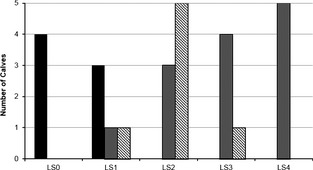
In this prospective study, calves with low respiratory scores underwent US, BALF and postmortem examination (normal US, n = 5; comet-tails, n = 5; consolidation, n = 15). Bronchoalveolar lavage fluid was collected and analyzed for total and differential cell counts. Lung lesions were assessed by gross and histopathologic examination. Data were analyzed using nonparametric methods and relative risk analysis. The accuracy of US and BALF were estimated relative to postmortem examination.
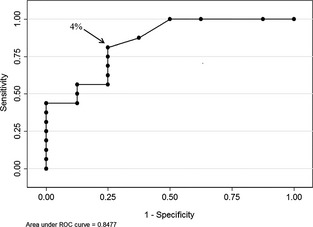
The sensitivity and specificity of US for detecting lung lesions was 94% (95% CI, 69-100%) and 100% (95% CI, 64-100%), respectively. A cut-point of ≥4% BALF neutrophils was associated with the highest BALF sensitivity and specificity, 81% (95% CI, 56-94%) and 75% (95% CI, 36-95%). The presence of consolidation on US increased the risk of having a BALF neutrophil proportion ≥4% (RR, 3.9; 95% CI, 1.13-13.45; P = .003).
Ultrasonography accurately detects lung lesions in calves with subclinical disease. Clinicians should use a cut-point of ≥4% BALF neutrophils to diagnose subclinical respiratory disease.
胸部超声检查(US)和支气管肺泡灌洗术(BALF)分析是用于识别与牛呼吸道疾病(BRD)相关肺部病变的生前诊断方法。在患有亚临床疾病的犊牛中,US的准确性以及BALF中的细胞分布尚未得到明确。
评估US和BALF的准确性,并描述患有亚临床肺部病变的犊牛的BALF特征。
25头1至12周龄的荷斯坦犊牛。
在这项前瞻性研究中,对呼吸评分较低的犊牛进行了US、BALF和死后检查(正常US,n = 5;彗星尾征,n = 5;实变,n = 15)。收集支气管肺泡灌洗液并分析总细胞计数和分类细胞计数。通过大体和组织病理学检查评估肺部病变。使用非参数方法和相对风险分析对数据进行分析。相对于死后检查估计US和BALF的准确性。
US检测肺部病变的敏感性和特异性分别为94%(95%CI,69 - 100%)和100%(95%CI,64 - 100%)。BALF中性粒细胞≥4%的切点与最高的BALF敏感性和特异性相关,分别为81%(95%CI,56 - 94%)和75%(95%CI,36 - 95%)。US上出现实变增加了BALF中性粒细胞比例≥4%的风险(RR,3.9;95%CI,1.13 - 13.45;P = 0.003)。
超声检查可准确检测患有亚临床疾病的犊牛的肺部病变。临床医生应使用BALF中性粒细胞≥4%的切点来诊断亚临床呼吸道疾病。