Basta Daniele, Latinovic Olga, Lafferty Mark K, Sun Lingling, Bryant Joseph, Lu Wuyuan, Caccuri Francesca, Caruso Arnaldo, Gallo Robert, Garzino-Demo Alfredo
Institute of Human Virology, University of Maryland School of Medicine, Baltimore, MD 21201, USA Microbiology Section, Department of Molecular and Translational Medicine, University of Brescia, Brescia 25123, Italy.
Institute of Human Virology, University of Maryland School of Medicine, Baltimore, MD 21201, USA Department of Microbiology and Immunology, Baltimore, MD 21201, USA.
Pathog Dis. 2015 Nov;73(8):ftv062. doi: 10.1093/femspd/ftv062. Epub 2015 Sep 1.
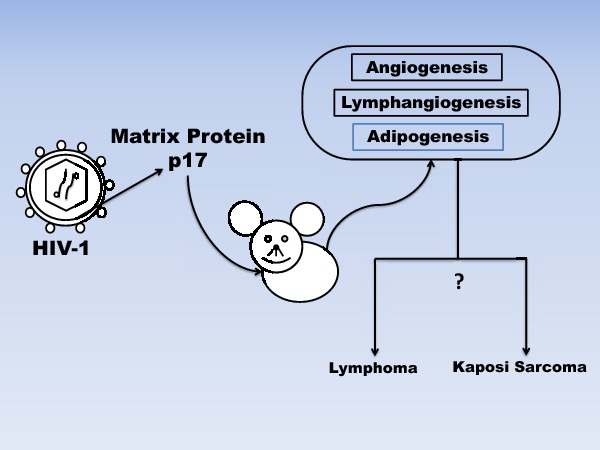
Lymphangiogenesis and concurrent angiogenesis are essential in supporting proliferation and survival of AIDS-related lymphomas, which are often metastatic. In vitro studies suggest a candidate angiogienic and lymphangiogenic factor encoded by HIV: the matrix protein p17. p17 accumulates in lymph nodes of patients even when they are undergoing highly active antiretroviral therapy. p17 has been found to affect immune cells, and recent data showed that a variant p17, called S75X, induces cell growth by triggering MAPK/ERK and PI3K/AKT pathways. We tested the in vivo angiogenic activity of p17 by injecting it in Matrigel plugs in nude mice. Plugs were retrieved 7 days after injection, and assessed macroscopically, and by light and confocal microscopy. Our data revealed that both reference and S75X variant p17 promote angiogenesis and lymphangiogenesis in vivo. Our results suggest that the induction of angiogenesis and lymphangiogenesis by HIV-1 p17 may generate a favorable microenvironment that could trigger tumor growth and maintenance. Moreover, the presence of adipocytes infiltration observed at the histological level suggests a possible interplay between angiogenesis, lymphangiogenesis and adipogenesis. These findings offer new opportunities for the development of treatment strategies to combat HIV-related cancers.
淋巴管生成与同时发生的血管生成对于支持艾滋病相关淋巴瘤(这类淋巴瘤通常具有转移性)的增殖和存活至关重要。体外研究提示一种由HIV编码的血管生成和淋巴管生成候选因子:基质蛋白p17。即使患者正在接受高效抗逆转录病毒治疗,p17仍会在其淋巴结中蓄积。已发现p17会影响免疫细胞,并且最近的数据表明一种名为S75X的p17变体通过触发MAPK/ERK和PI3K/AKT信号通路诱导细胞生长。我们通过将p17注射到裸鼠的基质胶塞中来测试其体内血管生成活性。注射7天后取出胶塞,进行宏观评估,并通过光学显微镜和共聚焦显微镜检查。我们的数据显示,参照p17和S75X变体p17均可在体内促进血管生成和淋巴管生成。我们的结果提示,HIV-1 p17诱导血管生成和淋巴管生成可能会产生一个有利于触发肿瘤生长和维持的微环境。此外,在组织学水平观察到的脂肪细胞浸润提示血管生成、淋巴管生成和脂肪生成之间可能存在相互作用。这些发现为开发对抗HIV相关癌症的治疗策略提供了新的契机。