Division of Malaria & Parasitic Disease, Korea National Institute of Health, Cheongwon-gun, Chungbuk, Korea.
Allergy Asthma Immunol Res. 2015 Nov;7(6):557-64. doi: 10.4168/aair.2015.7.6.557. Epub 2015 May 29.
Toxoplasma gondii (T. gondii) is an obligate intracellular protozoan parasite that infects humans and animals via congenital or postnatal routes, and it is found worldwide. Modulation of the immune system by parasite infection is proposed to suppress allergic inflammation. Growing evidences have shown that interleukin (IL)-10-producing regulatory B cells (B(regs)) and CD4+CD25+FoxP3+ regulatory T cells (T(regs)) induced by parasite infection play a critical role in allergic or autoimmune diseases because these cells regulate negatively cellular immune responses and inflammation. Currently, the role of IL-10-producing regulatory B cells in host immune response during T. gondii infection is unknown. In this study, we investigate whether T. gondii infection can suppress the development of unrelated atopic dermatitis (AD)-like lesions.
AD is a chronically relapsing inflammatory skin disease accompanied by severe itching; for this, we used NC/Nga mice, a well-known experimental model of systemic AD. Repeated exposure to Dermatophagoides farinae crude extract (DfE), known as a major environmental allergen, evokes AD-like skin lesions in NC/Nga mice under specific pathogen-free conditions. NC/Nga mice were intraperitoneally infected with 10 cysts of T. gondii.
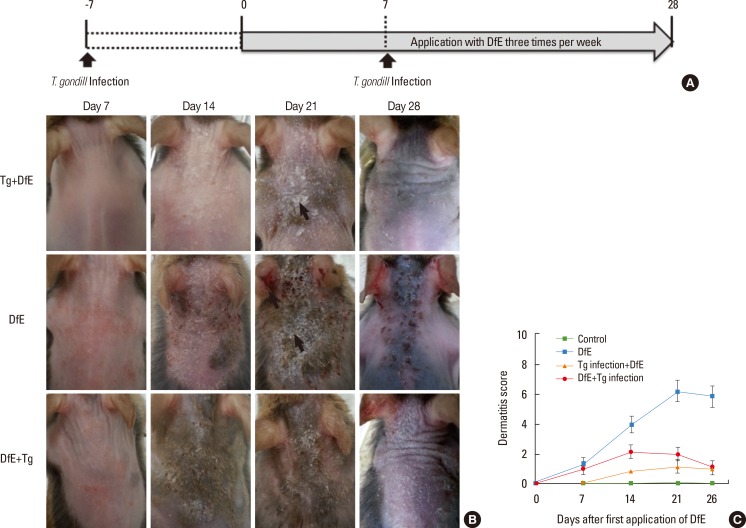
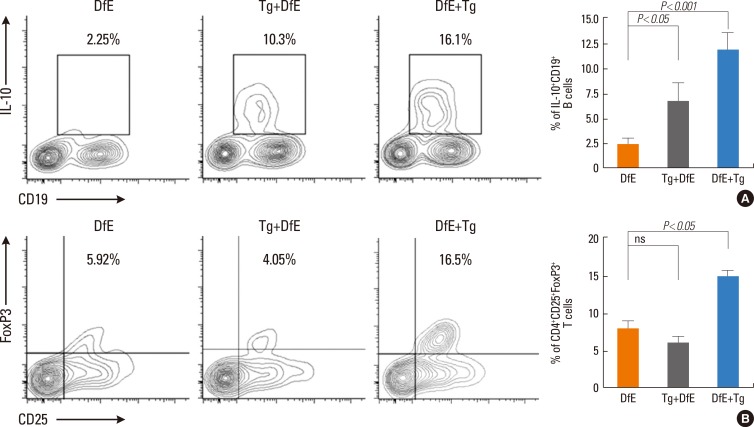
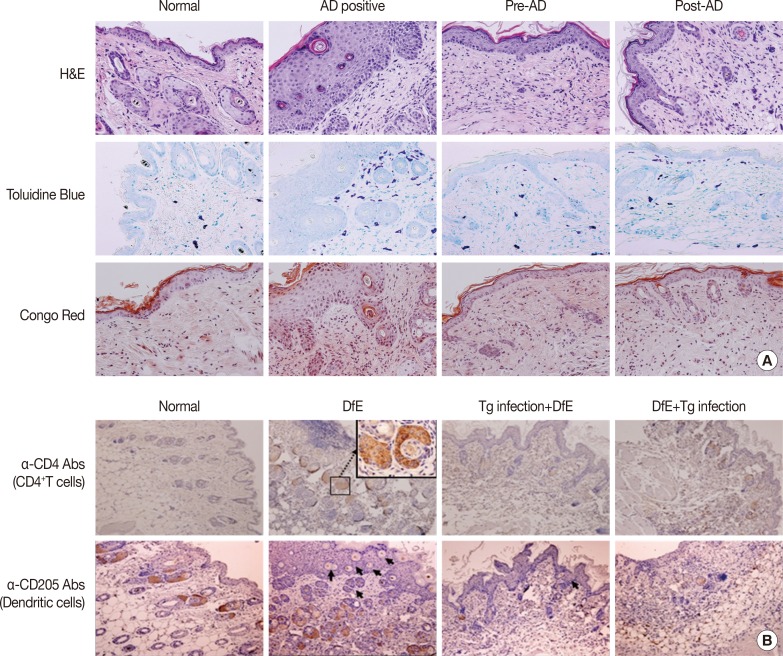
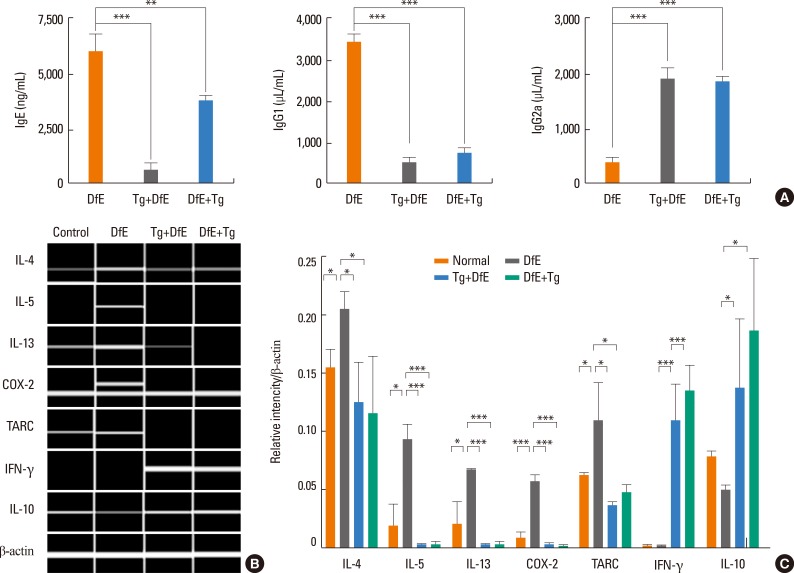
T. gondii infection significantly ameliorated AD-like skin lesions in NC/Nga mice. The subpopulation of B(regs) and T(regs) in the AD mice was expanded in the course of T. gondii infection. In addition, T. gondii infection inhibited Th2 and enhanced Th1 immune response in the DfE-treated AD mice.
We have experimentally demonstrated for the first time that T. gondii infection ameliorated AD-like skin lesions in a mouse model of AD. Our study could in part explain the mechanisms of how parasite infection prevents the development of allergic disorder. Therefore, these immunemechanisms induced by T. gondii infection may be beneficial for the host in terms of reduced risk of allergic immune reactions.
刚地弓形虫(T. gondii)是一种专性细胞内原生动物寄生虫,通过先天性或后天性途径感染人类和动物,广泛存在于世界各地。寄生虫感染对免疫系统的调节被认为可以抑制过敏炎症。越来越多的证据表明,寄生虫感染诱导的白细胞介素(IL)-10 产生的调节性 B 细胞(Bregs)和 CD4+CD25+FoxP3+调节性 T 细胞(Tregs)在过敏或自身免疫性疾病中发挥关键作用,因为这些细胞负向调节细胞免疫反应和炎症。目前,尚不清楚寄生虫感染时 IL-10 产生的调节性 B 细胞在宿主免疫反应中的作用。在这项研究中,我们研究了刚地弓形虫感染是否可以抑制无关的特应性皮炎(AD)样病变的发展。
AD 是一种慢性复发性炎症性皮肤疾病,伴有严重瘙痒;为此,我们使用 NC/Nga 小鼠,这是一种系统性 AD 的著名实验模型。在无特定病原体条件下,反复暴露于尘螨粗提取物(DfE),这是一种主要的环境过敏原,可引起 NC/Nga 小鼠出现 AD 样皮肤损伤。NC/Nga 小鼠经腹腔感染 10 个刚地弓形虫包囊。
刚地弓形虫感染显著改善了 NC/Nga 小鼠的 AD 样皮肤损伤。在刚地弓形虫感染过程中,AD 小鼠的 Bregs 和 Tregs 亚群得到了扩增。此外,刚地弓形虫感染抑制了 DfE 处理的 AD 小鼠中的 Th2 并增强了 Th1 免疫反应。
我们首次在 AD 小鼠模型中实验证明,刚地弓形虫感染改善了 AD 样皮肤损伤。我们的研究部分解释了寄生虫感染如何防止过敏疾病发展的机制。因此,刚地弓形虫感染诱导的这些免疫机制可能对宿主降低过敏免疫反应的风险有益。