Vanhove Maarten P M, Pariselle Antoine, Van Steenberge Maarten, Raeymaekers Joost A M, Hablützel Pascal I, Gillardin Céline, Hellemans Bart, Breman Floris C, Koblmüller Stephan, Sturmbauer Christian, Snoeks Jos, Volckaert Filip A M, Huyse Tine
Laboratory of Biodiversity and Evolutionary Genomics, Department of Biology, University of Leuven, Ch. Deberiotstraat 32, B-3000 Leuven, Belgium.
Biology Department, Royal Museum for Central Africa, Leuvensesteenweg 13, B-3080 Tervuren, Belgium.
Sci Rep. 2015 Sep 3;5:13669. doi: 10.1038/srep13669.
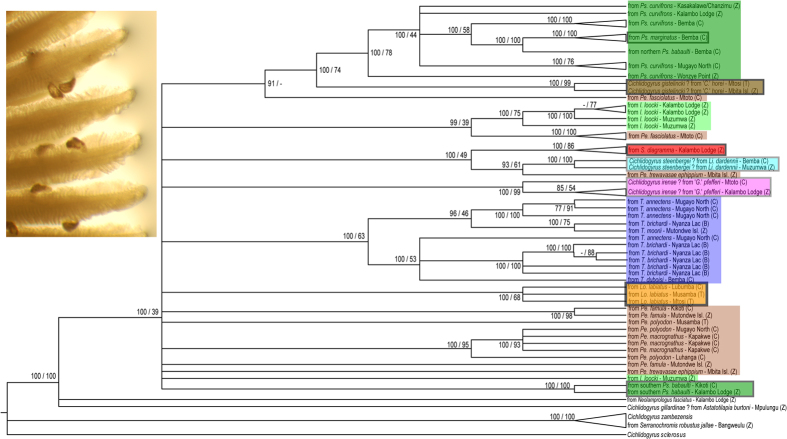
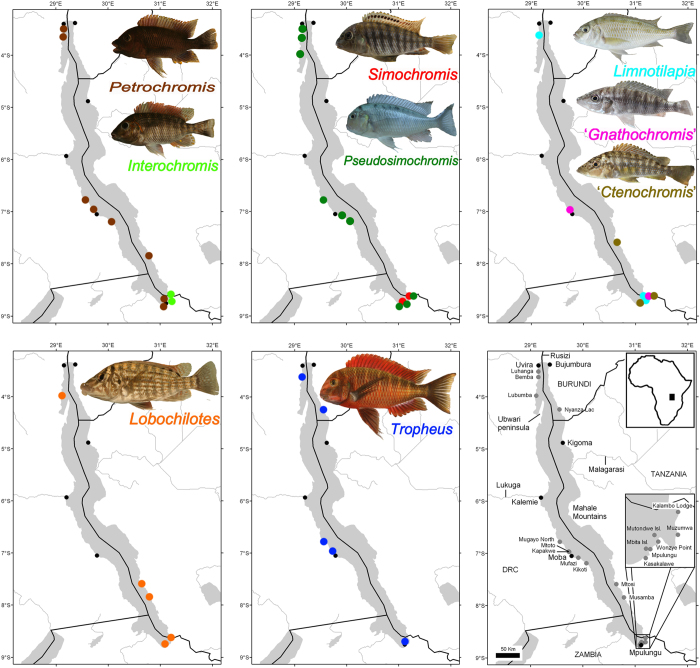
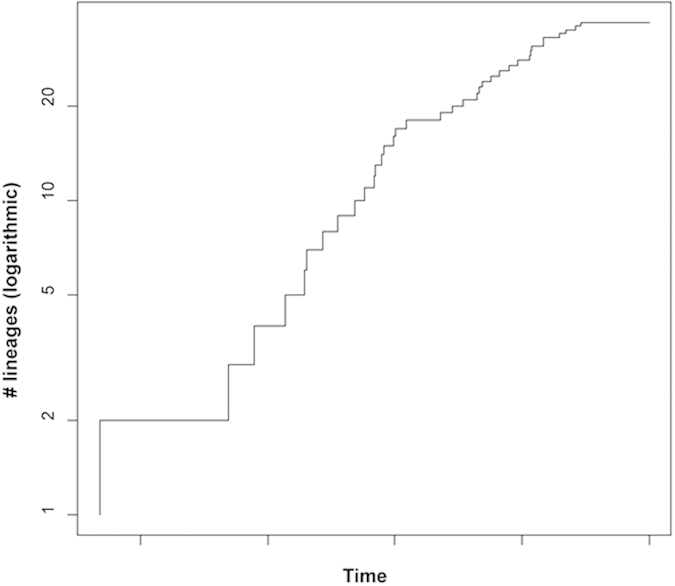
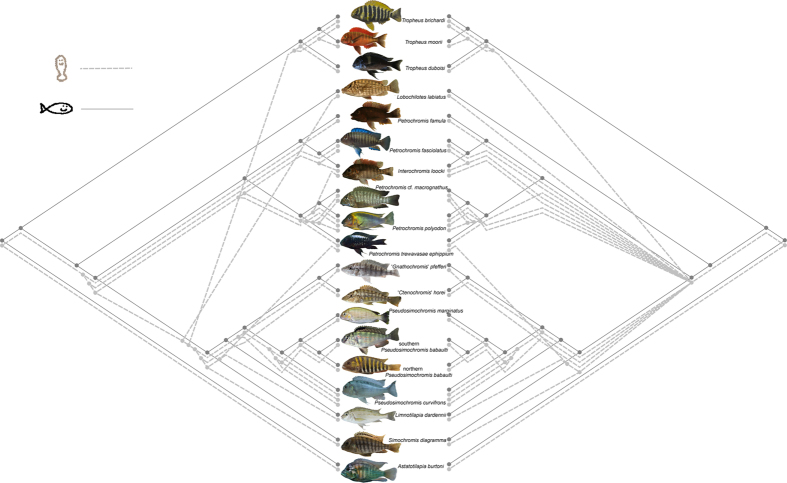
The stunning diversity of cichlid fishes has greatly enhanced our understanding of speciation and radiation. Little is known about the evolution of cichlid parasites. Parasites are abundant components of biodiversity, whose diversity typically exceeds that of their hosts. In the first comprehensive phylogenetic parasitological analysis of a vertebrate radiation, we study monogenean parasites infecting tropheine cichlids from Lake Tanganyika. Monogeneans are flatworms usually infecting the body surface and gills of fishes. In contrast to many other parasites, they depend only on a single host species to complete their lifecycle. Our spatially comprehensive combined nuclear-mitochondrial DNA dataset of the parasites covering almost all tropheine host species (N = 18), reveals species-rich parasite assemblages and shows consistent host-specificity. Statistical comparisons of host and parasite phylogenies based on distance and topology-based tests demonstrate significant congruence and suggest that host-switching is rare. Molecular rate evaluation indicates that species of Cichlidogyrus probably diverged synchronically with the initial radiation of the tropheines. They further diversified through within-host speciation into an overlooked species radiation. The unique life history and specialisation of certain parasite groups has profound evolutionary consequences. Hence, evolutionary parasitology adds a new dimension to the study of biodiversity hotspots like Lake Tanganyika.
丽鱼科鱼类惊人的多样性极大地增进了我们对物种形成和辐射的理解。人们对丽鱼科寄生虫的进化知之甚少。寄生虫是生物多样性的重要组成部分,其多样性通常超过其宿主。在对脊椎动物辐射进行的首次全面系统发育寄生虫学分析中,我们研究了感染坦噶尼喀湖小鳞丽鱼属丽鱼科鱼类的单殖吸虫寄生虫。单殖吸虫是一种扁虫,通常感染鱼类的体表和鳃。与许多其他寄生虫不同,它们仅依赖单一宿主物种来完成其生命周期。我们对几乎所有小鳞丽鱼属宿主物种(N = 18)的寄生虫进行的空间全面的核线粒体DNA数据集组合,揭示了物种丰富的寄生虫群落,并显示出一致的宿主特异性。基于距离和拓扑的测试对宿主和寄生虫系统发育进行的统计比较表明存在显著的一致性,并表明宿主转换很少见。分子速率评估表明,丽体盘虫属的物种可能与小鳞丽鱼属的初始辐射同步分化。它们通过宿主内物种形成进一步多样化,形成了一个被忽视的物种辐射。某些寄生虫群体独特的生活史和特化具有深远的进化后果。因此,进化寄生虫学为坦噶尼喀湖等生物多样性热点地区的研究增添了新的维度。