Seror Raphaèle, Nocturne Gaétane, Lazure Thierry, Hendel-Chavez Houria, Desmoulins Frédéric, Belkhir Rakiba, Ravaud Philippe, Benbijja Mohcine, Poirier-Colame Vichnou, Taoufik Yacine, Mariette Xavier
Université Paris-Sud, Center of Research on Immunology of Viral and Autoimmune diseases (IMVA), INSERM U1184, Le Kremlin Bicêtre, France.
Université Paris-Sud, Assistance Publique-Hôpitaux de Paris (AP-HP), Service de Rhumatologie, Hôpitaux Universitaires Paris-Sud, Hôpital Bicêtre, 78 rue du Général Leclerc, 94275, Le Kremlin Bicêtre, France.
Arthritis Res Ther. 2015 Sep 4;17(1):241. doi: 10.1186/s13075-015-0750-y.
In this study, we sought to address changes in blood lymphocyte subpopulations and labial salivary gland (LSG) inflammation after belimumab treatment in patients with primary Sjögren's syndrome (pSS) and to identify predictors of response to treatment.
Sequential blood lymphocyte subsets and LSG biopsies were analysed between week 0 (W0) and W28 in 15 patients with pSS treated with belimumab. Systemic response to treatment was defined as a decrease in the European League Against Rheumatism Sjögren's Syndrome Disease Activity Index score of ≥3 points at W28.
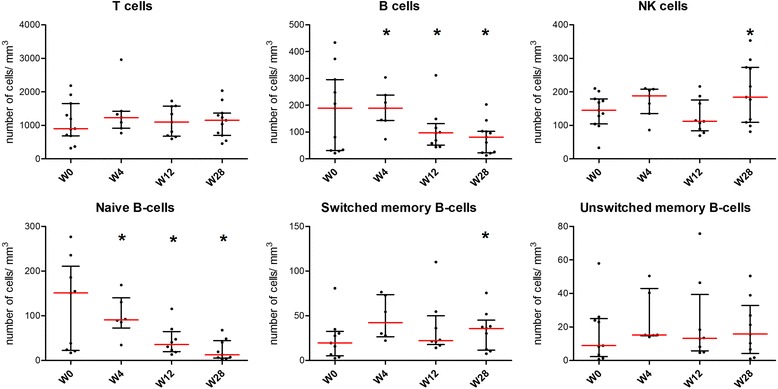
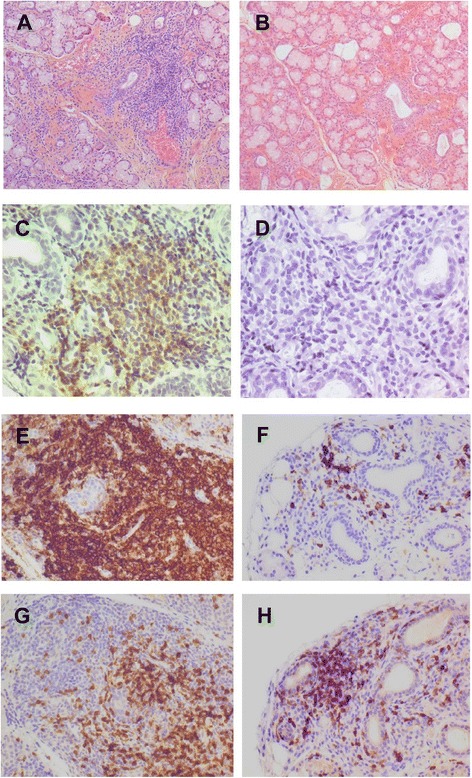
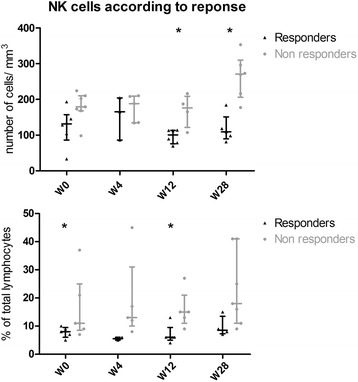
After belimumab, we observed a decrease in blood B lymphocytes primarily involving CD27-negative/immunoglobulin D-positive naïve B cells (p=0.008). Lymphocytic sialadenitis (focus score >1) that was present in 12 patients (80.0 %) before belimumab treatment became negative in 5 of them after treatment (p=0.03). The median (interquartile range) LSG B-cell/T-cell ratio decreased from 0.58 (0.5-0.67) to 0.50 (0.5-0.5) (p=0.06). B-cell activating factor (BAFF) staining was detected in 11 (78.6 %) of 14 patients before belimumab treatment compared with 7 (50.0 %) of 14 after belimumab therapy (p=0.10). The median percentage of BAFF-positive cells in foci significantly decreased from 27.5 % (10-40) to 5 % (0-20) (p=0.03). A systemic response was achieved in six patients (40 %). The only predictor of response was the presence of a low number of natural killer (NK) cells, both in blood (8.5 % [7-10] vs 11 % [9-21]; p=0.04) and in LSG (20.6/mm(3) [20.0-21.4] vs 30.0/mm(3) [25.0-100.0], p=0.003). Serum BAFF levels did not influence response to treatment.
Low blood and salivary NK cell numbers are associated with a better response to belimumab. This suggests that two distinct subsets of pSS may exist: one with a predominant type I interferon (IFN)-BAFF-B-cell axis, representing good responders to belimumab; and one with a predominant type II IFN-NK cell axis, representing non-responders.
ClinicalTrials.gov identifier: NCT01160666 . Registered 9 July 2010.
在本研究中,我们试图探讨贝利木单抗治疗原发性干燥综合征(pSS)患者后血液淋巴细胞亚群的变化以及唇腺(LSG)炎症情况,并确定治疗反应的预测因素。
对15例接受贝利木单抗治疗的pSS患者在第0周(W0)和第28周(W28)之间进行连续的血液淋巴细胞亚群分析和LSG活检。治疗的全身反应定义为在W28时欧洲抗风湿病联盟干燥综合征疾病活动指数评分降低≥3分。
使用贝利木单抗治疗后,我们观察到血液B淋巴细胞减少,主要涉及CD27阴性/免疫球蛋白D阳性的幼稚B细胞(p = 0.008)。12例(80.0%)患者在贝利木单抗治疗前存在淋巴细胞性涎腺炎(灶性评分>1),其中5例治疗后转阴(p = 0.03)。LSG的B细胞/T细胞比值中位数(四分位间距)从0.58(0.5 - 0.67)降至0.50(0.5 - 0.5)(p = 0.06)。14例患者中有11例(78.6%)在贝利木单抗治疗前检测到B细胞活化因子(BAFF)染色,而治疗后14例中有7例(50.0%)(p = 0.10)。灶性中BAFF阳性细胞的中位数百分比从27.5%(10 - 40)显著降至5%(0 - 20)(p = 0.03)。6例患者(40%)实现了全身反应。唯一的反应预测因素是血液(8.5% [7 - 10] 对 11% [9 - 21];p = 0.04)和LSG中(20.6/mm³ [20.0 - 21.4] 对 30.0/mm³ [25.0 - 100.0],p = 0.003)自然杀伤(NK)细胞数量较少。血清BAFF水平不影响治疗反应。
血液和唾液中NK细胞数量低与对贝利木单抗的反应较好相关。这表明可能存在两种不同的pSS亚群:一种以I型干扰素(IFN)-BAFF-B细胞轴为主,是贝利木单抗的良好反应者;另一种以II型IFN-NK细胞轴为主,是无反应者。
ClinicalTrials.gov标识符:NCT01160666。2010年7月9日注册。