Garcia-Ramos Camille, Jackson Daren C, Lin Jack J, Dabbs Kevin, Jones Jana E, Hsu David A, Stafstrom Carl E, Zawadzki Lucy, Seidenberg Michael, Prabhakaran Vivek, Hermann Bruce P
Department of Medical Physics, University of Wisconsin-Madison, Madison, Wisconsin, U.S.A.
Department of Neurology, University of Wisconsin-Madison, Madison, Wisconsin, U.S.A.
Epilepsia. 2015 Oct;56(10):1615-22. doi: 10.1111/epi.13125. Epub 2015 Sep 4.
Benign epilepsy with centrotemporal spikes (BECTS), the most common focal childhood epilepsy, is associated with subtle abnormalities in cognition and possible developmental alterations in brain structure when compared to healthy participants, as indicated by previous cross-sectional studies. To examine the natural history of BECTS, we investigated cognition, cortical thickness, and subcortical volumes in children with new/recent onset BECTS and healthy controls (HC).
Participants were 8-15 years of age, including 24 children with new-onset BECTS and 41 age- and gender-matched HC. At baseline and 2 years later, all participants completed a cognitive assessment, and a subset (13 BECTS, 24 HC) underwent T1 volumetric magnetic resonance imaging (MRI) scans focusing on cortical thickness and subcortical volumes.
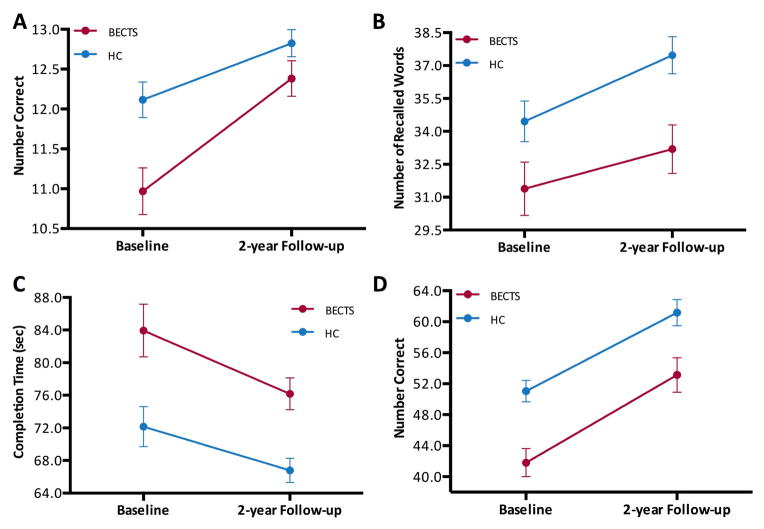
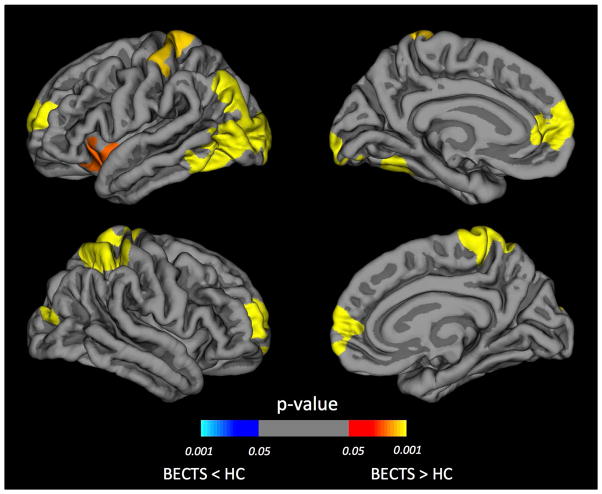
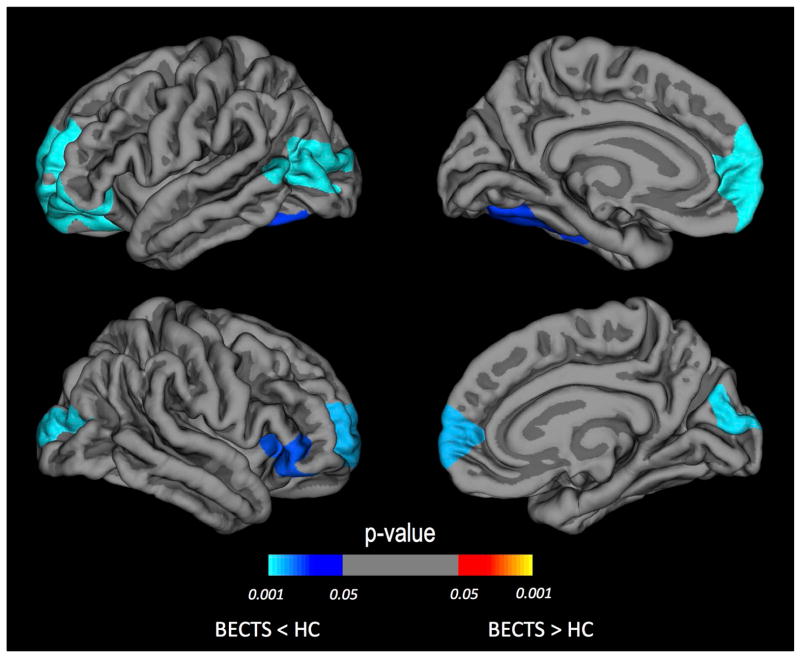
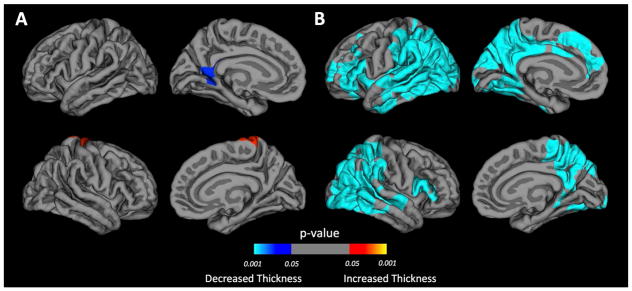
Baseline cognitive abnormalities associated with BECTS (object naming, verbal learning, arithmetic computation, and psychomotor speed/dexterity) persisted over 2 years, with the rate of cognitive development paralleling that of HC. Baseline neuroimaging revealed thinner cortex in BECTS compared to controls in frontal, temporal, and occipital regions. Longitudinally, HC showed widespread cortical thinning in both hemispheres, whereas BECTS participants showed sparse regions of both cortical thinning and thickening. Analyses of subcortical volumes showed larger left and right putamens persisting over 2 years in BECTS compared to HC.
Cognitive and structural brain abnormalities associated with BECTS are present at onset and persist (cognition) and/or evolve (brain structure) over time. Atypical maturation of cortical thickness antecedent to BECTS onset results in early identified abnormalities that continue to develop abnormally over time. However, compared to anatomic development, cognition appears more resistant to further change over time.
中央颞区棘波的良性癫痫(BECTS)是儿童期最常见的局灶性癫痫,以往的横断面研究表明,与健康参与者相比,其与认知方面的细微异常以及脑结构可能的发育改变有关。为了研究BECTS的自然病程,我们调查了新发病/近期发病的BECTS患儿和健康对照(HC)的认知、皮质厚度和皮质下体积。
参与者年龄在8至15岁之间,包括24名新发病的BECTS患儿和41名年龄及性别匹配的HC。在基线和2年后,所有参与者完成认知评估,一部分(13名BECTS患儿,24名HC)接受了T1容积磁共振成像(MRI)扫描,重点关注皮质厚度和皮质下体积。
与BECTS相关的基线认知异常(物体命名、语言学习、算术计算和精神运动速度/灵活性)持续了2年,认知发展速度与HC平行。基线神经影像学显示,与对照组相比,BECTS患儿在额叶、颞叶和枕叶区域的皮质较薄。纵向来看,HC在两个半球均出现广泛的皮质变薄,而BECTS参与者则出现皮质变薄和增厚的稀疏区域。皮质下体积分析显示,与HC相比,BECTS患儿在2年中双侧壳核持续较大。
与BECTS相关的认知和脑结构异常在发病时就已存在,并随时间持续存在(认知方面)和/或演变(脑结构方面)。BECTS发病前皮质厚度的非典型成熟导致早期发现的异常随着时间的推移继续异常发展。然而,与解剖学发育相比,认知似乎随时间更不易进一步改变。