Shao Jiahui, Li Shuqing, Zhang Nan, Cui Xiaoshuang, Zhou Xuan, Zhang Guishan, Shen Qirong, Zhang Ruifu
Key Laboratory of Microbial Resources Collection and Preservation, Ministry of Agriculture, Institute of Agricultural Resources and Regional Planning, Chinese Academy of Agricultural Sciences, Beijing, 100081, People's Republic of China.
Jiangsu Key Lab and Engineering Center for Solid Organic Waste Utilization, Nanjing Agricultural University, Nanjing, 210095, People's Republic of China.
Microb Cell Fact. 2015 Sep 4;14:130. doi: 10.1186/s12934-015-0323-4.
The plant growth-promoting rhizobacteria (PGPR) strain Bacillus amyloliquefaciens SQR9, isolated from the cucumber rhizosphere, protects the host plant from pathogen invasion and promotes plant growth through efficient root colonization. The phytohormone indole-3-acetic acid (IAA) has been suggested to contribute to the plant-growth-promoting effect of Bacillus strains. The possible IAA synthetic pathways in B. amyloliquefaciens SQR9 were investigated in this study, using a combination of chemical and genetic analysis.
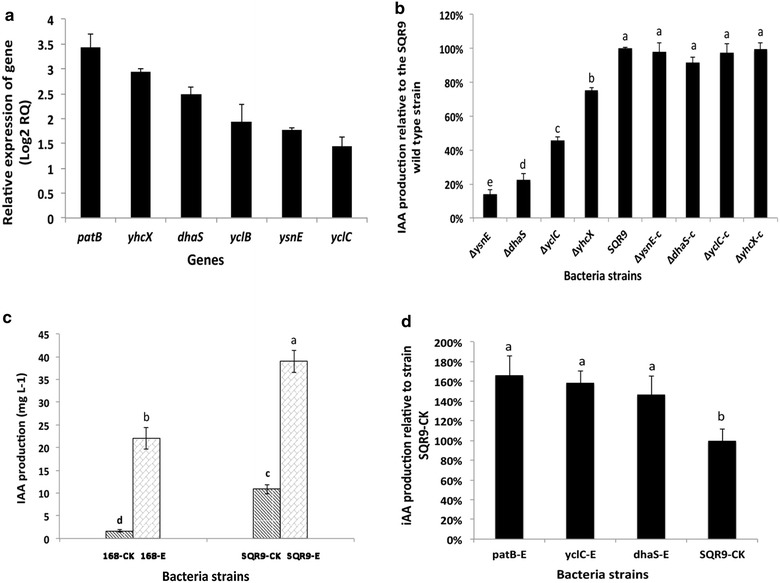
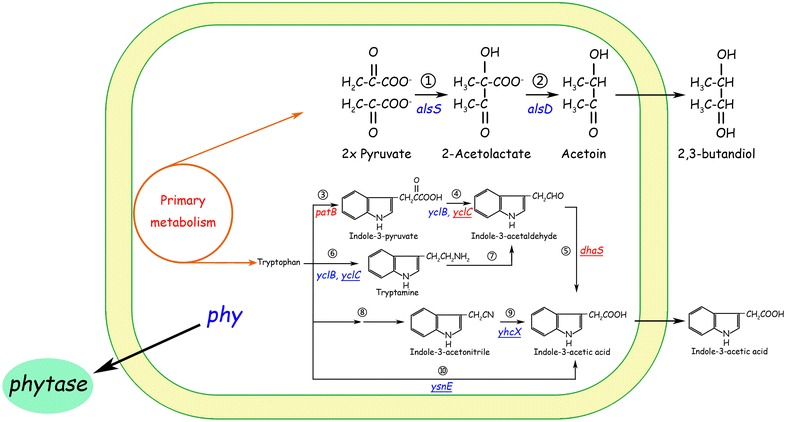
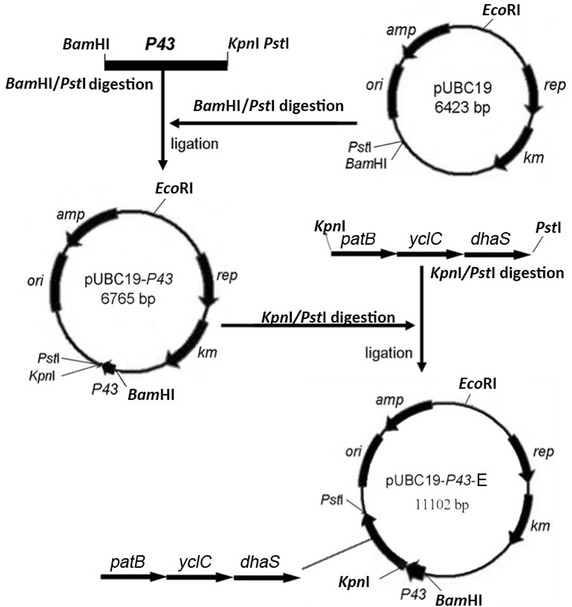
Gene candidates involved in tryptophan-dependent IAA synthesis were identified through tryptophan response transcriptional analysis, and inactivation of genes ysnE, dhaS, yclC, and yhcX in SQR9 led to 86, 77, 55, and 24 % reductions of the IAA production, respectively. The genes patB (encoding a conserved hypothetical protein predicted to be an aminotransferase), yclC (encoding a UbiD family decarboxylase), and dhaS (encoding indole 3-acetaldehyde dehydrogenase), which were proposed to constitute the indole-3-pyruvic acid (IPyA) pathway for IAA biosynthesis, were separately expressed in SQR9 or co-expressed as an entire IAA synthesis pathway cluster in SQR9 and B. subtilis 168, all these recombinants showed increased IAA production. These results suggested that gene products of dhaS, patB, yclB, yclC, yhcX and ysnE were involved in IAA biosynthesis. Genes patB, yclC and dhaS constitute a potential complete IPyA pathway of IAA biosynthesis in SQR9.
In conclusion, biosynthesis of IAA in B. amyloliquefaciens SQR9 occurs through multiple pathways.
从黄瓜根际分离得到的植物促生根际细菌(PGPR)解淀粉芽孢杆菌SQR9可保护宿主植物免受病原体入侵,并通过高效的根部定殖促进植物生长。植物激素吲哚-3-乙酸(IAA)被认为有助于芽孢杆菌菌株的植物生长促进作用。本研究采用化学和遗传分析相结合的方法,研究了解淀粉芽孢杆菌SQR9中可能的IAA合成途径。
通过色氨酸响应转录分析鉴定了参与色氨酸依赖性IAA合成的候选基因,SQR9中ysnE、dhaS、yclC和yhcX基因的失活分别导致IAA产量降低86%、77%、55%和24%。推测构成IAA生物合成吲哚-3-丙酮酸(IPyA)途径的patB基因(编码一种预测为转氨酶的保守假定蛋白)、yclC基因(编码UbiD家族脱羧酶)和dhaS基因(编码吲哚3-乙醛脱氢酶)分别在SQR9中表达,或作为完整的IAA合成途径簇在SQR9和枯草芽孢杆菌168中共表达,所有这些重组体的IAA产量均增加。这些结果表明,dhaS、patB、yclB、yclC、yhcX和ysnE的基因产物参与IAA生物合成。patB、yclC和dhaS基因构成了解淀粉芽孢杆菌SQR9中IAA生物合成的潜在完整IPyA途径。
总之,解淀粉芽孢杆菌SQR9中IAA的生物合成通过多种途径进行。