Amorim Beatriz O, Covolan Luciene, Ferreira Elenn, Brito José Geraldo, Nunes Diego P, de Morais David G, Nobrega José N, Rodrigues Antonio M, deAlmeida Antonio Carlos G, Hamani Clement
Disciplina de Neurofisiologia, Universidade Federal de São Paulo, Rua Botucatu, 862 5 andar, 04023-062, São Paulo, Brazil.
Behavioural Neurobiology Laboratory, Centre for Addiction and Mental Health, Toronto, Canada.
J Neuroinflammation. 2015 Sep 4;12:162. doi: 10.1186/s12974-015-0384-7.
Status epilepticus (SE) is a severe condition that may lead to hippocampal cell loss and epileptogenesis. Some of the mechanisms associated with SE-induced cell death are excitotoxicity, neuroinflammation, and apoptosis.
The objective of the present study is to test the hypothesis that DBS has anti-inflammatory and antiapoptotic effects when applied during SE.
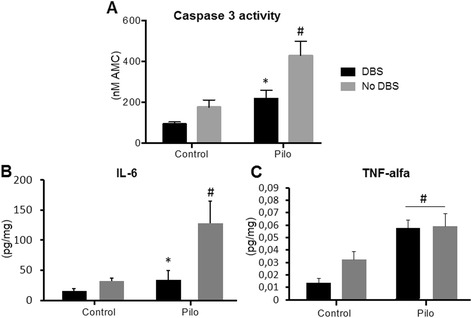
Rats undergoing pilocarpine-induced SE were treated with anterior thalamic nucleus (AN) deep brain stimulation (DBS). Inflammatory changes and caspase 3 activity were measured within 1 week of treatment.
In pilocarpine-treated rats, DBS countered the significant increase in hippocampal caspase 3 activity and interleukin-6 (IL-6) levels that follows SE but had no effect on tumor necrosis factor α (TNFα).
DBS has anti-inflammatory and antiapoptotic effects when given to animals undergoing status.
癫痫持续状态(SE)是一种严重病症,可能导致海马体细胞丢失和癫痫发生。与SE诱导的细胞死亡相关的一些机制是兴奋性毒性、神经炎症和细胞凋亡。
本研究的目的是检验以下假设:在SE期间应用脑深部电刺激(DBS)具有抗炎和抗凋亡作用。
对接受匹鲁卡品诱导的SE的大鼠进行丘脑前核(AN)深部脑刺激(DBS)治疗。在治疗1周内测量炎症变化和半胱天冬酶3活性。
在匹鲁卡品治疗的大鼠中,DBS对抗了SE后海马体半胱天冬酶3活性和白细胞介素-6(IL-6)水平的显著升高,但对肿瘤坏死因子α(TNFα)没有影响。
对处于癫痫持续状态的动物给予DBS具有抗炎和抗凋亡作用。