Yang Xiao-Rong, Xiong Yan, Duan Hong, Gong Ren-Rong
Department of Operation Room, West China Hospital, Sichuan University, No 37, Guo Xue Lane, Chengdu, Sichuan, 610041, People's Republic of China.
Department of Orthopedics, West China Hospital, Sichuan University, No 37, Guo Xue Lane, Chengdu, Sichuan, 610041, People's Republic of China.
J Orthop Surg Res. 2015 Sep 4;10:136. doi: 10.1186/s13018-015-0275-8.
This study aimed to better understand the mechanisms underlying methotrexate (MTX)-resistance in osteosarcoma.
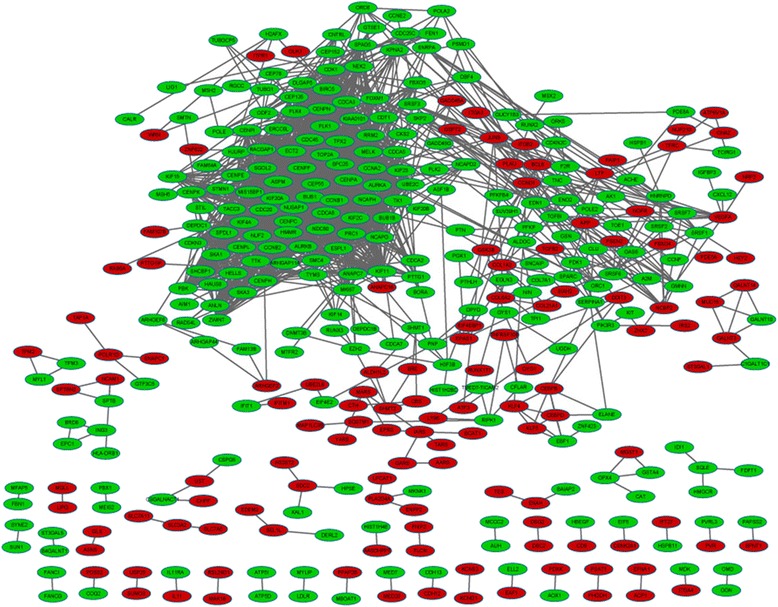
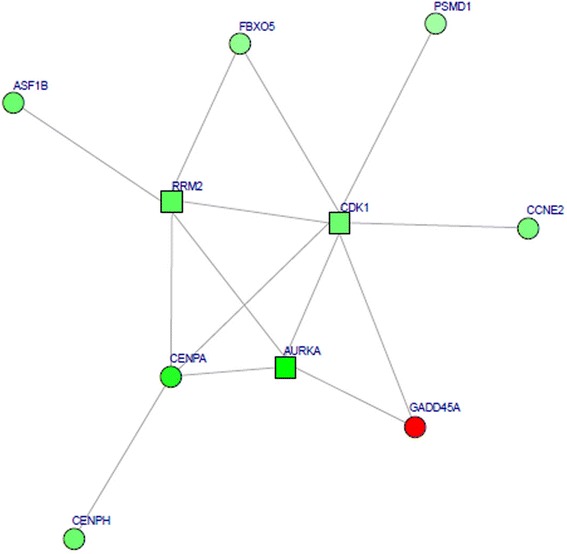
The raw transcription microarray data GSE16089 collected from three MTX-sensitive osteosarcoma (Saos-2) cell samples and three MTX-resistant osteosarcoma (Saos-2) cell samples were downloaded from Gene Expression Omnibus. After data processing, the differentially expressed genes (DEGs) were identified. Next, DEGs were submitted to DAVID for functional annotation based on the GO (Gene Ontology) database, as well as pathway enrichment analysis based on the KEGG (Kyoto Encyclopedia of Genes and Genomes) database. Transcription factors (TFs) and tumor-associated genes (TAGs) were identified with reference to TRANSFAC and TAG, and TSGene databases, respectively. The protein-protein interaction (PPI) network of the gene-encoded products was constructed, and the subnetwork with the highest score was also detected using Search Tool for the Retrieval of Interacting Genes and BioNet package.
A total of 690 up-regulated genes and down-regulated 626 genes were identified. Up-regulated DEGs (including AARS and PARS2) were associated to transfer RNA (tRNA) aminoacylation while down-regulated DEGs (including AURKA, CCNB1, CCNE2, CDK1, and CENPA) were correlated with mitotic cell cycle. Totally, 13 TFs (including HMGB2), 13 oncogenes (including CCNA2 and AURKA), and 19 tumor suppressor genes (TSGs) (including CDKN2C) were identified from the down-regulated DEGs. Ten DEGs, including nine down-regulated genes (such as AURKA, CDK1, CCNE2, and CENPA) and one up-regulated gene (GADD45A), were involved in the highest score subnetwork.
AARS, AURKA, AURKB, CENPA, CCNB1, CCNE2, and CDK may contribute to MTX resistance via aminoacyl-tRNA biosynthesis pathway, cell cycle pathway, or p53 signaling pathway.
本研究旨在更好地理解骨肉瘤中氨甲蝶呤(MTX)耐药的潜在机制。
从基因表达综合数据库下载了从三个MTX敏感骨肉瘤(Saos-2)细胞样本和三个MTX耐药骨肉瘤(Saos-2)细胞样本中收集的原始转录微阵列数据GSE16089。经过数据处理后,鉴定出差异表达基因(DEG)。接下来,将DEG提交给DAVID,基于基因本体论(GO)数据库进行功能注释,并基于京都基因与基因组百科全书(KEGG)数据库进行通路富集分析。分别参考TRANSFAC和TAG以及TSGene数据库鉴定转录因子(TF)和肿瘤相关基因(TAG)。构建基因编码产物的蛋白质-蛋白质相互作用(PPI)网络,并使用搜索相互作用基因工具和BioNet软件包检测得分最高的子网。
共鉴定出690个上调基因和626个下调基因。上调的DEG(包括AARS和PARS2)与转运RNA(tRNA)氨酰化相关,而下调的DEG(包括AURKA、CCNB1、CCNE2、CDK1和CENPA)与有丝分裂细胞周期相关。从下调的DEG中总共鉴定出13个TF(包括HMGB2)、13个癌基因(包括CCNA2和AURKA)和19个肿瘤抑制基因(TSG)(包括CDKN2C)。包括9个下调基因(如AURKA、CDK1、CCNE2和CENPA)和1个上调基因(GADD45A)在内的10个DEG参与了得分最高的子网。
AARS、AURKA、AURKB、CENPA、CCNB1、CCNE2和CDK可能通过氨酰-tRNA生物合成途径、细胞周期途径或p53信号通路导致MTX耐药。