• 文献检索
  • 文档翻译
  • 深度研究
  • 学术资讯
  • Suppr Zotero 插件Zotero 插件
  • 邀请有礼
  • 套餐&价格
  • 历史记录
应用&插件
Suppr Zotero 插件Zotero 插件浏览器插件Mac 客户端Windows 客户端微信小程序
定价
高级版会员购买积分包购买API积分包
服务
文献检索文档翻译深度研究API 文档MCP 服务
关于我们
关于 Suppr公司介绍联系我们用户协议隐私条款
关注我们

Suppr 超能文献

核心技术专利:CN118964589B侵权必究
粤ICP备2023148730 号-1Suppr @ 2026

文献检索

告别复杂PubMed语法,用中文像聊天一样搜索,搜遍4000万医学文献。AI智能推荐,让科研检索更轻松。

立即免费搜索

文件翻译

保留排版,准确专业,支持PDF/Word/PPT等文件格式,支持 12+语言互译。

免费翻译文档

深度研究

AI帮你快速写综述,25分钟生成高质量综述,智能提取关键信息,辅助科研写作。

立即免费体验

源自母体的嵌合细胞在青少年特发性炎性肌病或肌营养不良中似乎并无致病性。

Chimeric cells of maternal origin do not appear to be pathogenic in the juvenile idiopathic inflammatory myopathies or muscular dystrophy.

作者信息

Artlett Carol M, Sassi-Gaha Sihem, Ramos Ronald C, Miller Frederick W, Rider Lisa G

机构信息

Department of Microbiology and Immunology, Drexel University College of Medicine, 2900 Queen Lane, Philadelphia, PA, 19129, USA.

Department of Medicine, Thomas Jefferson University, 1020 Walnut Street, Philadelphia, PA, 19107, USA.

出版信息

Arthritis Res Ther. 2015 Sep 4;17(1):238. doi: 10.1186/s13075-015-0732-0.

DOI:10.1186/s13075-015-0732-0
PMID:26338728
原文链接:https://pmc.ncbi.nlm.nih.gov/articles/PMC4558637/
Abstract

INTRODUCTION

Microchimeric cells have been studied for over a decade, with conflicting reports on their presence and role in autoimmune and other inflammatory diseases. To determine whether microchimeric cells were pathogenic or mediating tissue repair in inflammatory myopathies, we phenotyped and quantified microchimeric cells in juvenile idiopathic inflammatory myopathies (JIIM), muscular dystrophy (MD), and noninflammatory control muscle tissues.

METHOD

Fluorescence immunophenotyping for infiltrating cells with sequential fluorescence in situ hybridization was performed on muscle biopsies from ten patients with JIIM, nine with MD and ten controls.

RESULTS

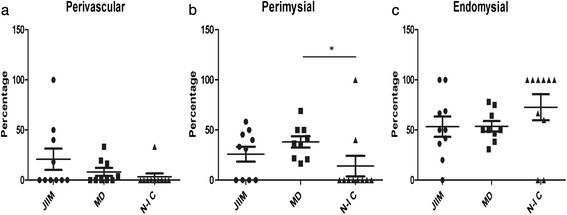
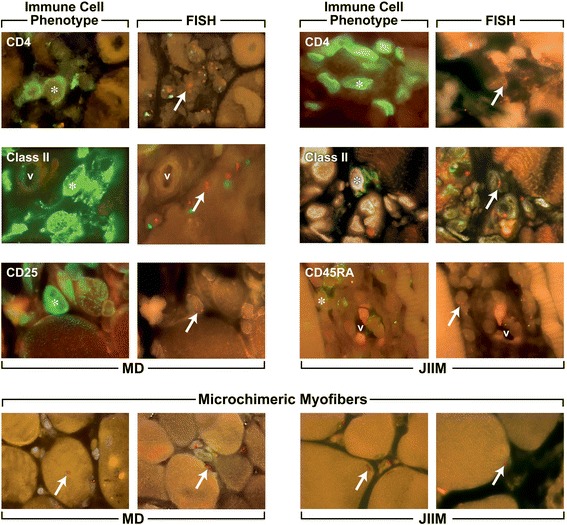
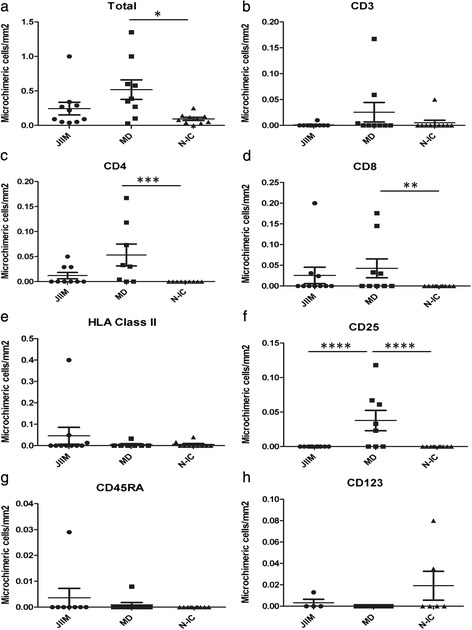
Microchimeric cells were significantly increased in MD muscle (0.079 ± 0.024 microchimeric cells/mm(2) tissue) compared to controls (0.019 ± 0.007 cells/mm(2) tissue, p = 0.01), but not elevated in JIIM muscle (0.043 ± 0.015 cells/mm(2)). Significantly more CD4+ and CD8+ microchimeric cells were in the muscle of patients with MD compared with controls (mean 0.053 ± 0.020/mm(2) versus 0 ± 0/mm(2) p = 0.003 and 0.043 ± 0.023/mm(2) versus 0 ± 0/mm(2) p = 0.025, respectively). No differences in microchimeric cells between JIIM, MD, and noninflammatory controls were found for CD3+, Class II+, CD25+, CD45RA+, and CD123+ phenotypes, and no microchimeric cells were detected in CD20, CD83, or CD45RO populations. The locations of microchimeric cells were similar in all three conditions, with MD muscle having more microchimeric cells in perimysial regions than controls, and JIIM having fewer microchimeric muscle nuclei than MD. Microchimeric inflammatory cells were found, in most cases, at significantly lower proportions than autologous cells of the same phenotype.

CONCLUSIONS

Microchimeric cells are not specific to autoimmune disease, and may not be important in muscle inflammation or tissue repair in JIIM.

摘要

引言

微嵌合细胞已被研究了十多年,关于它们在自身免疫性疾病和其他炎症性疾病中的存在及作用,报告结果相互矛盾。为了确定微嵌合细胞在炎性肌病中是致病的还是介导组织修复的,我们对青少年特发性炎性肌病(JIIM)、肌肉营养不良(MD)和非炎性对照肌肉组织中的微嵌合细胞进行了表型分析和定量。

方法

对10例JIIM患者、9例MD患者和10例对照的肌肉活检组织进行连续荧光原位杂交,对浸润细胞进行荧光免疫表型分析。

结果

与对照组(0.019±0.007个微嵌合细胞/mm²组织,p = 0.01)相比,MD肌肉中的微嵌合细胞显著增加(0.079±0.024个微嵌合细胞/mm²组织),但JIIM肌肉中的微嵌合细胞未升高(0.043±0.015个细胞/mm²)。与对照组相比,MD患者肌肉中的CD4⁺和CD8⁺微嵌合细胞明显更多(分别为平均0.053±0.020/mm²对0±0/mm²,p = 0.003;0.043±0.023/mm²对0±0/mm²,p = 0.025)。在JIIM、MD和非炎性对照之间,CD3⁺、II类⁺、CD25⁺、CD45RA⁺和CD123⁺表型的微嵌合细胞没有差异,在CD20、CD83或CD45RO群体中未检测到微嵌合细胞。在所有三种情况下,微嵌合细胞的位置相似,MD肌肉中肌束膜区域的微嵌合细胞比对照组更多,而JIIM中微嵌合肌核比MD更少。在大多数情况下,发现微嵌合炎性细胞的比例明显低于相同表型的自体细胞。

结论

微嵌合细胞并非自身免疫性疾病所特有,并可能在JIIM的肌肉炎症或组织修复中并不重要。
https://cdn.ncbi.nlm.nih.gov/pmc/blobs/b71c/4558637/4bd991c18d36/13075_2015_732_Fig3_HTML.jpg
https://cdn.ncbi.nlm.nih.gov/pmc/blobs/b71c/4558637/dd52c0e96a0d/13075_2015_732_Fig1_HTML.jpg
https://cdn.ncbi.nlm.nih.gov/pmc/blobs/b71c/4558637/52e811391af4/13075_2015_732_Fig2_HTML.jpg
https://cdn.ncbi.nlm.nih.gov/pmc/blobs/b71c/4558637/4bd991c18d36/13075_2015_732_Fig3_HTML.jpg
https://cdn.ncbi.nlm.nih.gov/pmc/blobs/b71c/4558637/dd52c0e96a0d/13075_2015_732_Fig1_HTML.jpg
https://cdn.ncbi.nlm.nih.gov/pmc/blobs/b71c/4558637/52e811391af4/13075_2015_732_Fig2_HTML.jpg
https://cdn.ncbi.nlm.nih.gov/pmc/blobs/b71c/4558637/4bd991c18d36/13075_2015_732_Fig3_HTML.jpg

相似文献

1
Chimeric cells of maternal origin do not appear to be pathogenic in the juvenile idiopathic inflammatory myopathies or muscular dystrophy.源自母体的嵌合细胞在青少年特发性炎性肌病或肌营养不良中似乎并无致病性。
Arthritis Res Ther. 2015 Sep 4;17(1):238. doi: 10.1186/s13075-015-0732-0.
2
Major histocompatibility complex and inflammatory cell subtype expression in inflammatory myopathies and muscular dystrophies.主要组织相容性复合体和炎症细胞亚型在炎症性肌病和肌营养不良症中的表达。
Neurol India. 2013 Nov-Dec;61(6):614-21. doi: 10.4103/0028-3886.125264.
3
Persistent maternally derived peripheral microchimerism is associated with the juvenile idiopathic inflammatory myopathies.持续存在的母源性外周微嵌合体与幼年特发性炎性肌病相关。
Rheumatology (Oxford). 2001 Nov;40(11):1279-84. doi: 10.1093/rheumatology/40.11.1279.
4
Chimeric cells of maternal origin in juvenile idiopathic inflammatory myopathies. Childhood Myositis Heterogeneity Collaborative Group.青少年特发性炎性肌病中母源嵌合细胞。儿童肌炎异质性协作组。
Lancet. 2000;356(9248):2155-6. doi: 10.1016/s0140-6736(00)03499-1.
5
Chimerism in myositis.肌炎中的嵌合体现象。
Curr Rheumatol Rep. 2003 Dec;5(6):421-4. doi: 10.1007/s11926-003-0051-3.
6
PCR detectable Y chromosome-specific DNA but no intact Y chromosome-bearing cells in polymyositis biopsies of two women with male offspring.在两名生育男性后代的女性多发性肌炎活检组织中,PCR 可检测到 Y 染色体特异性 DNA,但不存在完整的带有 Y 染色体的细胞。
Pathology. 2010 Feb;42(2):160-4. doi: 10.3109/00313020903494953.
7
Anti-MDA5 juvenile idiopathic inflammatory myopathy: a specific subgroup defined by differentially enhanced interferon-α signalling.抗 MDA5 少年特发性炎性肌病:干扰素-α信号差异增强定义的特定亚群。
Rheumatology (Oxford). 2020 Aug 1;59(8):1927-1937. doi: 10.1093/rheumatology/kez525.
8
HLA-DQA1 is not an apparent risk factor for microchimerism in patients with various autoimmune diseases and in healthy individuals.HLA - DQA1并非各种自身免疫性疾病患者及健康个体中微嵌合体的明显风险因素。
Arthritis Rheum. 2003 Sep;48(9):2567-72. doi: 10.1002/art.11235.
9
Damage and inflammation in muscular dystrophy: potential implications and relationships with autoimmune myositis.肌营养不良中的损伤与炎症:潜在影响及与自身免疫性肌炎的关系
Curr Opin Rheumatol. 2005 Nov;17(6):707-13. doi: 10.1097/01.bor.0000179948.65895.1a.
10
Monoclonal antibody analysis of mononuclear cells in myopathies. I: Quantitation of subsets according to diagnosis and sites of accumulation and demonstration and counts of muscle fibers invaded by T cells.肌病中单核细胞的单克隆抗体分析。I:根据诊断和积聚部位对亚群进行定量,并对T细胞侵入的肌纤维进行示踪和计数。
Ann Neurol. 1984 Aug;16(2):193-208. doi: 10.1002/ana.410160206.

引用本文的文献

1
The when, what, and where of naturally-acquired microchimerism.自然获得性微嵌合体的时间、内容和位置。
Semin Immunopathol. 2025 Mar 11;47(1):20. doi: 10.1007/s00281-024-01029-2.
2
Deciphering the Role of Maternal Microchimerism in Offspring Autoimmunity: A Narrative Review.解析母源性微小嵌合体在子代自身免疫中的作用:叙述性综述。
Medicina (Kaunas). 2024 Sep 5;60(9):1457. doi: 10.3390/medicina60091457.
3
How does age determine the development of human immune-mediated arthritis?年龄如何决定人类免疫介导性关节炎的发展?

本文引用的文献

1
Selective organ specific inflammation in offspring harbouring microchimerism from strongly alloreactive mothers.强烈同种异体反应的母亲所生嵌合体后代的选择性器官特异性炎症。
J Autoimmun. 2014 May;50:51-8. doi: 10.1016/j.jaut.2013.10.005. Epub 2013 Nov 20.
2
Muscular dystrophies.肌肉萎缩症。
Lancet. 2013 Mar 9;381(9869):845-60. doi: 10.1016/S0140-6736(12)61897-2.
3
High male chimerism in the female breast shows quantitative links with cancer.男性嵌合体在女性乳房中高表达与癌症有定量关系。
Nat Rev Rheumatol. 2022 Sep;18(9):501-512. doi: 10.1038/s41584-022-00814-3. Epub 2022 Aug 10.
4
Maternal-Fetal Inflammation in the Placenta and the Developmental Origins of Health and Disease.胎盘的母婴炎症与健康和疾病的发育起源。
Front Immunol. 2020 Nov 13;11:531543. doi: 10.3389/fimmu.2020.531543. eCollection 2020.
5
Dermatomyositis etiopathogenesis: a rebel soldier in the muscle.皮肌炎的发病机制:肌肉中的叛逆士兵。
Curr Opin Rheumatol. 2018 Nov;30(6):623-629. doi: 10.1097/BOR.0000000000000540.
Int J Cancer. 2013 Aug 15;133(4):835-42. doi: 10.1002/ijc.28077. Epub 2013 Mar 4.
4
The clinical phenotypes of the juvenile idiopathic inflammatory myopathies.青少年特发性炎性肌病的临床表型。
Medicine (Baltimore). 2013 Jan;92(1):25-41. doi: 10.1097/MD.0b013e31827f264d.
5
The muscular dystrophies.肌肉萎缩症。
Semin Neurol. 2012 Jul;32(3):255-63. doi: 10.1055/s-0032-1329199. Epub 2012 Nov 1.
6
Maternal microchimerism in muscle biopsies from children with juvenile dermatomyositis.肌肉活检中儿童皮肌炎的母婴微嵌合体。
Rheumatology (Oxford). 2012 Jun;51(6):987-91. doi: 10.1093/rheumatology/ker430. Epub 2012 Jan 23.
7
Maternal microchimerism in pediatric inflammatory bowel disease.小儿炎症性肠病中的母体微嵌合体现象。
Chimerism. 2011 Apr;2(2):50-4. doi: 10.4161/chim.2.2.16556.
8
Specific maternal microchimeric T cells targeting fetal antigens in β cells predispose to auto-immune diabetes in the child.特定的母体微小嵌合 T 细胞针对β细胞中的胎儿抗原,使儿童易患自身免疫性糖尿病。
J Autoimmun. 2011 May;36(3-4):253-62. doi: 10.1016/j.jaut.2011.02.003. Epub 2011 Mar 17.
9
Why are levels of maternal microchimerism higher in type 1 diabetes pancreas?为什么1型糖尿病胰腺中的母体微嵌合体水平更高?
Chimerism. 2010 Oct;1(2):45-50. doi: 10.4161/chim.1.2.13891.
10
Fetal microchimerism as an explanation of disease.胎儿微嵌合体现象作为疾病发生的一种解释。
Nat Rev Endocrinol. 2011 Feb;7(2):89-97. doi: 10.1038/nrendo.2010.216. Epub 2010 Dec 21.