Almeda-Valdes Paloma, Aguilar Olivos Nancy E, Barranco-Fragoso Beatriz, Uribe Misael, Méndez-Sánchez Nahum
Endocrinology and Metabolism Department, Instituto Nacional de Ciencias Médicas y Nutrición Salvador Zubirán, 14080 Mexico, DF, Mexico.
Liver Research Unit, Medica Sur Clinic & Foundation, 14050 Mexico, DF, Mexico.
Biomed Res Int. 2015;2015:768071. doi: 10.1155/2015/768071. Epub 2015 Aug 3.
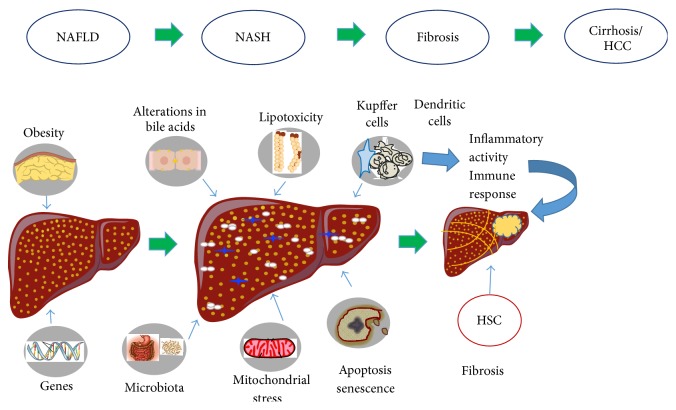
Nonalcoholic fatty liver disease (NAFLD) is the most frequent cause of chronic liver disease. NAFLD encompasses a wide range of pathologies, from simple steatosis to steatosis with inflammation to fibrosis. The pathogenesis of NAFLD progression has not been completely elucidated, and different liver cells could be implicated. This review focuses on the current evidence of the role of liver dendritic cells (DCs) in the progression from NAFLD to fibrosis. Liver DCs are a heterogeneous population of hepatic antigen-presenting cells; their main function is to induce T-cell mediated immunity by antigen processing and presentation to T cells. During the steady state liver DCs are immature and tolerogenic. However, in an environment of chronic inflammation, DCs are transformed to potent inducers of immune responses. There is evidence about the role of DC in liver fibrosis, but it is not clearly understood. Interestingly, there might be a link between lipid metabolism and DC function, suggesting that immunogenic DCs are associated with liver lipid storage, representing a possible pathophysiological mechanism in NAFLD development. A better understanding of the interaction between inflammatory pathways and the different cell types and the effect on the progression of NAFLD is of great relevance.
非酒精性脂肪性肝病(NAFLD)是慢性肝病最常见的病因。NAFLD涵盖了广泛的病理情况,从单纯性脂肪变性到伴有炎症的脂肪变性再到纤维化。NAFLD进展的发病机制尚未完全阐明,不同的肝细胞可能与之相关。本综述聚焦于肝脏树突状细胞(DCs)在NAFLD向纤维化进展过程中作用的当前证据。肝脏DCs是肝脏抗原呈递细胞的异质性群体;它们的主要功能是通过抗原加工和呈递给T细胞来诱导T细胞介导的免疫。在稳态时,肝脏DCs不成熟且具有耐受性。然而,在慢性炎症环境中,DCs会转变为免疫反应的强效诱导剂。有关于DC在肝纤维化中作用的证据,但尚未完全明确。有趣的是,脂质代谢与DC功能之间可能存在联系,这表明具有免疫原性的DCs与肝脏脂质储存相关,代表了NAFLD发展中一种可能的病理生理机制。更好地理解炎症途径与不同细胞类型之间的相互作用以及对NAFLD进展的影响具有重要意义。