
连接脯氨酸代谢与植物衰老中的信号通路。
Connecting proline metabolism and signaling pathways in plant senescence.
作者信息
Zhang Lu, Becker Donald F
机构信息
Redox Biology Center, Department of Biochemistry, University of Nebraska-Lincoln , Lincoln, NE, USA.
出版信息
Front Plant Sci. 2015 Jul 22;6:552. doi: 10.3389/fpls.2015.00552. eCollection 2015.
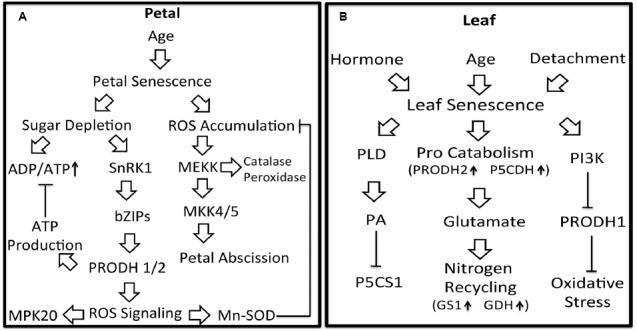
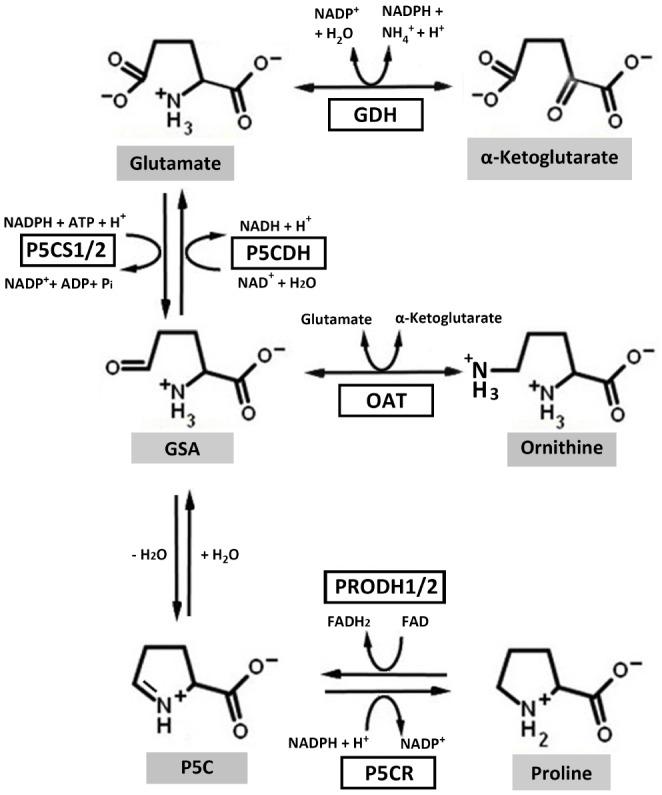
The amino acid proline has a unique biological role in stress adaptation. Proline metabolism is manipulated under stress by multiple and complex regulatory pathways and can profoundly influence cell death and survival in microorganisms, plants, and animals. Though the effects of proline are mediated by diverse signaling pathways, a common theme appears to be the generation of reactive oxygen species (ROS) due to proline oxidation being coupled to the respiratory electron transport chain. Considerable research has been devoted to understand how plants exploit proline metabolism in response to abiotic and biotic stress. Here, we review potential mechanisms by which proline metabolism influences plant senescence, namely in the petal and leaf. Recent studies of petal senescence suggest proline content is manipulated to meet energy demands of senescing cells. In the flower and leaf, proline metabolism may influence ROS signaling pathways that delay senescence progression. Future studies focusing on the mechanisms by which proline metabolic shifts occur during senescence may lead to novel methods to rescue crops under stress and to preserve post-harvest agricultural products.
氨基酸脯氨酸在应激适应中具有独特的生物学作用。脯氨酸代谢在应激状态下受多种复杂调控途径的影响,并且能深刻影响微生物、植物和动物细胞的死亡与存活。尽管脯氨酸的作用是由多种信号通路介导的,但一个共同的主题似乎是由于脯氨酸氧化与呼吸电子传递链偶联而产生活性氧(ROS)。大量研究致力于了解植物如何利用脯氨酸代谢来应对非生物和生物胁迫。在此,我们综述脯氨酸代谢影响植物衰老的潜在机制,特别是在花瓣和叶片中的机制。最近关于花瓣衰老的研究表明,脯氨酸含量被调控以满足衰老细胞的能量需求。在花和叶中,脯氨酸代谢可能影响延缓衰老进程的ROS信号通路。未来聚焦于衰老过程中脯氨酸代谢转变机制的研究,可能会带来在胁迫下拯救作物以及保存收获后农产品的新方法。
 Zotero 插件