
碱基切除修复介导KRAS(G12C)突变型非小细胞肺癌细胞对顺铂的耐药性。
Base excision repair-mediated resistance to cisplatin in KRAS(G12C) mutant NSCLC cells.
作者信息
Caiola Elisa, Salles Daniela, Frapolli Roberta, Lupi Monica, Rotella Giuseppe, Ronchi Anna, Garassino Marina Chiara, Mattschas Nikola, Colavecchio Stefano, Broggini Massimo, Wiesmüller Lisa, Marabese Mirko
机构信息
Laboratory of Molecular Pharmacology, Department of Oncology, IRCCS - Istituto di Ricerche Farmacologiche "Mario Negri", Milan, Italy.
Department of Obstetrics and Gynecology, University of Ulm, Ulm, Germany.
出版信息
Oncotarget. 2015 Oct 6;6(30):30072-87. doi: 10.18632/oncotarget.5019.
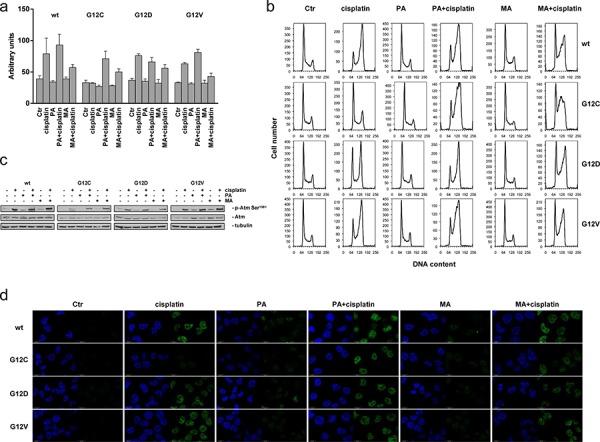
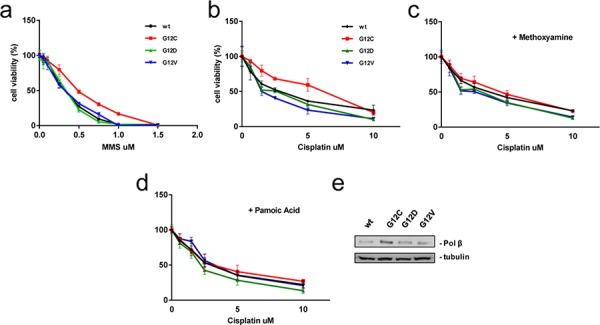
KRAS mutations in NSCLC are supposed to indicate a poor prognosis and poor response to anticancer treatments but this feature lacks a mechanistic basis so far. In tumors, KRAS was found to be mutated mostly at codons 12 and 13 and a pool of mutations differing in the base alteration and the amino acid substitution have been described. The different KRAS mutations may differently impact on cancerogenesis and drug sensitivity. On this basis, we hypothesized that a different KRAS mutational status in NSCLC patients determines a different profile in the tumor response to treatments. In this paper, isogenic NSCLC cell clones expressing mutated forms of KRAS were used to determine the response to cisplatin, the main drug used in the clinic against NSCLC. Cells expressing the KRAS(G12C) mutation were found to be less sensitive to treatment both in vitro and in vivo. Systematic analysis of drug uptake, DNA adduct formation and DNA damage responses implicated in cisplatin adducts removal revealed that the KRAS(G12C) mutation might be particular because it stimulates Base Excision Repair to rapidly remove platinum from DNA even before the formation of cross-links. The presented results suggest a different pattern of sensitivity/resistance to cisplatin depending on the KRAS mutational status and these data might provide proof of principle for further investigations on the role of the KRAS status as a predictor of NSCLC response.
非小细胞肺癌(NSCLC)中的KRAS突变被认为预示着预后不良以及对抗癌治疗反应不佳,但迄今为止这一特征缺乏机制基础。在肿瘤中,发现KRAS主要在密码子12和13处发生突变,并且已经描述了一系列在碱基改变和氨基酸取代方面存在差异的突变。不同的KRAS突变可能对肿瘤发生和药物敏感性产生不同影响。在此基础上,我们推测NSCLC患者中不同的KRAS突变状态决定了肿瘤对治疗反应的不同特征。在本文中,使用表达KRAS突变形式的同基因NSCLC细胞克隆来确定对顺铂(临床上用于治疗NSCLC的主要药物)的反应。发现表达KRAS(G12C)突变的细胞在体外和体内对治疗均不太敏感。对药物摄取、DNA加合物形成以及与顺铂加合物清除相关的DNA损伤反应进行系统分析发现,KRAS(G12C)突变可能具有特殊性,因为它甚至在交联形成之前就刺激碱基切除修复以快速从DNA中去除铂。所呈现的结果表明,根据KRAS突变状态,对顺铂的敏感性/耐药性模式不同,这些数据可能为进一步研究KRAS状态作为NSCLC反应预测指标的作用提供原理证明。


 Zotero 插件