Jankovic Nicole, Geelen Anouk, Streppel Martinette T, de Groot Lisette Cpgm, Kiefte-de Jong Jessica C, Orfanos Philippos, Bamia Christina, Trichopoulou Antonia, Boffetta Paolo, Bobak Martin, Pikhart Hynek, Kee Frank, O'Doherty Mark G, Buckland Genevieve, Woodside Jayne, Franco Oscar H, Ikram M Arfan, Struijk Ellen A, Pajak Andrzej, Malyutina Sofia, Kubinova Růžena, Wennberg Maria, Park Yikyung, Bueno-de-Mesquita H Bas, Kampman Ellen, Feskens Edith J
Division of Human Nutrition, Wageningen University, Wageningen, Netherlands; Centre of Clinical Epidemiology, Institute for Medical Informatics, Biometry and Epidemiology, University Hospital, University Duisburg-Essen, Essen, Germany;
Division of Human Nutrition, Wageningen University, Wageningen, Netherlands;
Am J Clin Nutr. 2015 Oct;102(4):745-56. doi: 10.3945/ajcn.114.095117. Epub 2015 Sep 9.
Cardiovascular disease (CVD) represents a leading cause of mortality worldwide, especially in the elderly. Lowering the number of CVD deaths requires preventive strategies targeted on the elderly.
The objective was to generate evidence on the association between WHO dietary recommendations and mortality from CVD, coronary artery disease (CAD), and stroke in the elderly aged ≥60 y.
We analyzed data from 10 prospective cohort studies from Europe and the United States comprising a total sample of 281,874 men and women free from chronic diseases at baseline. Components of the Healthy Diet Indicator (HDI) included saturated fatty acids, polyunsaturated fatty acids, mono- and disaccharides, protein, cholesterol, dietary fiber, and fruit and vegetables. Cohort-specific HRs adjusted for sex, education, smoking, physical activity, and energy and alcohol intakes were pooled by using a random-effects model.
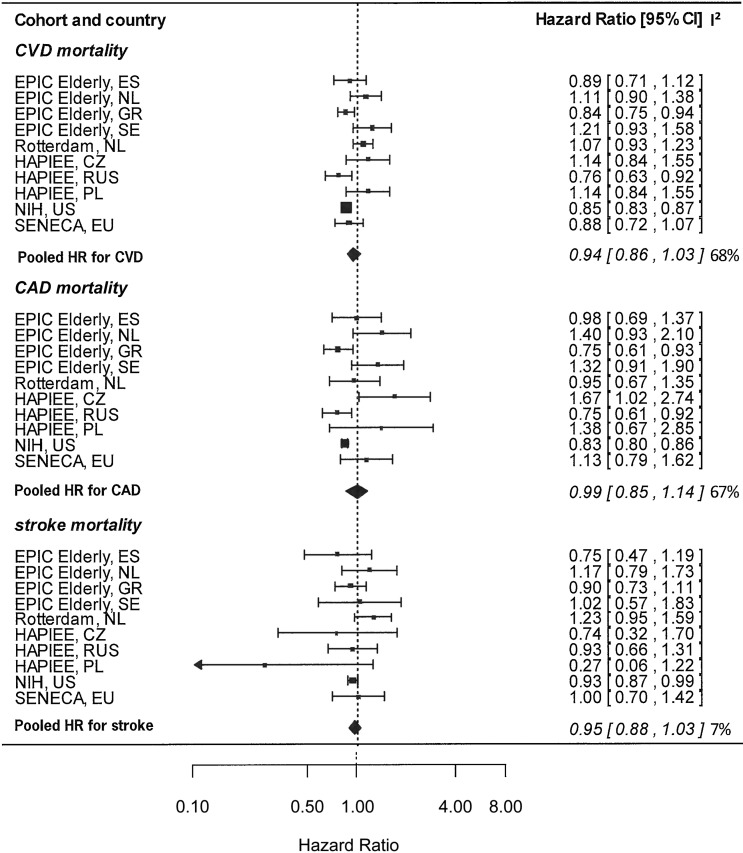
During 3,322,768 person-years of follow-up, 12,492 people died of CVD. An increase of 10 HDI points (complete adherence to an additional WHO guideline) was, on average, not associated with CVD mortality (HR: 0.94; 95% CI: 0.86, 1.03), CAD mortality (HR: 0.99; 95% CI: 0.85, 1.14), or stroke mortality (HR: 0.95; 95% CI: 0.88, 1.03). However, after stratification of the data by geographic region, adherence to the HDI was associated with reduced CVD mortality in the southern European cohorts (HR: 0.87; 95% CI: 0.79, 0.96; I(2) = 0%) and in the US cohort (HR: 0.85; 95% CI: 0.83, 0.87; I(2) = not applicable).
Overall, greater adherence to the WHO dietary guidelines was not significantly associated with CVD mortality, but the results varied across regions. Clear inverse associations were observed in elderly populations in southern Europe and the United States.
心血管疾病(CVD)是全球主要的死亡原因,在老年人中尤为突出。降低心血管疾病死亡人数需要针对老年人的预防策略。
目的是提供证据,证明世界卫生组织(WHO)饮食建议与60岁及以上老年人的心血管疾病、冠状动脉疾病(CAD)和中风死亡率之间的关联。
我们分析了来自欧洲和美国的10项前瞻性队列研究的数据,这些研究在基线时共纳入了281874名无慢性病的男性和女性。健康饮食指标(HDI)的组成部分包括饱和脂肪酸、多不饱和脂肪酸、单糖和双糖、蛋白质、胆固醇、膳食纤维以及水果和蔬菜。采用随机效应模型汇总针对性别、教育程度、吸烟、体力活动以及能量和酒精摄入量进行调整后的队列特异性风险比(HR)。
在3322768人年的随访期间,12492人死于心血管疾病。HDI增加10分(完全遵守另外一条WHO指南),平均而言与心血管疾病死亡率(HR:0.94;95%CI:0.86,1.03)、CAD死亡率(HR:0.99;95%CI:0.85,1.14)或中风死亡率(HR:0.95;95%CI:0.88,1.03)无关。然而,按地理区域对数据进行分层后,在南欧队列(HR:0.87;95%CI:0.79,0.96;I² = 0%)和美国队列(HR:0.85;95%CI:0.83,0.87;I² = 不适用)中,遵守HDI与心血管疾病死亡率降低相关。
总体而言,更高程度地遵守WHO饮食指南与心血管疾病死亡率无显著关联,但结果因地区而异。在南欧和美国的老年人群中观察到了明显的负相关。