Keppler Hannah, Ingeborg Dhooge, Sofie Degeest, Bart Vinck
Department of Speech, Language and Hearing Sciences, Ghent University, Ghent, Belgium, .
Noise Health. 2015 Sep-Oct;17(78):253-62. doi: 10.4103/1463-1741.165028.
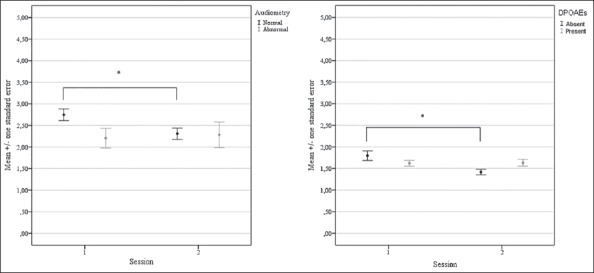
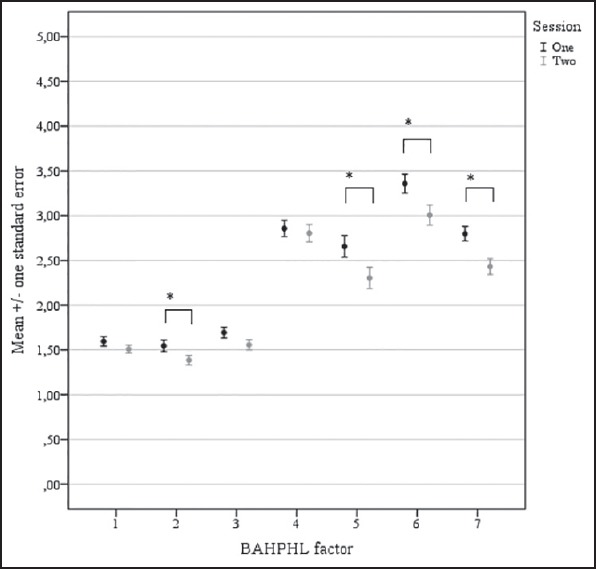
Excessive recreational noise exposure in young adults might result in noise-induced hearing loss (NIHL) and tinnitus. Inducing behavioral change in young adults is one of the aims of a hearing conservation program (HCP). The goal of the current study was to evaluate the effect of a hearing education program after 6 months in young adults in relation to knowledge regarding their individual hearing status. The results of a questionnaire regarding the weekly equivalent recreational noise exposure, attitudes and beliefs toward noise, and hearing loss and hearing protector devices (HPDs) were compared between both sessions. Seventy-eight young adults completed the questionnaire concerning recreational noise exposure, youth attitude to noise scale (YANS), and beliefs about hearing protection and hearing loss (BAHPHL). Their hearing status was evaluated based on admittance measures, audiometry, transient-evoked otoacoustic emissions (TEOAEs), and distortion-product otoacoustic emissions (DPOAEs). The main analysis consisted of a mixed model analysis of variance with dependent variables of either the noise exposure or the scores on (subscales of) YANS and BAHPHL. The independent variables were hearing status and session one versus session two. There was a significant decrease in recreational noise exposure and several (sub) scales of YANS and BAHPHL between both the sessions. This behavioral change resulted in a more frequent use of HPDs in 12% of the participants. However, the behavioral change was not completely related to the knowledge of young adults' individual hearing status. To prevent hearing damage in young people, investing in HCPs is necessary, apart from regulating sound levels and its compliance at various leisure-time activities. Also, the long-term effect of HCPs and their most cost-efficient repetition rates should be further investigated.
年轻人过度暴露于娱乐性噪音可能会导致噪声性听力损失(NIHL)和耳鸣。促使年轻人改变行为是听力保护计划(HCP)的目标之一。本研究的目的是评估一项听力教育计划在6个月后对年轻人关于其个人听力状况知识的影响。比较了两个阶段关于每周等效娱乐性噪音暴露、对噪音的态度和信念以及听力损失和听力保护装置(HPD)的问卷结果。78名年轻人完成了关于娱乐性噪音暴露、青少年对噪音态度量表(YANS)以及听力保护和听力损失信念(BAHPHL)的问卷。根据导纳测量、听力测定、瞬态诱发耳声发射(TEOAEs)和畸变产物耳声发射(DPOAEs)评估他们的听力状况。主要分析包括对噪音暴露或YANS和BAHPHL(子量表)得分作为因变量的混合模型方差分析。自变量是听力状况以及第一阶段与第二阶段。两个阶段之间,娱乐性噪音暴露以及YANS和BAHPHL的几个(子)量表都有显著下降。这种行为改变导致12%的参与者更频繁地使用HPD。然而,这种行为改变与年轻人对其个人听力状况的了解并不完全相关。为了预防年轻人的听力损伤,除了在各种休闲活动中调节声音水平及其合规性之外,投资于HCP是必要的。此外,应进一步研究HCP的长期效果及其最具成本效益的重复率。