Riedl David, Rumpold Gerhard, Schmidt Annette, Zorowka Patrick G, Bliem Harald R, Moschen Roland
Department of Medical Psychology, Medical University of Innsbruck, Innsbruck, Austria.
Noise Health. 2015 Sep-Oct;17(78):374-81. doi: 10.4103/1463-1741.165068.
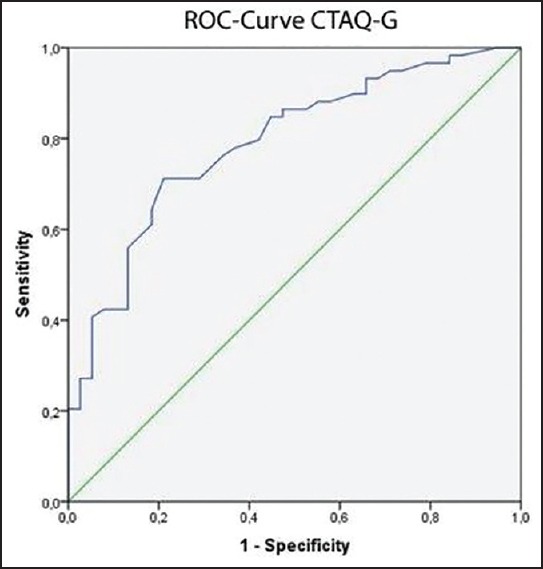
Recent findings show the importance of acceptance in the treatment of chronic tinnitus. So far, very limited research investigating the different levels of tinnitus acceptance has been conducted. The aim of this study was to investigate the quality of life (QoL) and psychological distress in patients with chronic tinnitus who reported different levels of tinnitus acceptance. The sample consisted of outpatients taking part in a tinnitus coping group (n = 97). Correlations between tinnitus acceptance, psychological distress, and QoL were calculated. Receiver operating characteristic (ROC) curves were used to calculate a cutoff score for the German "Tinnitus Acceptance Questionnaire" (CTAQ-G) and to evaluate the screening abilities of the CTAQ-G. Independent sample t-tests were conducted to compare QoL and psychological distress in patients with low tinnitus acceptance and high tinnitus acceptance. A cutoff point for CTAQ-G of 62.5 was defined, differentiating between patients with "low-to-mild tinnitus acceptance" and "moderate-to-high tinnitus acceptance." Patients with higher levels of tinnitus acceptance reported a significantly higher QoL and lower psychological distress. Tinnitus acceptance plays an important role for patients with chronic tinnitus. Increased levels of acceptance are related to better QoL and less psychological distress.
最近的研究结果表明了接纳在慢性耳鸣治疗中的重要性。到目前为止,针对不同程度耳鸣接纳情况的研究非常有限。本研究的目的是调查报告了不同程度耳鸣接纳情况的慢性耳鸣患者的生活质量(QoL)和心理困扰。样本包括参加耳鸣应对小组的门诊患者(n = 97)。计算耳鸣接纳、心理困扰和生活质量之间的相关性。使用受试者工作特征(ROC)曲线来计算德国版“耳鸣接纳问卷”(CTAQ-G)的临界值,并评估CTAQ-G的筛查能力。进行独立样本t检验,以比较耳鸣接纳程度低和耳鸣接纳程度高的患者的生活质量和心理困扰。定义CTAQ-G的临界值为62.5,以区分“低至轻度耳鸣接纳”和“中度至高耳鸣接纳”的患者。耳鸣接纳程度较高的患者报告的生活质量显著更高,心理困扰更低。耳鸣接纳对慢性耳鸣患者起着重要作用。接纳程度的提高与更好的生活质量和更少的心理困扰相关。