Caldow Marissa K, Thomas Emily E, Dale Michael J, Tomkinson Grant R, Buckley Jonathan D, Cameron-Smith David
Molecular Nutrition Unit, School of Exercise and Nutrition Sciences, Deakin University, Melbourne, Australia Basic and Clinical Myology Laboratory, Department of Physiology, University of Melbourne, Melbourne, Australia
Molecular Nutrition Unit, School of Exercise and Nutrition Sciences, Deakin University, Melbourne, Australia.
Physiol Rep. 2015 Sep;3(9). doi: 10.14814/phy2.12511.
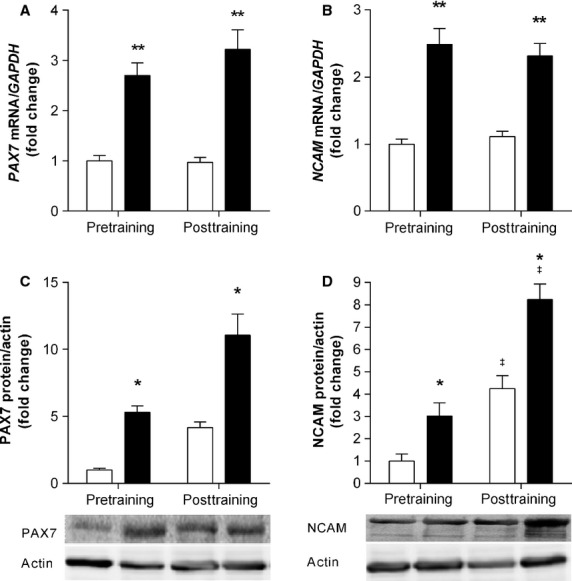
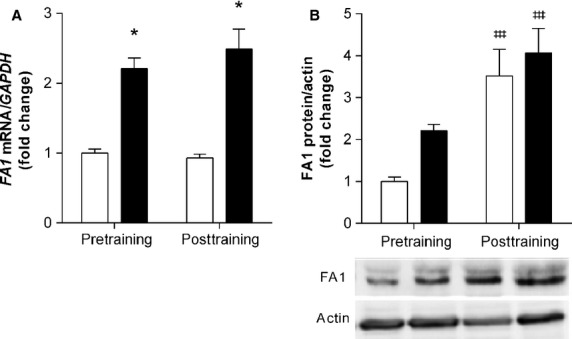
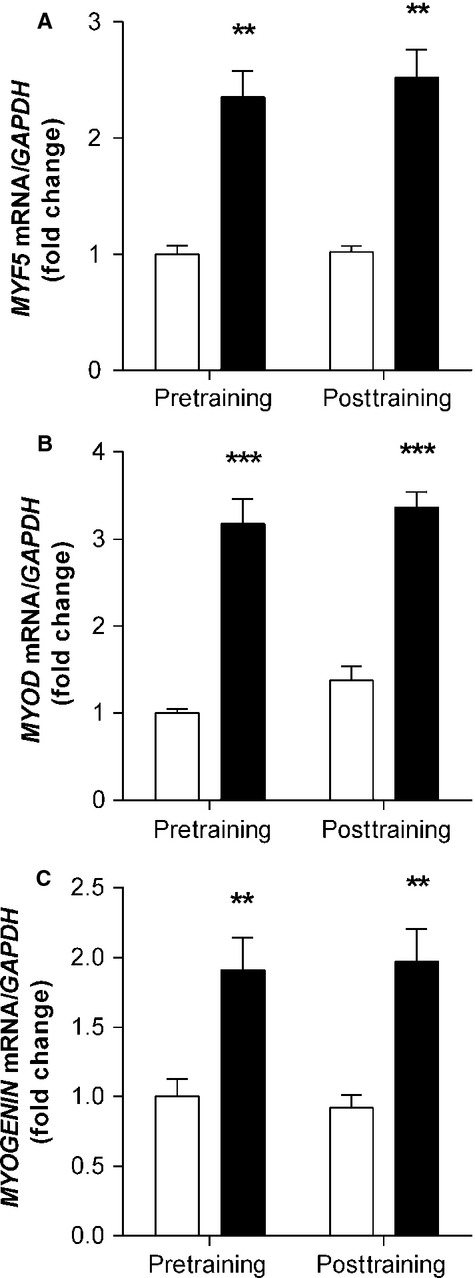
To enable dynamic regulation of muscle mass and myofiber repair following injury, a satellite cell precursor population exists to supply additional nuclei. Activated satellite cells express many genes and associated proteins necessary for maturation and incorporation into the damaged fiber. There is little knowledge about the response of these markers following whole-body resistance exercise training. We investigated the impact of 12 weeks of progressive whole-body resistance training on the expression of MRFs, PAX7, NCAM, and FA1, incorporating both acute and chronic resistance exercise components. Ten young recreationally active males (21.2 ± 3.5 years) performed 12 weeks of whole-body resistance training at 70-85% of their predetermined one-repetition maximum (1RM). At the initiation and completion of the training period, muscular strength was assessed by RM and dynamometer testing, and vastus lateralis samples were obtained prior to and 3 h following an acute resistance exercise test (both whole-body and isometric exercises). Increased mRNA expression of PAX7 (threefold), NCAM (threefold), MYF5 (threefold), MYOD (threefold) and MYOGENIN (twofold) was observed 3 h after the acute resistance exercise test, both pre and posttraining. Similarly, PAX7 (11-fold) and FA1 (twofold) protein abundance increased after acute exercise, while resting NCAM (eightfold) and FA1 (threefold) protein abundance increased following 12 weeks of resistance training. It is possible that these molecular changes are primarily due to the preceding exercise bout, and are not modified by long-term or whole-body exercise training.
为了在损伤后实现肌肉质量的动态调节和肌纤维修复,存在一群卫星细胞前体来提供额外的细胞核。活化的卫星细胞表达许多成熟和融入受损纤维所需的基因及相关蛋白质。关于全身抗阻运动训练后这些标志物的反应,人们了解甚少。我们研究了12周渐进式全身抗阻训练对肌肉调节因子(MRFs)、配对盒蛋白7(PAX7)、神经细胞黏附分子(NCAM)和FA1表达的影响,其中纳入了急性和慢性抗阻运动成分。十名年轻的有运动习惯的男性(21.2±3.5岁)以其预定的一次重复最大重量(1RM)的70 - 85%进行了12周的全身抗阻训练。在训练期开始和结束时,通过RM和测力计测试评估肌肉力量,并在急性抗阻运动测试(包括全身和等长运动)之前和之后3小时获取股外侧肌样本。在急性抗阻运动测试后3小时,无论训练前还是训练后,均观察到PAX7(三倍)、NCAM(三倍)、肌源性因子5(MYF5,三倍)、肌分化抗原(MYOD,三倍)和成肌素(MYOGENIN,两倍)的mRNA表达增加。同样,急性运动后PAX7(11倍)和FA1(两倍)的蛋白质丰度增加,而在12周抗阻训练后,静息状态下NCAM(八倍)和FA1(三倍)的蛋白质丰度增加。这些分子变化可能主要归因于先前的运动 bout,并且未被长期或全身运动训练所改变。