Koyanagi Mitsumasa, Wada Seiji, Kawano-Yamashita Emi, Hara Yuichiro, Kuraku Shigehiro, Kosaka Shigeaki, Kawakami Koichi, Tamotsu Satoshi, Tsukamoto Hisao, Shichida Yoshinori, Terakita Akihisa
Department of Biology and Geosciences, Graduate School of Science, Osaka City University, Osaka, 558-8585, Japan.
Japan Science and Technology Agency (JST), Precursory Research for Embryonic Science and Technology (PRESTO), Kawaguchi, Saitama, 332-0012, Japan.
BMC Biol. 2015 Sep 15;13:73. doi: 10.1186/s12915-015-0174-9.
Recent genome projects of various animals have uncovered an unexpectedly large number of opsin genes, which encode protein moieties of photoreceptor molecules, in most animals. In visual systems, the biological meanings of this diversification are clear; multiple types of visual opsins with different spectral sensitivities are responsible for color vision. However, the significance of the diversification of non-visual opsins remains uncertain, in spite of the importance of understanding the molecular mechanism and evolution of varied non-visual photoreceptions.
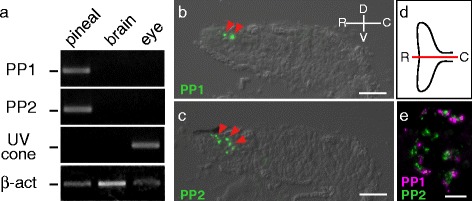
Here, we investigated the diversification of the pineal photopigment parapinopsin, which serves as the UV-sensitive photopigment for the pineal wavelength discrimination in the lamprey, linking it with other pineal photoreception. Spectroscopic analyses of the recombinant pigments of the two teleost parapinopsins PP1 and PP2 revealed that PP1 is a UV-sensitive pigment, similar to lamprey parapinopsin, but PP2 is a blue-sensitive pigment, with an absorption maximum at 460-480 nm, showing the diversification of non-visual pigment with respect to spectral sensitivity. We also found that PP1 and PP2 exhibit mutually exclusive expressions in the pineal organs of three teleost species. By using transgenic zebrafish in which these parapinopsin-expressing cells are labeled, we found that PP1-expressing cells basically possess neuronal processes, which is consistent with their involvement in wavelength discrimination. Interestingly, however, PP2-expressing cells rarely possess neuronal processes, raising the possibility that PP2 could be involved in non-neural responses rather than neural responses. Furthermore, we found that PP2-expressing cells contain serotonin and aanat2, the key enzyme involved in melatonin synthesis from serotonin, whereas PP1-expressing cells do not contain either, suggesting that blue-sensitive PP2 is instead involved in light-regulation of melatonin secretion.
In this paper, we have clearly shown the different molecular properties of duplicated non-visual opsins by demonstrating the diversification of parapinopsin with respect to spectral sensitivity. Moreover, we have shown a plausible link between the diversification and its physiological impact by discovering a strong candidate for the underlying pigment in light-regulated melatonin secretion in zebrafish; the diversification could generate a new contribution of parapinopsin to pineal photoreception. Current findings could also provide an opportunity to understand the "color" preference of non-visual photoreception.
近期对各种动物的基因组计划发现,大多数动物中存在数量惊人的视蛋白基因,这些基因编码光感受器分子的蛋白质部分。在视觉系统中,这种多样化的生物学意义很明确;多种具有不同光谱敏感性的视觉视蛋白负责颜色视觉。然而,尽管理解各种非视觉光感受的分子机制和进化很重要,但非视觉视蛋白多样化的意义仍不确定。
在此,我们研究了松果体光色素副视蛋白的多样化,它作为七鳃鳗松果体波长辨别中的紫外线敏感光色素,并将其与其他松果体光感受联系起来。对两种硬骨鱼副视蛋白PP1和PP2的重组色素进行光谱分析发现,PP1是一种紫外线敏感色素,类似于七鳃鳗副视蛋白,但PP2是一种蓝光敏感色素,最大吸收峰在460 - 480纳米,显示出非视觉色素在光谱敏感性方面的多样化。我们还发现PP1和PP2在三种硬骨鱼的松果体器官中相互排斥表达。通过使用标记了这些表达副视蛋白细胞的转基因斑马鱼,我们发现表达PP1的细胞基本具有神经突起,这与其参与波长辨别一致。然而,有趣的是,表达PP2的细胞很少有神经突起,这增加了PP2可能参与非神经反应而非神经反应的可能性。此外,我们发现表达PP2的细胞含有血清素和aanat2,aanat2是血清素合成褪黑素的关键酶,而表达PP1的细胞则不含有这两者,这表明蓝光敏感的PP2反而参与了褪黑素分泌的光调节。
在本文中,我们通过展示副视蛋白在光谱敏感性方面的多样化,清楚地表明了重复的非视觉视蛋白的不同分子特性。此外,我们通过发现斑马鱼中光调节褪黑素分泌潜在色素的有力候选者,展示了这种多样化与其生理影响之间看似合理的联系;这种多样化可能为副视蛋白对松果体光感受带来新的贡献。目前的发现也可能为理解非视觉光感受的“颜色”偏好提供契机。