Gomes Isabele B S, Porto Marcella L, Santos Maria C L F S, Campagnaro Bianca P, Gava Agata L, Meyrelles Silvana S, Pereira Thiago M C, Vasquez Elisardo C
Laboratory of Translational Physiology, Health Sciences Center, Federal University of Espirito Santo Vitoria, Brazil.
Pharmaceutical Sciences Graduate Program, Vila Velha University Vila Velha, Brazil.
Front Physiol. 2015 Sep 2;6:247. doi: 10.3389/fphys.2015.00247. eCollection 2015.
Diabetic nephropathy (DN) is one of the most important causes of chronic renal disease, and the incidence of DN is increasing worldwide. Considering our previous report (Gomes et al., 2014) indicating that chronic treatment with oral low-dose quercetin (10 mg/Kg) demonstrated anti-oxidative, anti-apoptotic and renoprotective effects in the C57BL/6J model of DN, we investigated whether this flavonoid could also have beneficial effects in concurrent DN and spontaneous atherosclerosis using the apolipoprotein E-deficient mouse (apoE(-/-)).
Streptozotocin was used to induce diabetes (100 mg/kg/day, 3 days) in male apoE(-/-) mice (8 week-old). After 6 weeks, the mice were randomly separated into DQ: diabetic apoE(-/-) mice treated with quercetin (10 mg/kg/day, 4 weeks, n = 8), DV: diabetic ApoE(-/-) mice treated with vehicle (n = 8) and ND: non-treated non-diabetic mice (n = 8).
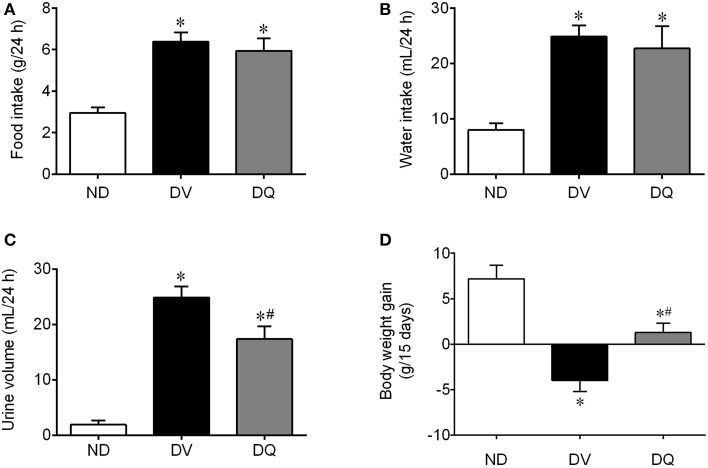
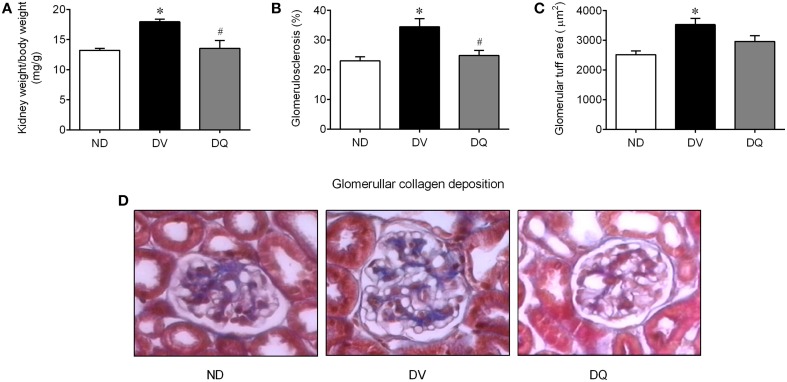
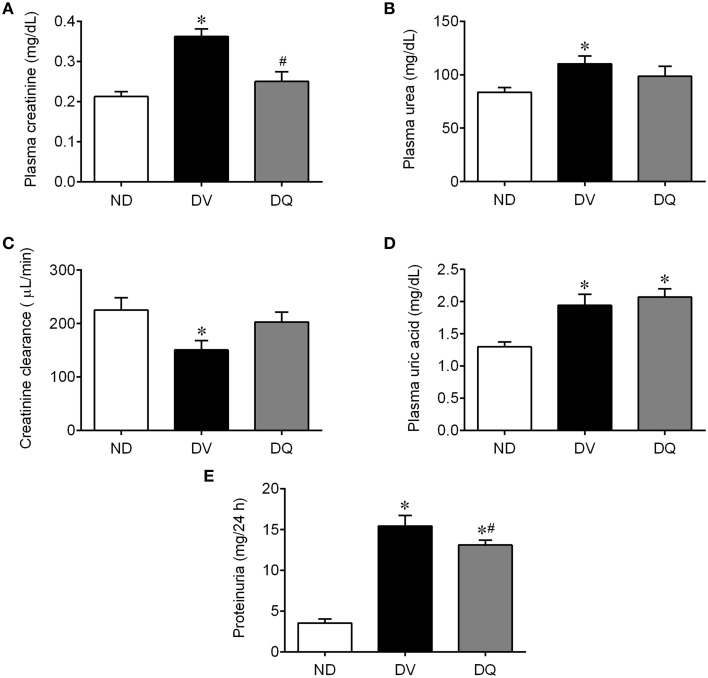
Quercetin treatment diminished polyuria (30%; p < 0.05), glycemia (25%, p < 0.05), normalized the hypertriglyceridemia. Moreover, this bioflavonoid diminished creatininemia (~30%, p < 0.01) and reduced proteinuria but not to normal levels. We also observed protective effects on the renal structural changes, including normalization of the index of glomerulosclerosis and kidney weight/body weight.
Our data revealed that quercetin treatment significantly reduced DN in hypercholesterolemic mice by inducing biochemical changes (decrease in glucose and triglycerides serum levels) and reduction of glomerulosclerosis. Thus, this study highlights the relevance of quercetin as an alternative therapeutic option for DN, including in diabetes associated with dyslipidemia.
糖尿病肾病(DN)是慢性肾脏疾病最重要的病因之一,且在全球范围内其发病率呈上升趋势。鉴于我们之前的报告(戈麦斯等人,2014年)表明,口服低剂量槲皮素(10毫克/千克)长期治疗在C57BL/6J糖尿病肾病模型中显示出抗氧化、抗凋亡和肾脏保护作用,我们研究了这种类黄酮在载脂蛋白E缺陷小鼠(apoE(-/-))并发糖尿病肾病和自发性动脉粥样硬化中是否也具有有益作用。
用链脲佐菌素诱导雄性apoE(-/-)小鼠(8周龄)患糖尿病(100毫克/千克/天,共3天)。6周后,将小鼠随机分为三组:DQ组:用槲皮素治疗的糖尿病apoE(-/-)小鼠(10毫克/千克/天,共4周,n = 8);DV组:用赋形剂治疗的糖尿病apoE(-/-)小鼠(n = 8);ND组:未治疗的非糖尿病小鼠(n = 8)。
槲皮素治疗减少了多尿(约30%;p < 0.05)、血糖(约25%,p < 0.05),使高甘油三酯血症恢复正常。此外,这种生物类黄酮降低了肌酐血症(约30%,p < 0.01)并减少了蛋白尿,但未降至正常水平。我们还观察到对肾脏结构变化的保护作用,包括肾小球硬化指数和肾脏重量/体重的正常化。
我们的数据显示,槲皮素治疗通过诱导生化变化(降低血糖和甘油三酯血清水平)和减少肾小球硬化,显著减轻了高胆固醇血症小鼠的糖尿病肾病。因此,本研究强调了槲皮素作为糖尿病肾病替代治疗选择的相关性,包括在伴有血脂异常的糖尿病中。