Ruiter Matthijs S, van Tiel Claudia M, Doornbos Albert, Marinković Goran, Strang Aart C, Attevelt Nico J M, de Waard Vivian, de Winter Robbert J, Steendam Rob, de Vries Carlie J M
Department of Medical Biochemistry, Academic Medical Center, University of Amsterdam, Amsterdam, The Netherlands.
InnoCore Pharmaceuticals, Groningen, The Netherlands.
PLoS One. 2015 Sep 21;10(9):e0138459. doi: 10.1371/journal.pone.0138459. eCollection 2015.
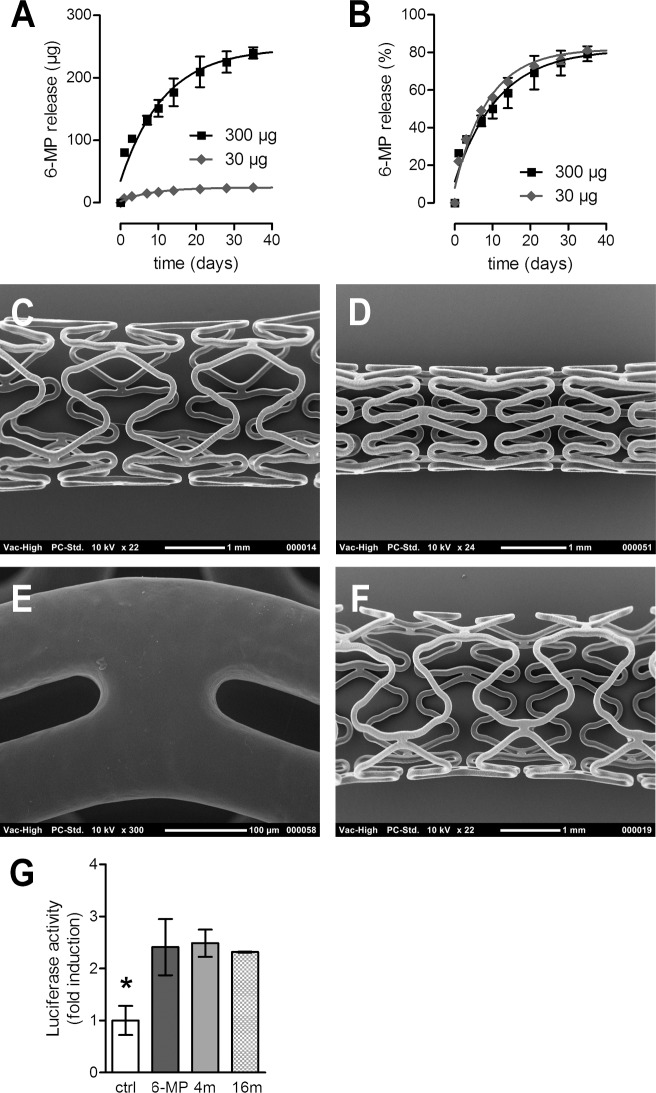
The introduction of drug-eluting stents (DES) has dramatically reduced restenosis rates compared with bare metal stents, but in-stent thrombosis remains a safety concern, necessitating prolonged dual anti-platelet therapy. The drug 6-Mercaptopurine (6-MP) has been shown to have beneficial effects in a cell-specific fashion on smooth muscle cells (SMC), endothelial cells and macrophages. We generated and analyzed a novel bioresorbable polymer coated DES, releasing 6-MP into the vessel wall, to reduce restenosis by inhibiting SMC proliferation and decreasing inflammation, without negatively affecting endothelialization of the stent surface.
Stents spray-coated with a bioresorbable polymer containing 0, 30 or 300 μg 6-MP were implanted in the iliac arteries of 17 male New Zealand White rabbits. Animals were euthanized for stent harvest 1 week after implantation for evaluation of cellular stent coverage and after 4 weeks for morphometric analyses of the lesions.
Four weeks after implantation, the high dose of 6-MP attenuated restenosis with 16% compared to controls. Reduced neointima formation could at least partly be explained by an almost 2-fold induction of the cell cycle inhibiting kinase p27Kip1. Additionally, inflammation score, the quantification of RAM11-positive cells in the vessel wall, was significantly reduced in the high dose group with 23% compared to the control group. Evaluation with scanning electron microscopy showed 6-MP did not inhibit strut coverage 1 week after implantation.
We demonstrate that novel stents coated with a bioresorbable polymer coating eluting 6-MP inhibit restenosis and attenuate inflammation, while stimulating endothelial coverage. The 6-MP-eluting stents demonstrate that inhibition of restenosis without leaving uncovered metal is feasible, bringing stents without risk of late thrombosis one step closer to the patient.
与裸金属支架相比,药物洗脱支架(DES)的引入显著降低了再狭窄率,但支架内血栓形成仍然是一个安全问题,需要延长双联抗血小板治疗。药物6-巯基嘌呤(6-MP)已被证明以细胞特异性方式对平滑肌细胞(SMC)、内皮细胞和巨噬细胞具有有益作用。我们制备并分析了一种新型可生物降解聚合物涂层的DES,其可将6-MP释放到血管壁中,通过抑制SMC增殖和减轻炎症来降低再狭窄,同时不会对支架表面的内皮化产生负面影响。
将喷涂有含0、30或300μg 6-MP的可生物降解聚合物的支架植入17只雄性新西兰白兔的髂动脉中。植入后1周对动物实施安乐死以取出支架,用于评估细胞对支架的覆盖情况;植入后4周进行病变的形态计量分析。
植入后4周,与对照组相比,高剂量的6-MP使再狭窄减轻了16%。内膜增生减少至少部分可由细胞周期抑制激酶p27Kip1几乎2倍的诱导来解释。此外,高剂量组血管壁中RAM11阳性细胞的定量炎症评分与对照组相比显著降低了23%。扫描电子显微镜评估显示,植入后1周6-MP并未抑制支架小梁的覆盖。
我们证明,涂有可生物降解聚合物涂层并洗脱6-MP的新型支架可抑制再狭窄并减轻炎症,同时促进内皮覆盖。洗脱6-MP的支架表明,在不留下未覆盖金属的情况下抑制再狭窄是可行的,使无晚期血栓形成风险的支架向临床应用又迈进了一步。