
一种经过修饰以表达成纤维细胞活化蛋白的全细胞肿瘤疫苗可诱导针对肿瘤细胞和癌症相关成纤维细胞的抗肿瘤免疫。
A whole-cell tumor vaccine modified to express fibroblast activation protein induces antitumor immunity against both tumor cells and cancer-associated fibroblasts.
作者信息
Chen Meihua, Xiang Rong, Wen Yuan, Xu Guangchao, Wang Chunting, Luo Shuntao, Yin Tao, Wei Xiawei, Shao Bin, Liu Ning, Guo Fuchun, Li Meng, Zhang Shuang, Li Minmin, Ren Kexing, Wang Yongsheng, Wei Yuquan
机构信息
State Key Laboratory of Biotherapy and Cancer Center, West China Hospital, West China Medical School, Sichuan University, Chengdu, China.
Department of Immunology, College of Medicine, Key Laboratory of Bioactive Materials, Ministry of Education, Nankai University, Tianjin, China.
出版信息
Sci Rep. 2015 Sep 23;5:14421. doi: 10.1038/srep14421.
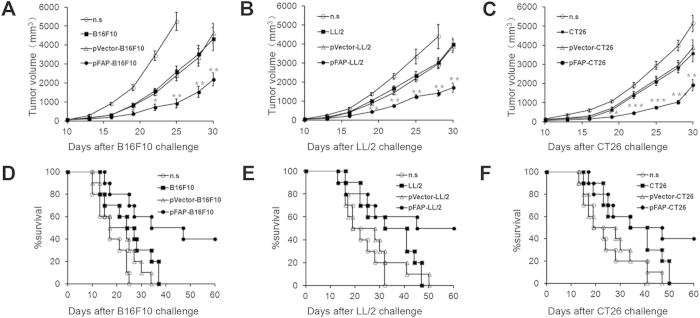
Cancer-associated fibroblasts (CAFs) are common components of the tumor-suppressive microenvironment, and are a major determinant of the poor outcome of therapeutic vaccination. In this study, we modified tumor cells to express the fibroblast activation protein (FAP), which is highly expressed by CAFs, to potentially improve whole-cell tumor vaccines by targeting both tumor cells and CAFs. Tumor cells were transfected with murine FAP plasmids bearing the cationic lipid DOTAP. Its antitumor effects were investigated in three established tumor models. Vaccination with tumor cells expressing FAP eliminated solid tumors and tumors resulting from hematogenous dissemination. This antitumor immune response was mediated by CD8+ T cells. Additionally, we found that CAFs were significantly reduced within the tumors. Furthermore, this vaccine enhanced the infiltration of CD8+ T lymphocytes, and suppressed the accumulation of immunosuppressive cells in the tumor microenvironment. Our results indicated that the FAP-modified whole-cell tumor vaccine induced strong antitumor immunity against both tumor cells and CAFs and reversed the immunosuppressive effects of tumors by decreasing the recruitment of immunosuppressive cells and enhancing the recruitment of effector T cells. This conclusion may have important implications for the clinical use of genetically modified tumor cells as cancer vaccines.
癌症相关成纤维细胞(CAFs)是肿瘤抑制性微环境的常见组成部分,也是治疗性疫苗接种效果不佳的主要决定因素。在本研究中,我们对肿瘤细胞进行修饰,使其表达CAFs中高表达的成纤维细胞活化蛋白(FAP),以期通过靶向肿瘤细胞和CAFs来改进全细胞肿瘤疫苗。用携带阳离子脂质DOTAP的鼠源FAP质粒转染肿瘤细胞。在三种已建立的肿瘤模型中研究其抗肿瘤作用。接种表达FAP的肿瘤细胞可消除实体瘤以及血行播散产生的肿瘤。这种抗肿瘤免疫反应由CD8 + T细胞介导。此外,我们发现肿瘤内的CAFs显著减少。此外,这种疫苗增强了CD8 + T淋巴细胞的浸润,并抑制了肿瘤微环境中免疫抑制细胞的积聚。我们的结果表明,FAP修饰的全细胞肿瘤疫苗诱导了针对肿瘤细胞和CAFs的强大抗肿瘤免疫力,并通过减少免疫抑制细胞的募集和增强效应T细胞的募集来逆转肿瘤的免疫抑制作用。这一结论可能对基因修饰肿瘤细胞作为癌症疫苗的临床应用具有重要意义。


 Zotero 插件