Haruta Izumi, Fuku Yuki, Kinoshita Kazuhisa, Yoneda Koichi, Morinaga Akinori, Amitani Marie, Amitani Haruka, Asakawa Akihiro, Sugawara Hideki, Takeda Yasuo, Bowers Cyril Y, Inui Akio
Department of Psychosomatic Internal Medicine, Graduate School of Medical and Dental Sciences, Kagoshima University and Kagoshima University Hospital Kagoshima, 890-8520, Japan.
Department of Clinical Pharmacy and Pharmacology, Graduate School of Medical and Dental Sciences, Kagoshima University Kagoshima, 890-8520, Japan.
J Cachexia Sarcopenia Muscle. 2015 Sep;6(3):237-41. doi: 10.1002/jcsm.12028. Epub 2015 Apr 27.
In Japan, growth hormone releasing peptide-2 (GHRP-2) is clinically used as a diagnostic agent for growth hormone secretion deficiency, but the therapeutic application of GHRP-2 has not been studied in anorexia nervosa. GHRP-2 reportedly exhibits agonistic action for ghrelin receptor and increases food intake.
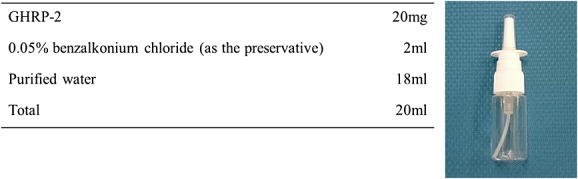
We administered GHRP-2 to a patient with a 20-year history of anorexia nervosa to determine whether GHRP-2 treatment increases food intake and body weight. GHRP-2 was administered before every meal by an intranasal approach for 1 year.
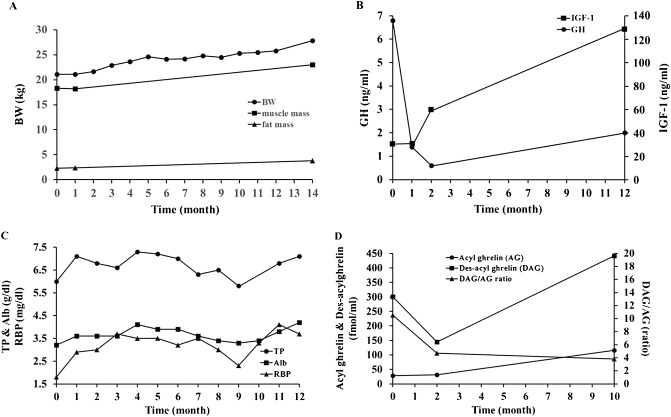
Although the patient reported a decreased fear of eating and decreased desire to be thin by our previous treatment, she was unable to increase food intake or body weight because of digestive tract dysfunction. Vomiting after meals caused by delayed gastric emptying and incurable constipation were prolonged, and sub-ileus and hypoglycemia were observed. GHRP-2 increased the feeling of hunger and food intake, decreased early satiety and improved hypoglycemia. The patient's body weight gradually increased by 6.7 kg (from 21.1 kg to 27.8 kg) in 14 months after starting GHRP-2 administration. The fatigability and muscle strength improved, and the physical and mental activities were also increased. No obvious side effects were observed after long-term intranasal administration of GHRP-2.
Patients with a long-term history of eating disorder occasionally recover from the psychological problems such as fear for obesity but remain emaciated. We believe that ghrelin agonists such as GHRP-2 may be promising agents for the effective treatments of severe anorexia nervosa in a chronic condition.
在日本,生长激素释放肽-2(GHRP-2)作为生长激素分泌不足的诊断剂被临床使用,但GHRP-2在神经性厌食症中的治疗应用尚未得到研究。据报道,GHRP-2对胃饥饿素受体具有激动作用,并能增加食物摄入量。
我们对一名有20年神经性厌食症病史的患者给予GHRP-2,以确定GHRP-2治疗是否能增加食物摄入量和体重。GHRP-2通过鼻内给药,在每餐饭前给药,持续1年。
尽管该患者通过我们之前的治疗报告称对进食的恐惧减少且变瘦的欲望降低,但由于消化道功能障碍,她无法增加食物摄入量或体重。胃排空延迟导致的饭后呕吐和无法治愈的便秘持续存在,并且观察到了肠梗阻和低血糖。GHRP-2增加了饥饿感和食物摄入量,减少了早饱感并改善了低血糖。在开始给予GHRP-2后的14个月内,患者体重逐渐增加了6.7千克(从21.1千克增至27.8千克)。疲劳感和肌肉力量得到改善,身心活动也有所增加。长期鼻内给予GHRP-2后未观察到明显的副作用。
患有长期饮食失调病史的患者偶尔会从诸如对肥胖的恐惧等心理问题中恢复,但仍会消瘦。我们认为,诸如GHRP-2之类的胃饥饿素激动剂可能是有效治疗慢性重度神经性厌食症的有前景的药物。