Song Jiho, Yoo Jakyung, Kwon Ara, Kim Doran, Nguyen Hong Khanh, Lee Bong-Yong, Suh Wonhee, Min Kyung Hoon
College of Pharmacy, Chung-Ang University, Seoul, Republic of Korea.
Life Science Research Institute, Daewoong Pharmaceutical Co., Ltd., Gyeonggi-Do, Republic of Korea.
PLoS One. 2015 Sep 24;10(9):e0138823. doi: 10.1371/journal.pone.0138823. eCollection 2015.
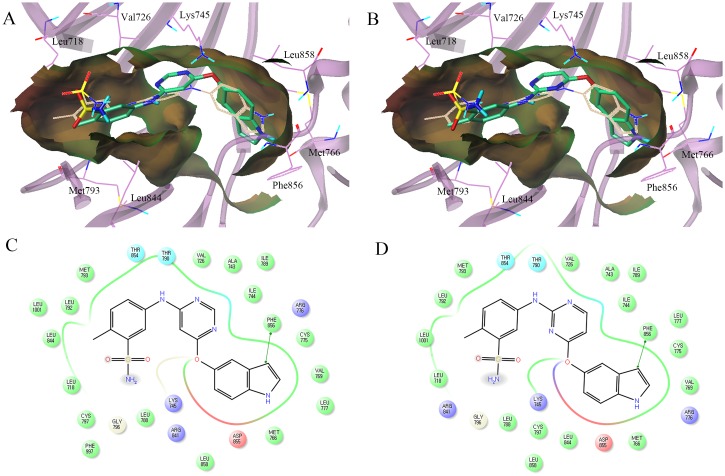
Antiangiogenic agents have been widely investigated in combination with standard chemotherapy or targeted cancer agents for better management of advanced cancers. Therapeutic agents that concurrently inhibit epidermal growth factor receptor and other angiokinases could be useful alternatives to combination therapies for epidermal growth factor receptor-dependent cancers. Here, we report the synthesis of an indole derivative of pazopanib using a bioisosteric replacement strategy, which was designated MKP101. MKP101 inhibited not only the epidermal growth factor receptor with an IC50 value of 43 nM but also inhibited angiokinases as potently as pazopanib. In addition, MKP101 effectively inhibited vascular endothelial growth factor-induced endothelial proliferation, tube formation, migration of human umbilical vein endothelial cells and proliferation of HCC827, an epidermal growth factor receptor-addicted cancer cell line. A docking model of MKP101 and the kinase domain of the epidermal growth factor receptor was generated to predict its binding mode, and validated by synthesizing and evaluating MKP101 derivatives. Additionally, a study of structure-activity relationships of indolylamino or indolyloxy pyrimidine analogues derived from MKP101 demonstrated that selectivity for epidermal growth factor receptor and other angiokinases, especially vascular endothelial growth factor receptor 2 depends on the position of substituents on pyrimidine and the type of link between pyrimidine and the indole moiety. We believe that this study could provide a basis for developing angiokinase inhibitors having high affinity for the epidermal growth factor receptor, from the pyrimidine scaffold.
抗血管生成剂已与标准化疗或靶向抗癌药物联合进行了广泛研究,以更好地治疗晚期癌症。同时抑制表皮生长因子受体和其他血管激酶的治疗药物可能是治疗依赖表皮生长因子受体的癌症联合疗法的有用替代方案。在此,我们报告了使用生物电子等排体替代策略合成的帕唑帕尼吲哚衍生物,命名为MKP101。MKP101不仅以43 nM的IC50值抑制表皮生长因子受体,还与帕唑帕尼一样有效地抑制血管激酶。此外,MKP101有效抑制血管内皮生长因子诱导的人脐静脉内皮细胞增殖、管腔形成、迁移以及表皮生长因子受体依赖的癌细胞系HCC827的增殖。生成了MKP101与表皮生长因子受体激酶结构域的对接模型以预测其结合模式,并通过合成和评估MKP101衍生物进行了验证。此外,对源自MKP101的吲哚基氨基或吲哚氧基嘧啶类似物的构效关系研究表明,对表皮生长因子受体和其他血管激酶,尤其是血管内皮生长因子受体2的选择性取决于嘧啶上取代基的位置以及嘧啶与吲哚部分之间的连接类型。我们相信这项研究可为从嘧啶支架开发对表皮生长因子受体具有高亲和力的血管激酶抑制剂提供依据。