Tusiime Suzan, Musinguzi Geofrey, Tinkitina Benjamin, Mwebaza Norah, Kisa Rose, Anguzu Ronald, Kiwanuka Noah
School of Public Health Makerere University College of Health Sciences, P.O BOX 7072, Kampala, Uganda.
School of Biomedical Sciences Makerere University College of Health Sciences, P.O BOX 7072, Kampala, Uganda.
BMC Womens Health. 2015 Sep 24;15:79. doi: 10.1186/s12905-015-0235-9.
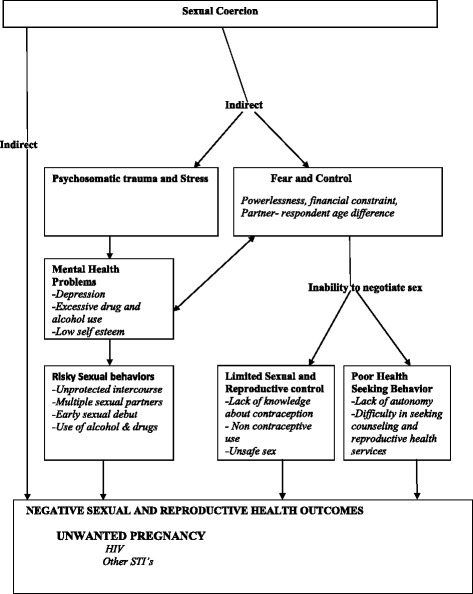
Sexual coercion is associated with sexually transmitted infections and unwanted pregnancies with consequential unsafe abortions and increased maternal morbidity and mortality. Current literature focuses mainly on its risk factors but less on its resultant deleterious health effects. We conducted a study to determine the prevalence of sexual coercion and its association with unwanted pregnancies among young pregnant women.
In a cross-sectional study, four hundred and sixteen (416) consenting pregnant females aged 15-24 years attending antenatal clinics in Lubaga division Kampala district in Uganda were enrolled using systematic sampling. Quantitative and qualitative data on sexual coercion were collected by female interviewers. Adjusted Prevalence Proportion Ratios (Adj. PPRs) of unwanted pregnancy and associated 95 % confidence intervals were estimated by generalized linear models with log link function and Poisson family distribution using robust variance estimator. Quantitative data were analyzed using Stata version 10.0, while qualitative data were analyzed using manifest content analysis.
Prevalence of sexual coercion was 24 % and was higher among those who had non consensual sexual debut (29.0 %) compared with those who had consensual sexual debut (22.6 %). The prevalence of unwanted pregnancy was 18.3 % and was higher among participants who had been sexually coerced relative to their counterparts (p < 0.001). History of sexual coercion in the past 12 months and non consensual sexual debut were associated with unwanted pregnancy [adj.PPR = 2.23, 95 % CI: (1.49-3.32)] and 1.72, 95 % CI: (1.16- 2.54)] respectively. Qualitative results indicated that different forms/contexts of sexual coercion, such as deception, transactional sex and physical force influenced unwanted pregnancies.
This study highlights that a quarter of our participants in our quantitative study had experienced sexual coercion in the past twelve months and nearly a third of these, had history of non consensual sexual debut. Unwanted pregnancy was higher among the sexually coerced and those who had non consensual sexual debut.
Sexual coercion among pregnant women aged 15-24 years in Kampala, Uganda is high and is significantly associated with unwanted pregnancy. Comprehensive sex education targeting young people (<25 years), along with availability and access to youth friendly centers may be useful in addressing sexual coercion and its negative outcomes.
性胁迫与性传播感染以及意外怀孕相关,随之而来的是不安全堕胎以及孕产妇发病率和死亡率的增加。当前文献主要关注其风险因素,而较少关注其对健康造成的有害影响。我们开展了一项研究,以确定年轻孕妇中性胁迫的患病率及其与意外怀孕的关联。
在一项横断面研究中,采用系统抽样方法,纳入了乌干达坎帕拉区卢巴加分区产前诊所的416名年龄在15至24岁之间且同意参与研究的怀孕女性。关于性胁迫的定量和定性数据由女性访谈员收集。使用具有对数链接函数和泊松族分布的广义线性模型,并采用稳健方差估计器,估计意外怀孕的调整患病率比例比(Adj. PPRs)及其相关的95%置信区间。定量数据使用Stata 10.0版本进行分析,而定性数据则采用显性内容分析法进行分析。
性胁迫的患病率为24%,其中非自愿首次性行为者(29.0%)的患病率高于自愿首次性行为者(22.6%)。意外怀孕的患病率为18.3%,遭受性胁迫的参与者的患病率高于未遭受性胁迫的参与者(p < 0.001)。过去12个月内的性胁迫史和非自愿首次性行为分别与意外怀孕相关[调整PPR = 2.23,95%置信区间:(1.49 - 3.32)]和[调整PPR = 1.72,95%置信区间:(1.16 - 2.54)]。定性结果表明,性胁迫的不同形式/情境,如欺骗、交易性行为和身体暴力,都会影响意外怀孕。
本研究强调,在我们的定量研究中,四分之一的参与者在过去十二个月内经历过性胁迫,其中近三分之一有非自愿首次性行为史。遭受性胁迫者和非自愿首次性行为者的意外怀孕率更高。
乌干达坎帕拉15至24岁孕妇中的性胁迫发生率较高,且与意外怀孕显著相关。针对年轻人(<25岁)开展全面的性教育,同时提供并方便其使用青年友好型中心,可能有助于解决性胁迫及其负面后果。