Guy Franck, Lazzari Vincent, Gilissen Emmanuel, Thiery Ghislain
CNRS INEE UMR 7262 - IPHEP, Institut de Paléoprimatologie et Paléontologie Humaine, Evolution et Paléoenvironnements. Université de Poitiers - Faculté des Sciences, Bât. B35 -TSA 51106, 6 rue Michel Brunet, 86073, Poitiers, Cedex 9, France.
Department of African Zoology, Royal Museum of Central Africa, B-3080, Tervuren, Belgium; Laboratory of Histology and Neuropathology, Université Libre de Bruxelles, B-1070, Brussels, Belgium.
PLoS One. 2015 Sep 25;10(9):e0138802. doi: 10.1371/journal.pone.0138802. eCollection 2015.
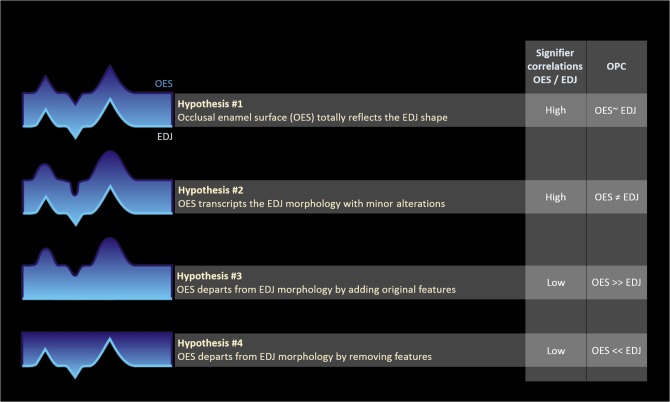
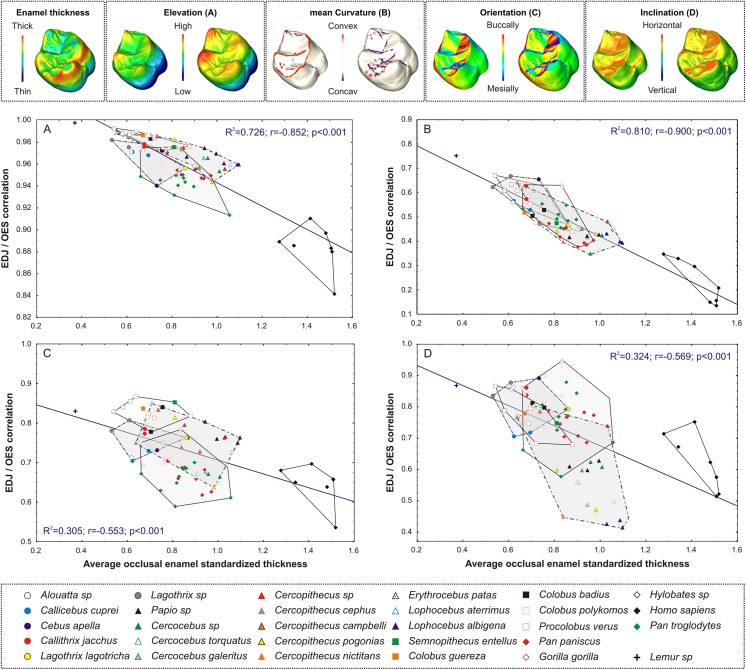
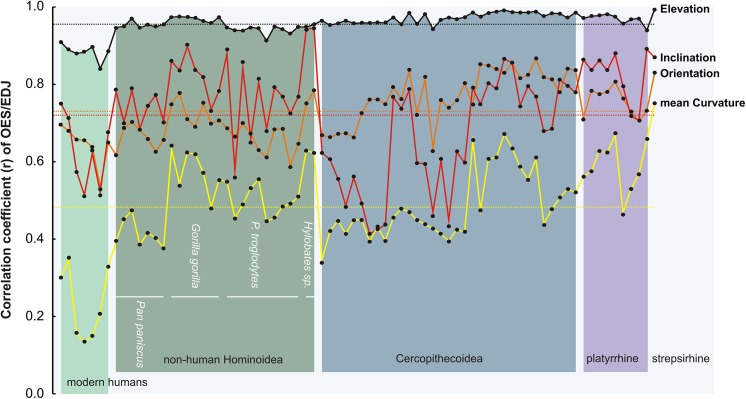
The form of two hard tissues of the mammalian tooth, dentine and enamel, is the result of a combination of the phylogenetic inheritance of dental traits and the adaptive selection of these traits during evolution. Recent decades have been significant in unveiling developmental processes controlling tooth morphogenesis, dental variation and the origination of dental novelties. The enamel-dentine junction constitutes a precursor for the morphology of the outer enamel surface through growth of the enamel cap which may go along with the addition of original features. The relative contribution of these two tooth components to morphological variation and their respective response to natural selection is a major issue in paleoanthropology. This study will determine how much enamel morphology relies on the form of the enamel-dentine junction. The outer occlusal enamel surface and the enamel-dentine junction surface of 76 primate second upper molars are represented by polygonal meshes and investigated using tridimensional topometrical analysis. Quantitative criteria (elevation, inclination, orientation, curvature and occlusal patch count) are introduced to show that the enamel-dentine junction significantly constrains the topographical properties of the outer enamel surface. Our results show a significant correlation for elevation, orientation, inclination, curvature and occlusal complexity between the outer enamel surface and the enamel dentine junction for all studied primate taxa with the exception of four modern humans for curvature (p<0.05). Moreover, we show that, for all selected topometrical parameters apart from occlusal patch count, the recorded correlations significantly decrease along with enamel thickening in our sample. While preserving tooth integrity by providing resistance to wear and fractures, the variation of enamel thickness may modify the curvature present at the occlusal enamel surface in relation to enamel-dentine junction, potentially modifying dental functionalities such as blunt versus sharp dental tools. In terms of natural selection, there is a balance between increasing tooth resistance and maintaining efficient dental tools. In this sense the enamel cap acts as a functional buffer for the molar occlusal pattern. In primates, results suggest a primary emergence of dental novelties on the enamel-dentine junction and a secondary transposition of these novelties with no or minor modifications of dental functionalities by the enamel cap. Whereas enamel crenations have been reported by previous studies, our analysis do not support the presence of enamel tubercles without dentine relief nuclei. As is, the enamel cap is, at most, a secondary source of morphological novelty.
哺乳动物牙齿的两种硬组织——牙本质和牙釉质的形态,是牙齿性状的系统发育遗传与这些性状在进化过程中的适应性选择共同作用的结果。近几十年来,在揭示控制牙齿形态发生、牙齿变异和牙齿新特征起源的发育过程方面取得了重大进展。釉质-牙本质界通过釉帽的生长构成了外釉质表面形态的前身,这一过程可能伴随着原始特征的增加。这两种牙齿成分对形态变异的相对贡献以及它们对自然选择的各自反应,是古人类学中的一个主要问题。本研究将确定釉质形态在多大程度上依赖于釉质-牙本质界的形态。用多边形网格表示76颗灵长类动物上颌第二磨牙的外咬合釉质表面和釉质-牙本质界表面,并使用三维拓扑测量分析进行研究。引入定量标准(高度、倾斜度、方向、曲率和咬合面片计数)以表明釉质-牙本质界显著限制了外釉质表面的地形特性。我们的结果表明,除了四名现代人类的曲率外(p<0.05),所有研究的灵长类分类群的外釉质表面与釉质-牙本质界之间在高度、方向、倾斜度、曲率和咬合复杂性方面存在显著相关性。此外,我们表明,对于除咬合面片计数之外的所有选定拓扑参数,在我们的样本中,记录的相关性随着釉质增厚而显著降低。在通过提供抗磨损和抗骨折能力来保持牙齿完整性的同时,釉质厚度的变化可能会改变咬合釉质表面相对于釉质-牙本质界的曲率,从而可能改变牙齿功能,如钝齿与锐齿工具。在自然选择方面,在增加牙齿抗性和保持高效牙齿工具之间存在平衡。从这个意义上说,釉帽充当了磨牙咬合模式的功能缓冲器。在灵长类动物中,结果表明牙齿新特征首先出现在釉质-牙本质界,然后这些新特征进行二次转移,而釉帽对牙齿功能没有或只有轻微改变。虽然先前的研究报告了釉质褶皱,但我们的分析不支持没有牙本质 relief 核的釉质结节的存在。实际上,釉帽最多只是形态新奇性的次要来源。