Reeve Sarah, Sheaves Bryony, Freeman Daniel
Department of Psychiatry, University of Oxford, UK.
Department of Psychiatry, University of Oxford, UK.
Clin Psychol Rev. 2015 Dec;42:96-115. doi: 10.1016/j.cpr.2015.09.001. Epub 2015 Sep 9.
Sleep dysfunction is extremely common in patients with schizophrenia. Recent research indicates that sleep dysfunction may contribute to psychotic experiences such as delusions and hallucinations.
The review aims to evaluate the evidence for a relationship between sleep dysfunction and individual psychotic experiences, make links between the theoretical understanding of each, and highlight areas for future research.
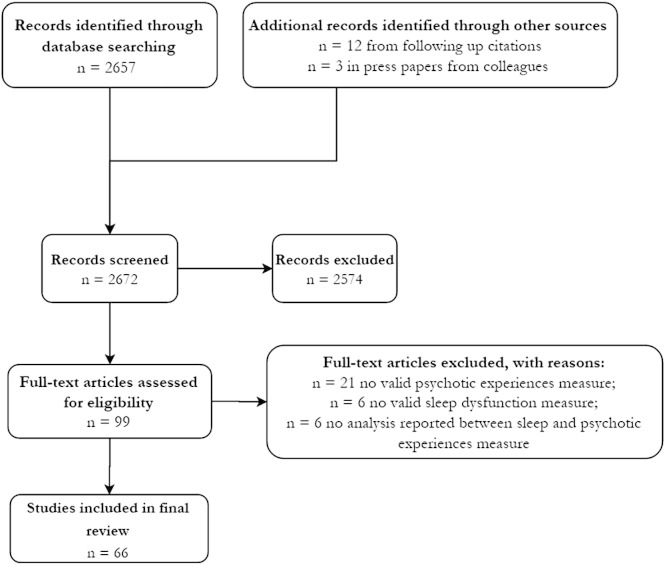
A systematic search was conducted to identify studies investigating sleep and psychotic experiences across clinical and non-clinical populations.
66 papers were identified. This literature robustly supports the co-occurrence of sleep dysfunction and psychotic experiences, particularly insomnia with paranoia. Sleep dysfunction predicting subsequent psychotic experiences receives support from epidemiological surveys, research on the transition to psychosis, and relapse studies. There is also evidence that reducing sleep elicits psychotic experiences in non-clinical individuals, and that improving sleep in individuals with psychosis may lessen psychotic experiences. Anxiety and depression consistently arise as (partial) mediators of the sleep and psychosis relationship.
Studies are needed that: determine the types of sleep dysfunction linked to individual psychotic experiences; establish a causal connection between sleep and psychotic experiences; and assess treatments for sleep dysfunction in patients with non-affective psychotic disorders such as schizophrenia.
睡眠功能障碍在精神分裂症患者中极为常见。近期研究表明,睡眠功能障碍可能导致妄想和幻觉等精神病性体验。
本综述旨在评估睡眠功能障碍与个体精神病性体验之间关系的证据,建立对二者的理论理解之间的联系,并突出未来研究的领域。
进行系统检索以识别调查临床和非临床人群中睡眠与精神病性体验的研究。
共识别出66篇论文。该文献有力地支持了睡眠功能障碍与精神病性体验的同时出现,尤其是失眠与妄想。睡眠功能障碍预测后续精神病性体验得到了流行病学调查、向精神病转变的研究以及复发研究的支持。也有证据表明,减少非临床个体的睡眠会引发精神病性体验,而改善精神病患者的睡眠可能会减轻精神病性体验。焦虑和抑郁始终作为睡眠与精神病关系的(部分)中介因素出现。
需要开展以下研究:确定与个体精神病性体验相关的睡眠功能障碍类型;建立睡眠与精神病性体验之间的因果联系;评估针对精神分裂症等非情感性精神病患者睡眠功能障碍的治疗方法。