Yamazaki N, Kiyohara Y, Uhara H, Fukushima S, Uchi H, Shibagaki N, Tsutsumida A, Yoshikawa S, Okuyama R, Ito Y, Tokudome T
Department of Dermatologic Oncology, National Cancer Center Hospital, Tokyo, Japan.
Dermatology Division, Shizuoka Cancer Center, Shizuoka, Japan.
Cancer Chemother Pharmacol. 2015 Nov;76(5):997-1004. doi: 10.1007/s00280-015-2873-x. Epub 2015 Sep 26.
Ipilimumab is designed to block cytotoxic T-lymphocyte antigen-4 to augment antitumor T cell responses. In studies of predominantly Caucasian patients with advanced melanoma, ipilimumab was associated with durable response, long-term survival benefit, and a manageable safety profile. This phase II study assessed the safety of ipilimumab in Japanese patients with unresectable stage III or IV melanoma.
Patients received ipilimumab 3 mg/kg every 3 weeks for four doses. The database lock for the original analysis was in August 2014. Overall survival, progression-free survival, and data on deaths were based on an updated, follow-up analysis (database lock April 2015).
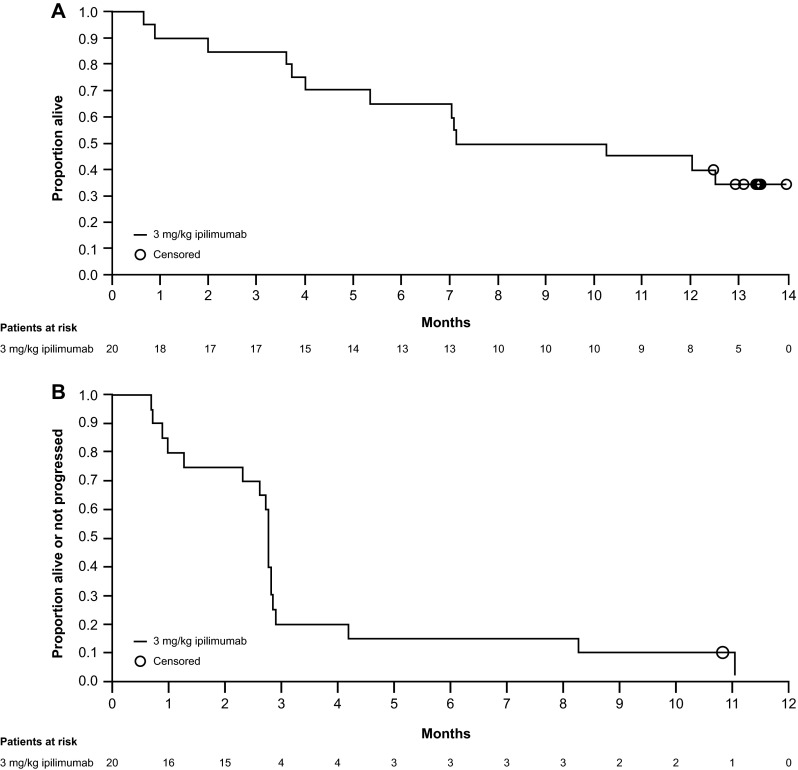
Data are reported from 20 patients. Fifteen patients (75 %) received all four doses of ipilimumab during induction. Twelve patients (60 %) had at least one drug-related adverse event (AE), and no patients discontinued due to a drug-related AE. There were no deaths related to study drug. The most common drug-related AEs were rash (n = 7), pyrexia (n = 3), increased aspartate aminotransferase (AST; n = 3), and increased alanine aminotransferase (ALT; n = 3). Twelve patients (60 %) reported immune-related AEs (irAEs); most frequent were skin (n = 9) and liver (n = 3) disorders. Grade 3 irAEs were ALT and AST elevation (n = 2) and diabetes mellitus (n = 1). Two patients had a partial response and two had stable disease, yielding a 20 % disease control rate. Median overall survival and progression-free survival were 8.71 and 2.74 months, respectively.
Ipilimumab 3 mg/kg had a manageable AE profile in this Japanese patient population with clinical outcomes similar to that in Caucasian patients. CLINICALTRIALS.
NCT01990859.
伊匹单抗旨在阻断细胞毒性T淋巴细胞相关抗原4,以增强抗肿瘤T细胞反应。在主要为白种人晚期黑色素瘤患者的研究中,伊匹单抗与持久反应、长期生存获益及可控的安全性相关。这项II期研究评估了伊匹单抗在日本不可切除的III期或IV期黑色素瘤患者中的安全性。
患者每3周接受一次3mg/kg的伊匹单抗,共4剂。原始分析的数据库锁定时间为2014年8月。总生存、无进展生存及死亡数据基于更新的随访分析(数据库锁定时间为2015年4月)。
报告了20例患者的数据。15例患者(75%)在诱导期接受了全部4剂伊匹单抗。12例患者(60%)发生至少1次药物相关不良事件(AE),且无患者因药物相关AE停药。无与研究药物相关的死亡。最常见的药物相关AE为皮疹(n = 7)、发热(n = 3)、天冬氨酸转氨酶(AST)升高(n = 3)及丙氨酸转氨酶(ALT)升高(n = 3)。12例患者(60%)报告了免疫相关AE(irAE);最常见的是皮肤(n = 9)和肝脏(n = 3)疾病。3级irAE为ALT和AST升高(n = 2)及糖尿病(n = )。2例患者部分缓解,2例病情稳定,疾病控制率为20%。总生存和无进展生存的中位数分别为8.71个月和2.74个月。
在该日本患者群体中,3mg/kg的伊匹单抗具有可控的AE谱,临床结果与白种人患者相似。临床试验。
NCT01990859