Okubo Takumi, Hayashi Daiki, Yaguchi Takayuki, Fujita Yudai, Sakaue Motoharu, Suzuki Takehito, Tsukamoto Atsushi, Murayama Ohoshi, Lynch Jonathan, Miyazaki Yoko, Tanaka Kazuaki, Takizawa Tatsuya
Graduate School of Veterinary Medicine, Azabu University, Fuchinobe, Chuo-ku, Sagamihara, Kanagawa 252-5201, Japan.
Exp Anim. 2016;65(1):45-51. doi: 10.1538/expanim.15-0038. Epub 2015 Sep 25.
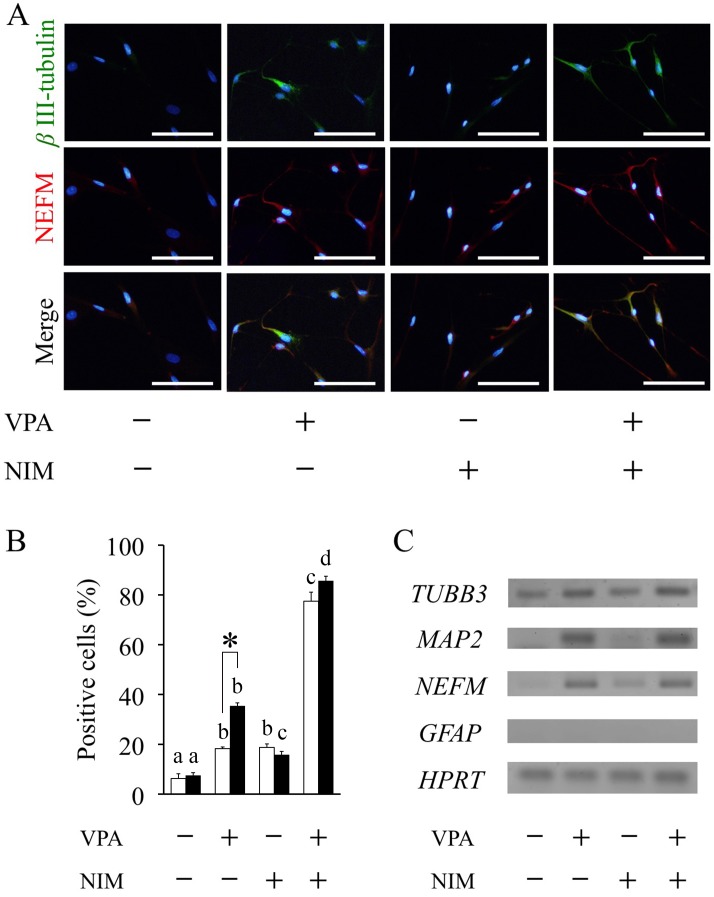
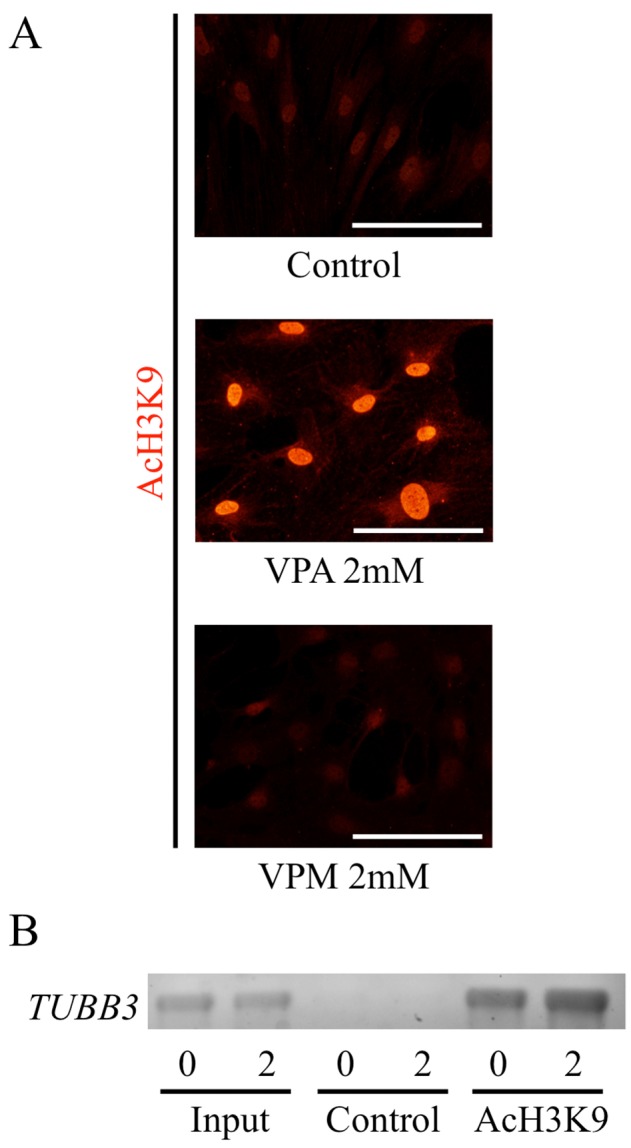
Valproic acid (VPA) is a widely used antiepileptic drug, which has recently been reported to modulate the neuronal differentiation of adipose tissue-derived stem cells (ASCs) in humans and dogs. However, controversy exists as to whether VPA really acts as an inducer of neuronal differentiation of ASCs. The present study aimed to elucidate the effect of VPA in neuronal differentiation of rat ASCs. One or three days of pretreatment with VPA (2 mM) followed by neuronal induction enhanced the ratio of immature neuron marker βIII-tubulin-positive cells in a time-dependent manner, where the majority of cells also had a positive signal for neurofilament medium polypeptide (NEFM), a mature neuron marker. RT-PCR analysis revealed increases in the mRNA expression of microtubule-associated protein 2 (MAP2) and NEFM mature neuron markers, even without neuronal induction. Three-days pretreatment of VPA increased acetylation of histone H3 of ASCs as revealed by immunofluorescence staining. Chromatin immunoprecipitation assay also showed that the status of histone acetylation at H3K9 correlated with the gene expression of TUBB3 in ASCs by VPA. These results indicate that VPA significantly promotes the differentiation of rat ASCs into neuron-like cells through acetylation of histone H3, which suggests that VPA may serve as a useful tool for producing transplantable cells for future applications in clinical treatments.
丙戊酸(VPA)是一种广泛使用的抗癫痫药物,最近有报道称其可调节人和犬脂肪组织来源干细胞(ASC)的神经元分化。然而,关于VPA是否真的作为ASC神经元分化的诱导剂存在争议。本研究旨在阐明VPA对大鼠ASC神经元分化的影响。用VPA(2 mM)预处理1天或3天,然后进行神经元诱导,以时间依赖性方式提高了未成熟神经元标志物βIII-微管蛋白阳性细胞的比例,其中大多数细胞对成熟神经元标志物神经丝中型多肽(NEFM)也有阳性信号。RT-PCR分析显示,即使没有神经元诱导,微管相关蛋白2(MAP2)和NEFM成熟神经元标志物的mRNA表达也增加。免疫荧光染色显示,VPA预处理3天可增加ASC组蛋白H3的乙酰化。染色质免疫沉淀分析还表明,VPA处理后,H3K9处的组蛋白乙酰化状态与ASC中TUBB3的基因表达相关。这些结果表明,VPA通过组蛋白H3的乙酰化显著促进大鼠ASC向神经元样细胞的分化,这表明VPA可能作为一种有用的工具,用于生产可移植细胞,以供未来临床治疗应用。