Wang Huiqing, Shao Ziqiang, Bacher Markus, Liebner Falk, Rosenau Thomas
Key Laboratory of Natural Polymeric Materials and Application Technology, Department of Materials Science and Engineering, Beijing Institute of Technology, Zhongguancun South Street 5, Beijing, 10081 People's Republic of China ; Division of Chemistry of Renewables, Department of Chemistry, University of Natural Resources and Life Sciences, Konrad-Lorenz-Straße 24, 3430 Tulln, Austria.
Key Laboratory of Natural Polymeric Materials and Application Technology, Department of Materials Science and Engineering, Beijing Institute of Technology, Zhongguancun South Street 5, Beijing, 10081 People's Republic of China.
Cellulose (Lond). 2013;20(6):3007-3024. doi: 10.1007/s10570-013-0035-z. Epub 2013 Sep 3.
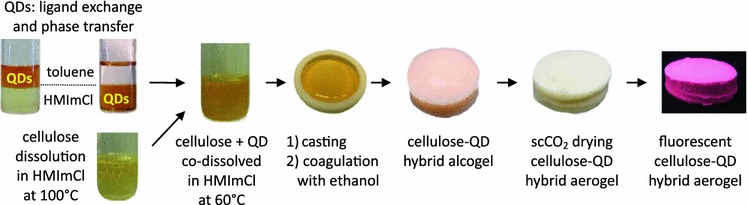
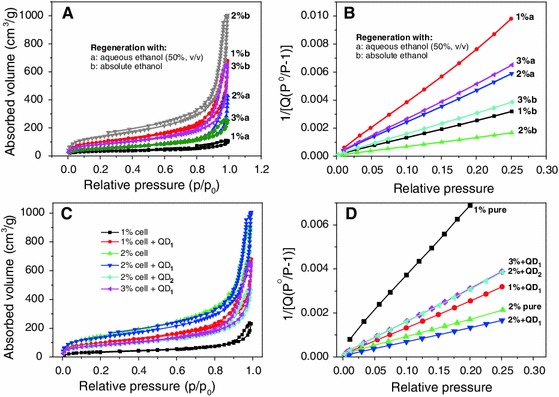
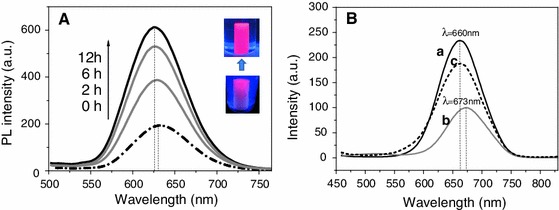
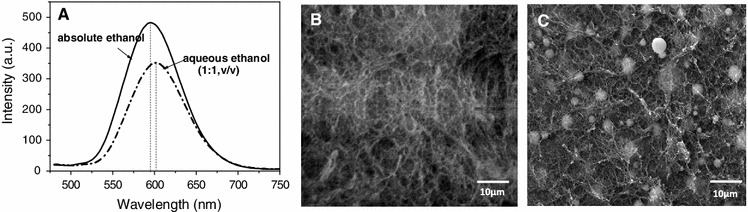
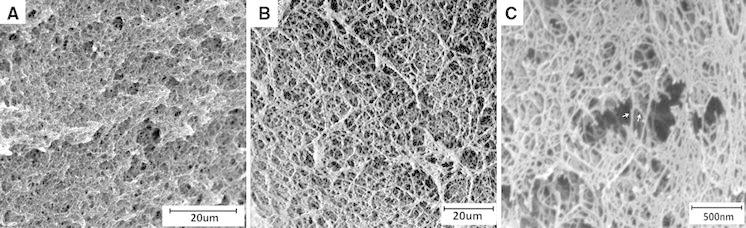
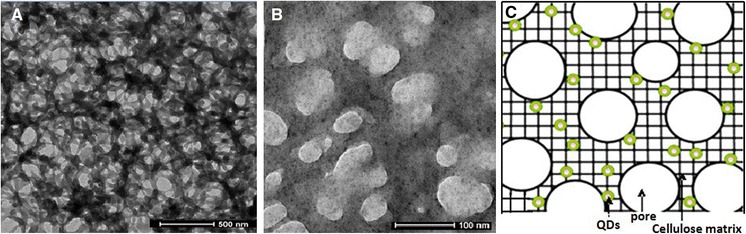
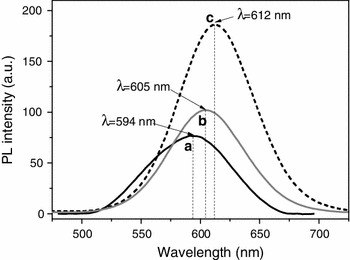
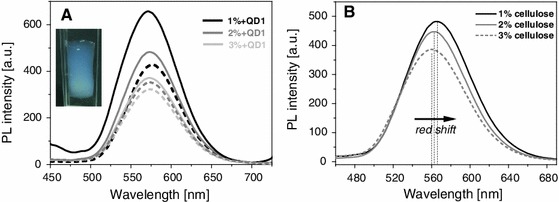
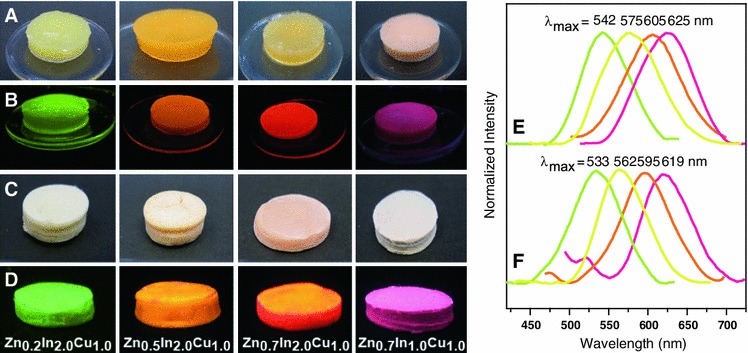
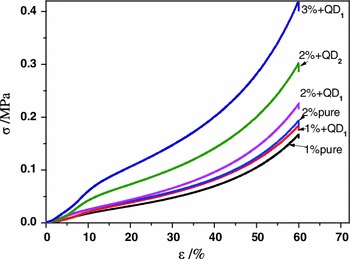
Photoluminiscent (PL) cellulose aerogels of variable shape containing homogeneously dispersed and surface-immobilized alloyed (ZnS)(CuInS)/ZnS (core/shell) quantum dots (QD) have been obtained by (1) dissolution of hardwood prehydrolysis kraft pulp in the ionic liquid 1-hexyl-3-methyl-1-imidazolium chloride, (2) addition of a homogenous dispersion of quantum dots in the same solvent, (3) molding, (4) coagulation of cellulose using ethanol as antisolvent, and (5) scCO drying of the resulting composite aerogels. Both compatibilization with the cellulose solvent and covalent attachment of the quantum dots onto the cellulose surface was achieved through replacement of 1-mercaptododecyl ligands typically used in synthesis of (ZnS)(CuInS)/ZnS (core-shell) QDs by 1-mercapto-3-(trimethoxysilyl)-propyl ligands. The obtained cellulose-quantum dot hybrid aerogels have apparent densities of 37.9-57.2 mg cm. Their BET surface areas range from 296 to 686 m g comparable with non-luminiscent cellulose aerogels obtained via the NMMO, TBAF/DMSO or Ca(SCN) route. Depending mainly on the ratio of QD core constituents and to a minor extent on the cellulose/QD ratio, the emission wavelength of the novel aerogels can be controlled within a wide range of the visible light spectrum. Whereas higher QD contents lead to bathochromic PL shifts, hypsochromism is observed when increasing the amount of cellulose at constant QD content. Reinforcement of the cellulose aerogels and hence significantly reduced shrinkage during scCO drying is a beneficial side effect when using α-mercapto-ω-(trialkoxysilyl) alkyl ligands for QD capping and covalent QD immobilization onto the cellulose surface.
通过以下步骤获得了形状可变的光致发光(PL)纤维素气凝胶,其中含有均匀分散且表面固定化的合金化(ZnS)(CuInS)/ZnS(核/壳)量子点(QD):(1)将阔叶木预水解硫酸盐浆溶解在离子液体1-己基-3-甲基-1-咪唑鎓氯化物中;(2)在同一溶剂中加入量子点的均匀分散体;(3)成型;(4)使用乙醇作为抗溶剂使纤维素凝固;(5)对所得复合气凝胶进行超临界二氧化碳(scCO₂)干燥。通过用1-巯基-3-(三甲氧基甲硅烷基)丙基配体取代通常用于合成(ZnS)(CuInS)/ZnS(核壳)量子点的1-巯基十二烷基配体,实现了与纤维素溶剂的相容性以及量子点在纤维素表面的共价连接。所获得的纤维素-量子点杂化气凝胶的表观密度为37.9 - 57.2 mg/cm³。它们的BET表面积范围为296至686 m²/g,与通过NMMO、TBAF/DMSO或Ca(SCN)路线获得的非发光纤维素气凝胶相当。主要取决于量子点核心成分的比例,在较小程度上取决于纤维素/量子点的比例,新型气凝胶的发射波长可以在可见光光谱的宽范围内进行控制。较高的量子点含量会导致PL红移,而在量子点含量恒定的情况下增加纤维素的量时会观察到蓝移。当使用α-巯基-ω-(三烷氧基甲硅烷基)烷基配体对量子点进行封端并将量子点共价固定在纤维素表面时,纤维素气凝胶的增强以及因此在scCO₂干燥过程中显著减少的收缩是一个有益的副作用。