Bonavina Luigi, Chirica Mircea, Skrobic Ognjan, Kluger Yoram, Andreollo Nelson A, Contini Sandro, Simic Aleksander, Ansaloni Luca, Catena Fausto, Fraga Gustavo P, Locatelli Carlo, Chiara Osvaldo, Kashuk Jeffry, Coccolini Federico, Macchitella Yuri, Mutignani Massimiliano, Cutrone Cesare, Poli Marco Dei, Valetti Tino, Asti Emanuele, Kelly Michael, Pesko Predrag
Department of Surgery, IRCCS Policlinico San Donato, University of Milan Medical School, Piazza Malan 1, 20097 San Donato Milanese (Milano), Italy.
Department of Digestive Surgery, Saint-Louis Hospital, Paris, France.
World J Emerg Surg. 2015 Sep 26;10:44. doi: 10.1186/s13017-015-0039-0. eCollection 2015.
Lesions of the upper digestive tract due to ingestion of caustic agents still represent a major medical and surgical emergency worldwide. The work-up of these patients is poorly defined and no clear therapeutic guidelines are available.
The aim of this study was to provide an evidence-based international consensus on primary and secondary prevention, diagnosis, staging, and treatment of this life-threatening and potentially disabling condition.
An extensive literature search was performed by an international panel of experts under the auspices of the World Society of Emergency Surgery (WSES). The level of evidence of the screened publications was graded using the Oxford 2011 criteria. The level of evidence of the literature and the main topics regarding foregut caustic injuries were discussed during a dedicated meeting in Milan, Italy (April 2015), and during the 3rd Annual Congress of the World Society of Emergency Surgery in Jerusalem, Israel (July 2015).
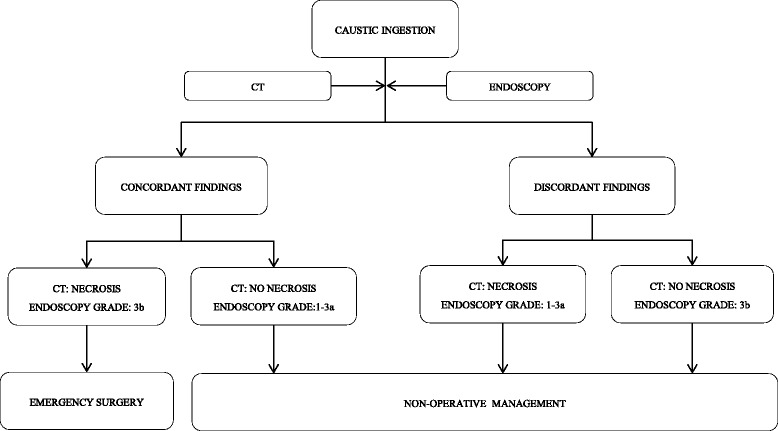
One-hundred-forty-seven full papers which addressed the relevant clinical questions of the research were admitted to the consensus conference. There was an unanimous consensus on the fact that the current literature on foregut caustic injuries lacks homogeneous classification systems and prospective methodology. Moreover, the non-standardized definition of technical and clinical success precludes any accurate comparison of therapeutic modalities. Key recommendations and algorithms based on expert opinions, retrospective studies and literature reviews were proposed and approved during the final consensus conference. The clinical practice guidelines resulting from the consensus conference were approved by the WSES council.
The recommendations emerging from this consensus conference, although based on a low level of evidence, have important clinical implications. A world registry of foregut caustic injuries could be useful to collect a homogeneous data-base for prospective clinical studies that may help improving the current clinical practice guidelines.
因摄入腐蚀性物质导致的上消化道损伤在全球范围内仍是一个重大的医疗和外科急症。对这些患者的检查流程尚不明确,也没有明确的治疗指南。
本研究旨在就这种危及生命且可能致残的疾病的一级和二级预防、诊断、分期及治疗提供基于证据的国际共识。
在世界急诊外科学会(WSES)的支持下,由一个国际专家小组进行了广泛的文献检索。使用牛津2011标准对筛选出的出版物的证据水平进行分级。在意大利米兰举行的一次专门会议(2015年4月)以及以色列耶路撒冷举行的世界急诊外科学会第三届年度大会(2015年7月)期间,讨论了文献的证据水平以及关于前肠腐蚀性损伤的主要主题。
147篇涉及该研究相关临床问题的全文被纳入共识会议。对于目前关于前肠腐蚀性损伤的文献缺乏统一的分类系统和前瞻性方法这一事实,存在一致共识。此外,技术和临床成功的非标准化定义妨碍了对治疗方式进行任何准确的比较。在最终的共识会议期间,基于专家意见、回顾性研究和文献综述提出并批准了关键建议和算法。共识会议产生的临床实践指南得到了WSES理事会的批准。
尽管本次共识会议得出的建议基于低水平的证据,但具有重要的临床意义。建立一个前肠腐蚀性损伤的全球登记册可能有助于收集一个统一的数据库,用于前瞻性临床研究,这可能有助于改进当前的临床实践指南。