Hancock Angela, Weeks Andrew D, Lavender Dame Tina
School of Nursing, Midwifery & Social Work, The University of Manchester, Jean McFarlane Building, Oxford Road, Manchester, M13 9PL, UK.
Department of Women's and Children's Health, Liverpool Women's Hospital, University of Liverpool, Crown Street, Liverpool, L8 7SS, UK.
BMC Pregnancy Childbirth. 2015 Sep 28;15:230. doi: 10.1186/s12884-015-0653-6.
Postpartum haemorrhage (PPH) is the leading cause of maternal mortality in low-income countries and severe maternal morbidity in many high-income countries. Poor outcomes following PPH are often attributed to delays in the recognition and treatment of PPH. Experts have suggested that improving the accuracy and reliability of blood loss estimation is the crucial step in preventing death and morbidity from PPH. However, there is little guidance on how this can be achieved. The aim of this integrative review was to evaluate the various methods of assessing maternal blood loss during childbirth.
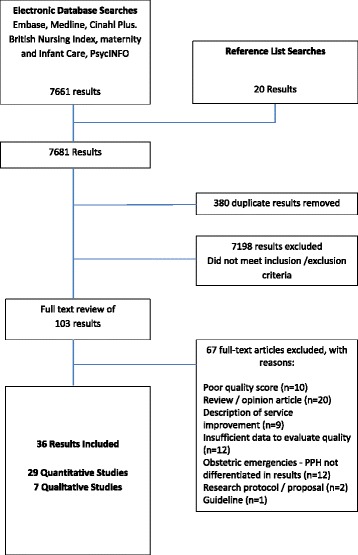
A systematic, integrative review of published research studies was conducted. All types of studies were included if they developed, tested, or aimed to improve methods and skills in quantifying blood loss during childbirth, or explored experiences of those involved in the process.
Thirty-six studies were included that evaluated the accuracy of visual estimation; tested methods to improve skills in measurement; examined their effect on PPH diagnosis and treatment, and / or explored additional factors associated with blood loss evaluation. The review found that health professionals were highly inaccurate at estimating blood loss as a volume. Training resulted in short term improvements in skills but these were not retained and did not improve clinical outcomes. Multi-faceted interventions changed some clinical practices but did not reduce the incidence of severe PPH or the timing of responses to excessive bleeding. Blood collection bags improved the accuracy of estimation but did not prevent delays or progression to severe PPH. Practitioners commonly used the nature and speed of blood flow, and the condition of the woman to indicate that the blood loss was abnormal.
Early diagnosis of PPH should improve maternal outcomes, but there is little evidence that this can be achieved through improving the accuracy of blood loss volume measurements. The diagnosis may rely on factors other than volume, such as speed of blood flow and nature of loss. A change in direction of future research is required to explore these in more detail.
产后出血(PPH)是低收入国家孕产妇死亡的主要原因,也是许多高收入国家严重孕产妇发病的原因。PPH后不良结局通常归因于对PPH的识别和治疗延迟。专家们认为,提高失血估计的准确性和可靠性是预防PPH导致死亡和发病的关键步骤。然而,关于如何实现这一点的指导很少。本综合综述的目的是评估分娩期间评估孕产妇失血的各种方法。
对已发表的研究进行系统的综合综述。如果研究开发、测试或旨在改进分娩期间量化失血的方法和技能,或探索参与该过程的人员的经验,则纳入所有类型的研究。
纳入了36项研究,这些研究评估了视觉估计的准确性;测试了提高测量技能的方法;检查了它们对PPH诊断和治疗的影响,和/或探索了与失血评估相关的其他因素。该综述发现,卫生专业人员在估计失血量方面极不准确。培训在短期内提高了技能,但这些技能没有得到保持,也没有改善临床结局。多方面的干预改变了一些临床实践,但没有降低严重PPH的发生率或对大出血反应的时间。采血袋提高了估计的准确性,但没有防止延迟或发展为严重PPH。从业者通常根据血流的性质和速度以及产妇的状况来表明失血异常。
PPH的早期诊断应能改善孕产妇结局,但几乎没有证据表明可以通过提高失血量测量的准确性来实现这一点。诊断可能依赖于失血量以外的因素,如血流速度和失血性质。需要改变未来的研究方向,以更详细地探索这些因素。