Drake Tom L, Kyaw Shwe Sin, Kyaw Myat Phone, Smithuis Frank M, Day Nicholas P J, White Lisa J, Lubell Yoel
Mahidol-Oxford Tropical Medicine Research Unit, 420/6 Rajvithi Rd, Bangkok, 10400, Thailand.
Nuffield Department of Medicine, University of Oxford, Oxford, UK.
Malar J. 2015 Sep 29;14:376. doi: 10.1186/s12936-015-0886-x.
Funding for malaria control and elimination in Myanmar has increased markedly in recent years. While there are various malaria control tools currently available, two interventions receive the majority of malaria control funding in Myanmar: (1) insecticide-treated bed nets and (2) early diagnosis and treatment through malaria community health workers. This study aims to provide practical recommendations on how to maximize impact from investment in these interventions.
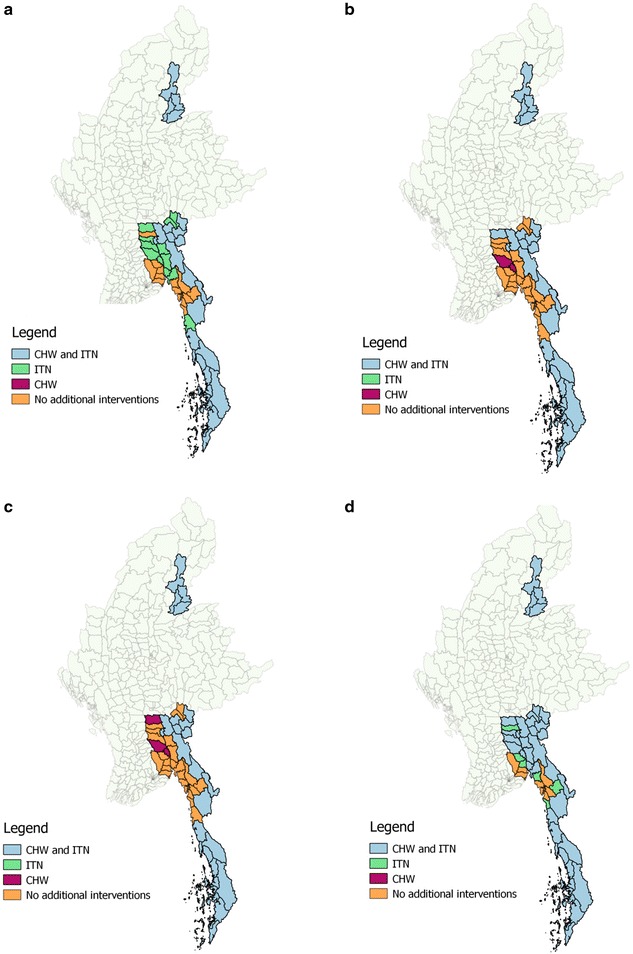
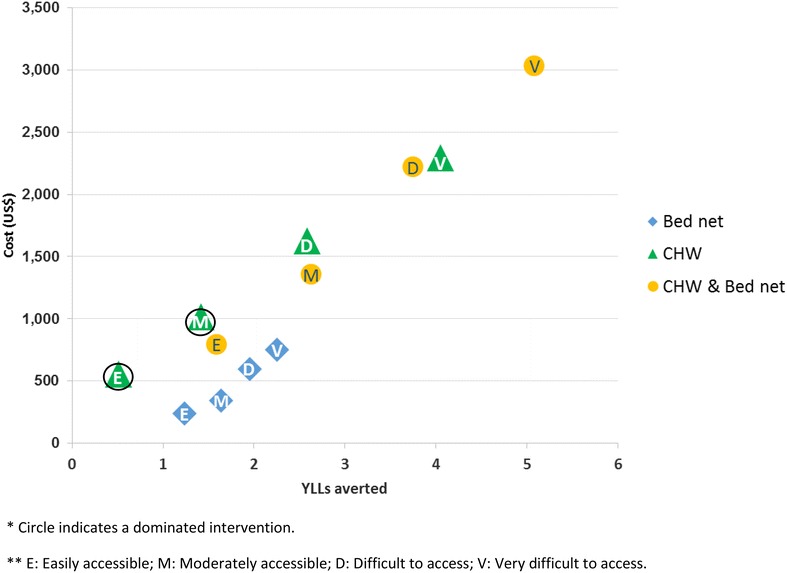
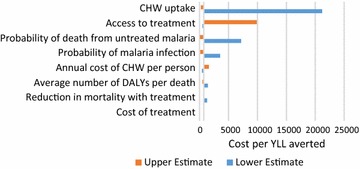
A simple decision tree is used to model intervention costs and effects in terms of years of life lost. The evaluation is from the perspective of the service provider and costs and effects are calculated in line with standard methodology. Sensitivity and scenario analysis are undertaken to identify key drivers of cost effectiveness. Standard cost effectiveness analysis is then extended via a spatially explicit resource allocation model.
Community health workers have the potential for high impact on malaria, particularly where there are few alternatives to access malaria treatment, but are relatively costly. Insecticide-treated bed nets are comparatively inexpensive and modestly effective in Myanmar, representing a low risk but modest return intervention. Unlike some healthcare interventions, bed nets and community health workers are not mutually exclusive nor are they necessarily at their most efficient when universally applied. Modelled resource allocation scenarios highlight that in this case there is no "one size fits all" cost effectiveness result. Health gains will be maximized by effective targeting of both interventions.
近年来,缅甸用于疟疾控制和消除的资金显著增加。虽然目前有多种疟疾控制工具,但缅甸大部分疟疾控制资金用于两种干预措施:(1)经杀虫剂处理的蚊帐;(2)通过疟疾社区卫生工作者进行早期诊断和治疗。本研究旨在就如何最大限度地提高对这些干预措施投资的影响提供切实可行的建议。
使用一个简单的决策树,根据生命年损失来模拟干预措施的成本和效果。评估从服务提供者的角度进行,成本和效果按照标准方法计算。进行敏感性和情景分析以确定成本效益的关键驱动因素。然后通过一个空间明确的资源分配模型扩展标准成本效益分析。
社区卫生工作者对疟疾有产生高影响的潜力,特别是在获得疟疾治疗的替代途径很少的地方,但成本相对较高。在缅甸,经杀虫剂处理的蚊帐相对便宜且效果一般,是一种低风险但回报一般的干预措施。与一些医疗保健干预措施不同,蚊帐和社区卫生工作者并非相互排斥,而且普遍应用时也不一定最有效。模拟的资源分配情景表明,在这种情况下不存在“一刀切”的成本效益结果。通过有效针对这两种干预措施,健康收益将最大化。