Vector Borne Disease Control, Naypyi Taw, Southern Shan State, Myanmar.
Department of Medical Research, Ministry of Health and Sports, Yangon, Myanmar.
Malar J. 2019 May 14;18(1):172. doi: 10.1186/s12936-019-2800-4.
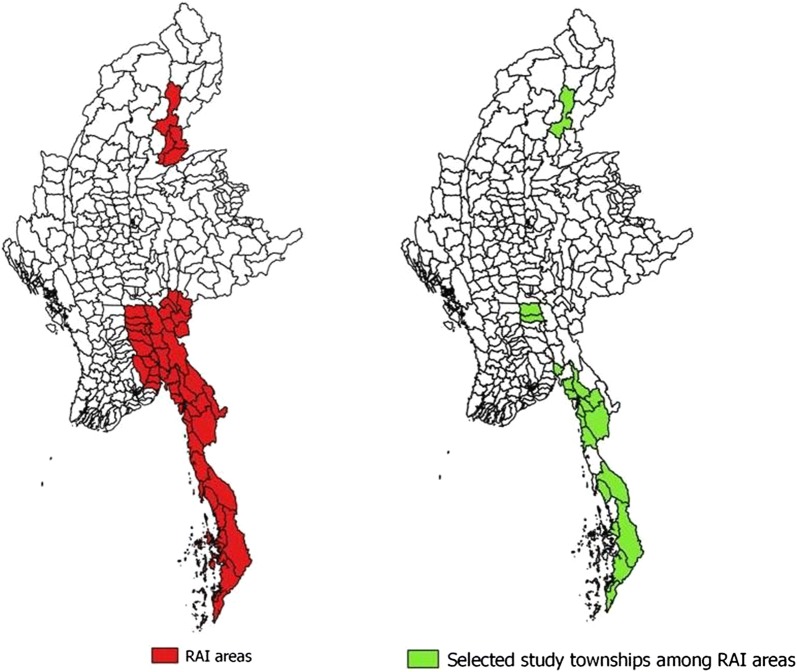
Sleeping under insecticide-treated mosquito nets/long-lasting insecticidal nets (ITNs/LLINs henceforth referred to as ITNs) is one of the core interventions recommended by the World Health Organization to reduce malaria transmission and prevent malaria in high-risk communities, such as migrants, by preventing mosquito bites. The malaria burden among the migrant population is a big challenge for malaria elimination in Myanmar. In this context, this study aimed to assess the ownership and utilization of ITNs and to understand the barriers to distribution and utilization of ITNs among the high-risk migrant communities in the Regional Artemisinin Resistance Initiative (RAI) project areas of Myanmar.
A sequential mixed methods study (quantitative component: cross-sectional study involving analysis of secondary data available from a survey conducted among migrant households in the RAI project areas of Myanmar in 2016 followed by a descriptive qualitative component in 2018). A total of 17 focus group discussions (involving 121 participants) with different groups of migrants and 17 key-informant interviews with key programme stakeholders were conducted in 4 selected townships of RAI project areas.
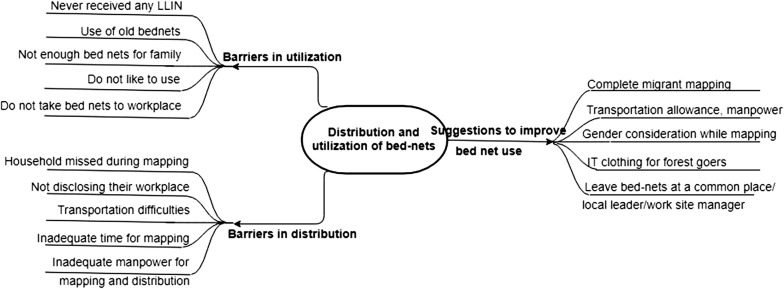
Of 3230 migrant households, 63.3% had at least one ITN while 36% had sufficient ITNs (i.e., 1 ITN per 2 persons). Regarding ITN utilization, about 52% of household members reported sleeping under an ITN the previous night, which is similar among under-fives and pregnant women. Over half of all bed nets were ITNs, with nearly one-third having holes or already undergone repairs. The qualitative findings revealed that the key challenges for ITN utilization were insufficient ITNs in households and dislike of ITNs. The barriers to ITN distribution were incomplete migrant mapping due to resource constraints (time, money, manpower) and difficulties in transportation and carrying ITNs.
This study highlights poor ownership and utilization of ITNs among migrants in the RAI project areas of Myanmar and barriers to their ownership and utilization. To achieve universal coverage and utilization, more programmatic support by the programme is needed to carry out complete migrant mapping and continuous ITN distribution in remote locations.
在世界卫生组织推荐的核心干预措施中,使用经杀虫剂处理的蚊帐/长效驱虫蚊帐(下文简称 ITN)是减少疟疾传播和预防高危社区(如移民)疟疾的措施之一,这是通过防止蚊虫叮咬来实现的。在缅甸,移民人群中的疟疾负担是消除疟疾的一个重大挑战。在此背景下,本研究旨在评估高危移民社区中 ITN 的拥有和使用情况,并了解在缅甸区域青蒿素耐药倡议(RAI)项目地区,阻碍 ITN 分发和使用的因素。
采用顺序混合方法研究(定量部分:2016 年在缅甸 RAI 项目地区的移民家庭中进行的一项调查,对调查获得的二手数据进行分析,随后在 2018 年进行描述性定性部分)。在 RAI 项目地区的 4 个选定镇区中,与不同移民群体进行了 17 次焦点小组讨论(涉及 121 名参与者),并对 17 名关键利益相关者进行了关键信息提供者访谈。
在 3230 户移民家庭中,63.3%的家庭至少拥有 1 顶 ITN,36%的家庭拥有足够的 ITN(即每 2 人 1 顶 ITN)。关于 ITN 的使用情况,约 52%的家庭成员报告前一晚睡在 ITN 下,这一比例在 5 岁以下儿童和孕妇中相似。所有床罩中有一半以上是 ITN,近三分之一的 ITN 有洞或已经修补过。定性研究结果表明,ITN 使用的主要挑战是家庭中 ITN 数量不足和对 ITN 的不喜欢。ITN 分发的障碍是由于资源限制(时间、金钱、人力)以及运输和携带 ITN 的困难,导致移民情况不完全映射。
本研究强调了缅甸 RAI 项目地区移民中 ITN 拥有和使用情况不佳,以及拥有和使用 ITN 的障碍。为了实现普遍覆盖和使用,该项目需要更多的方案支持,以在偏远地区进行完整的移民情况映射和持续的 ITN 分发。