Band Gavin, Rockett Kirk A, Spencer Chris C A, Kwiatkowski Dominic P
Nature. 2015 Oct 8;526(7572):253-7. doi: 10.1038/nature15390. Epub 2015 Sep 30.
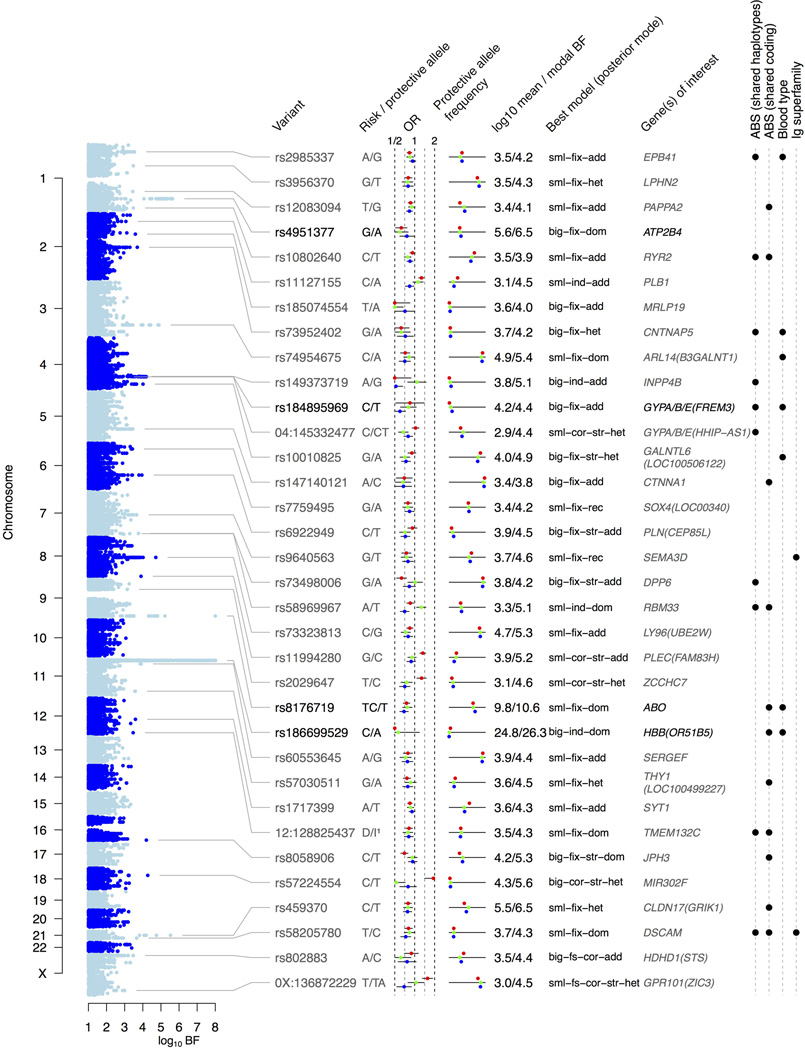
The high prevalence of sickle haemoglobin in Africa shows that malaria has been a major force for human evolutionary selection, but surprisingly few other polymorphisms have been proven to confer resistance to malaria in large epidemiological studies. To address this problem, we conducted a multi-centre genome-wide association study (GWAS) of life-threatening Plasmodium falciparum infection (severe malaria) in over 11,000 African children, with replication data in a further 14,000 individuals. Here we report a novel malaria resistance locus close to a cluster of genes encoding glycophorins that are receptors for erythrocyte invasion by P. falciparum. We identify a haplotype at this locus that provides 33% protection against severe malaria (odds ratio = 0.67, 95% confidence interval = 0.60-0.76, P value = 9.5 × 10(-11)) and is linked to polymorphisms that have previously been shown to have features of ancient balancing selection, on the basis of haplotype sharing between humans and chimpanzees. Taken together with previous observations on the malaria-protective role of blood group O, these data reveal that two of the strongest GWAS signals for severe malaria lie in or close to genes encoding the glycosylated surface coat of the erythrocyte cell membrane, both within regions of the genome where it appears that evolution has maintained diversity for millions of years. These findings provide new insights into the host-parasite interactions that are critical in determining the outcome of malaria infection.
镰状血红蛋白在非洲的高流行率表明,疟疾一直是人类进化选择的主要驱动力,但令人惊讶的是,在大型流行病学研究中,很少有其他多态性被证明能赋予对疟疾的抗性。为了解决这个问题,我们对11000多名非洲儿童进行了一项关于危及生命的恶性疟原虫感染(重症疟疾)的多中心全基因组关联研究(GWAS),并在另外14000名个体中进行了重复验证。在此,我们报告了一个新的疟疾抗性位点,该位点靠近一组编码血型糖蛋白的基因簇,而血型糖蛋白是恶性疟原虫入侵红细胞的受体。我们在这个位点鉴定出一种单倍型,它能提供33%的重症疟疾防护(优势比 = 0.67,95%置信区间 = 0.60 - 0.76,P值 = 9.5 × 10⁻¹¹),并且与先前基于人类和黑猩猩之间单倍型共享而显示具有古老平衡选择特征的多态性相关联。结合之前关于O型血对疟疾的保护作用的观察结果,这些数据表明,重症疟疾最强的两个GWAS信号位于或靠近编码红细胞细胞膜糖基化表面涂层的基因,这两个信号都在基因组中似乎进化已维持数百万年多样性的区域内。这些发现为宿主 - 寄生虫相互作用提供了新的见解,而这种相互作用在决定疟疾感染的结果中至关重要。