Yu Zixuan, Abdel-Azim Salma, Duggal Priya, Vergara Candelaria
Johns Hopkins University, Bloomberg School of Public Health, Baltimore, MD, USA.
BMC Genomics. 2025 Jul 12;26(1):661. doi: 10.1186/s12864-024-11076-6.
Acute infection with hepatitis C virus (HCV) affects millions of individuals worldwide. Host genetics plays a role in spontaneous clearance of the acute infection which occurs in approximately 30% of the individuals. Common variants in GPR158, genes in the interferon lambda (IFNL) cluster, and the Major Histocompatibility complex (MHC) region have been associated with HCV clearance in populations of diverse ancestry. Fine mapping of those regions has identified some key variants and amino acids as potential causal variants but the role of rare variants in those regions and in the genome, in general, has not been explored. We aimed to detect haplotypes containing rare variants related to HCV clearance using identity-by-descent (IBD) haplotype sharing between unrelated cases-case pairs and case-controls pairs in 1,739 individuals of European ancestry and 1,869 African Americans. Additionally, we aimed to detect ancestry-specific effects in African Americans using local ancestry mapping.
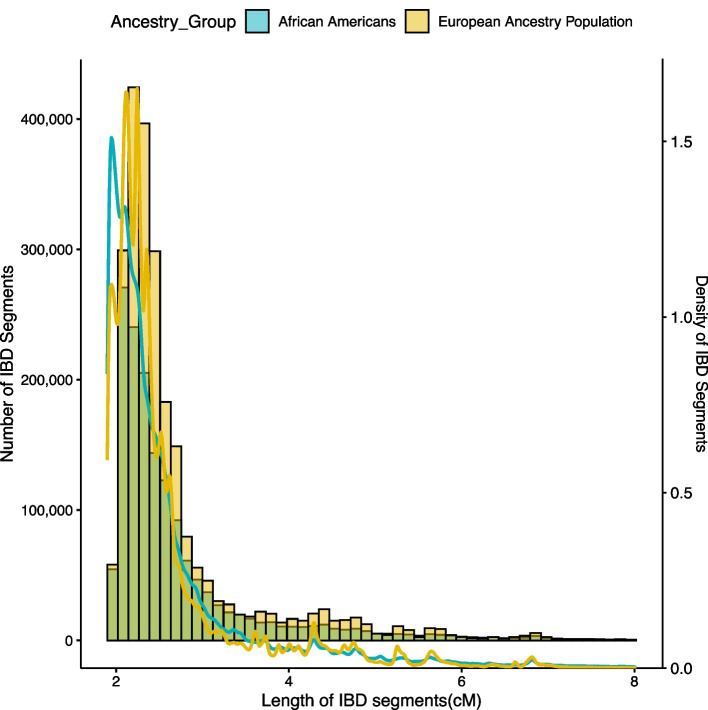
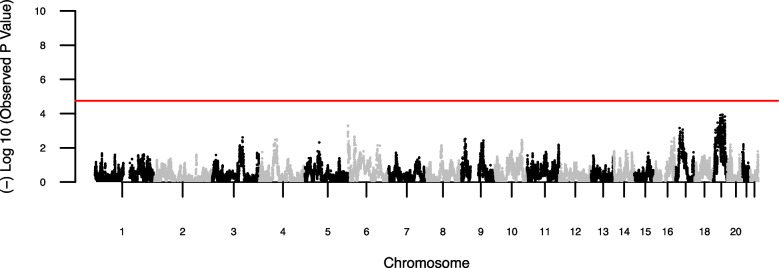
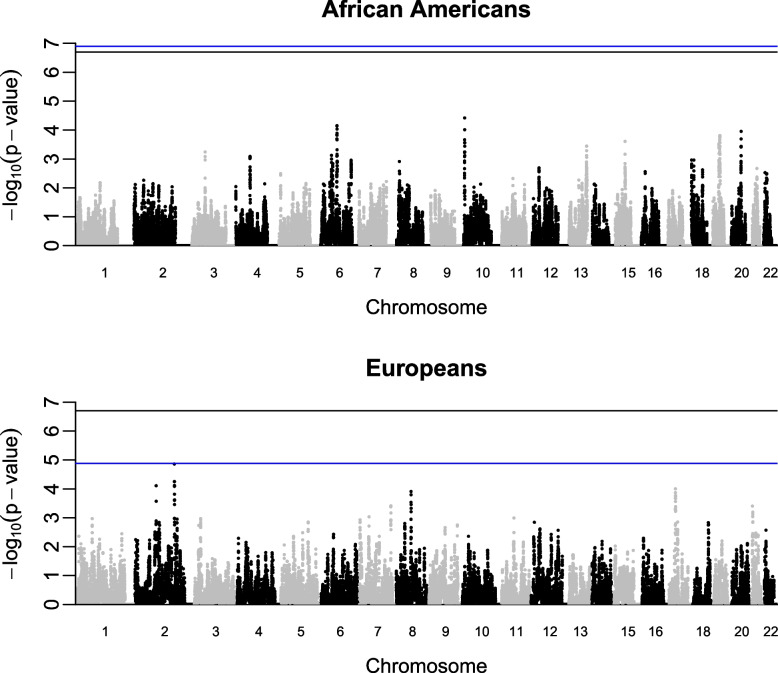
We detected 2,370,341 and 1,567,748 individual pairs of IBD segments in the individuals of European ancestry and African Americans, respectively. Individuals of European descent had more segments of longer length compared to African Americans. We did not detect any significant IBD signals in the known associated or new gene regions. We also failed to detect any significant genome-wide local ancestry signals in the African Americans.
IBD is based on sharing of haplotypes and is most powerful in populations with a shared founder or recent common ancestor. For the complex trait of HCV clearance, we used two outbred, global populations that limited our power to detect IBD associations. Overall, in these population-based samples we failed to detect rare variations associated with HCV clearance in individuals of European ancestry and African Americans, and we didn't detect local ancestry-specific effects associated with HCV clearance in African Americans with our current sample size.
丙型肝炎病毒(HCV)急性感染影响着全球数百万人。宿主基因在急性感染的自发清除中发挥作用,约30%的个体可出现这种情况。GPR158中的常见变异、干扰素λ(IFNL)基因簇中的基因以及主要组织相容性复合体(MHC)区域与不同血统人群的HCV清除相关。对这些区域的精细定位已确定了一些关键变异和氨基酸作为潜在的因果变异,但总体而言,这些区域以及基因组中罕见变异的作用尚未得到探索。我们旨在通过1739名欧洲血统个体和1869名非裔美国人中无关病例-病例对和病例-对照对之间的同源性(IBD)单倍型共享,检测包含与HCV清除相关的罕见变异的单倍型。此外,我们旨在通过本地血统定位检测非裔美国人中特定血统的效应。
我们分别在欧洲血统个体和非裔美国人中检测到2370341对和1567748对IBD片段。与非裔美国人相比,欧洲血统个体的片段长度更长。我们在已知相关或新基因区域未检测到任何显著的IBD信号。我们在非裔美国人中也未检测到任何全基因组范围内显著的本地血统信号。
IBD基于单倍型共享,在具有共同奠基者或近期共同祖先的人群中最为有效。对于HCV清除这种复杂性状,我们使用了两个远交的全球人群,这限制了我们检测IBD关联的能力。总体而言,在这些基于人群的样本中,我们未能在欧洲血统个体和非裔美国人中检测到与HCV清除相关的罕见变异,并且以我们目前的样本量,在非裔美国人中未检测到与HCV清除相关的特定血统效应。