Kwon Young-Chan, Ray Ratna B, Ray Ranjit
Department of Internal Medicine, Saint Louis University, Missouri.
Department of Pathology, Saint Louis University, Missouri.
EXCLI J. 2014 Aug 27;13:977-96. eCollection 2014.
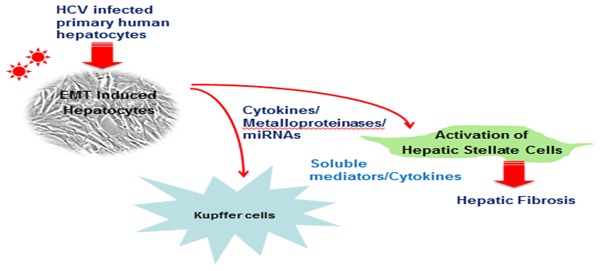
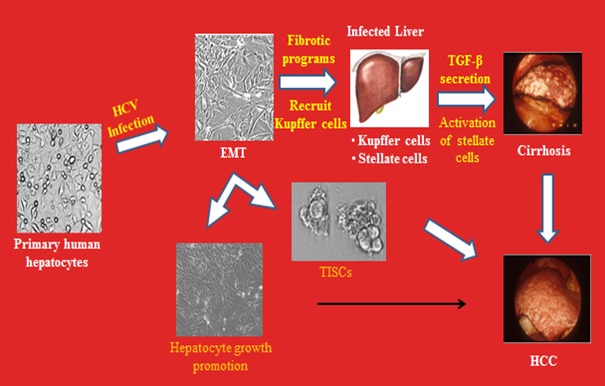
Hepatitis C virus (HCV) often causes persistent infection, and is an important factor in the etiology of fibrosis, cirrhosis, and hepatocellular carcinoma (HCC). There are no preventive or therapeutic vaccines available against HCV. Treatment strategies of HCV infection are likely to improve with recently discovered direct antiviral agents (DAAs). However, a proportion of patients still progress to liver failure and/or HCC despite having been cured of the infection. Thus, there is a need for early diagnosis and therapeutic modalities for HCV related end stage liver disease prevention. HCV genome does not integrate into its host genome, and has a predominantly cytoplasmic life cycle. Therefore, HCV mediated liver disease progression appears to involve indirect mechanisms from persistent infection of hepatocytes. Studying the underlying mechanisms of HCV mediated evasion of immune responses and liver disease progression is challenging due to the lack of a naturally susceptible small animal model. We and other investigators have used a number of experimental systems to investigate the mechanisms for establishment of chronic HCV infection and liver disease progression. HCV infection modulates immune systems. Further, HCV infection of primary human hepatocytes promotes growth, induces phenotypic changes, modulates epithelial mesenchymal transition (EMT) related genes, and generates tumor initiating stem-like cells (TISCs). HCV infection also modulates microRNAs (miRNAs), and influences growth by overriding normal death progression of primary human hepatocytes for disease pathogenesis. Understanding these ob-servations at the molecular level should aid in developing strategies for additional effective therapies against HCV mediated liver disease progression.
丙型肝炎病毒(HCV)常引起持续性感染,是纤维化、肝硬化和肝细胞癌(HCC)病因中的一个重要因素。目前尚无针对HCV的预防性或治疗性疫苗。随着最近发现的直接抗病毒药物(DAA),HCV感染的治疗策略可能会有所改善。然而,尽管一部分患者的感染已被治愈,但仍有一部分患者会进展为肝衰竭和/或HCC。因此,需要早期诊断和治疗方法来预防HCV相关的终末期肝病。HCV基因组不会整合到其宿主基因组中,并且主要具有细胞质生命周期。因此,HCV介导的肝病进展似乎涉及肝细胞持续感染的间接机制。由于缺乏天然易感的小动物模型,研究HCV介导的免疫反应逃避和肝病进展的潜在机制具有挑战性。我们和其他研究人员已经使用了一些实验系统来研究慢性HCV感染的建立机制和肝病进展。HCV感染会调节免疫系统。此外,原代人肝细胞的HCV感染促进生长、诱导表型变化、调节上皮-间质转化(EMT)相关基因,并产生肿瘤起始干细胞样细胞(TISC)。HCV感染还会调节微小RNA(miRNA),并通过超越原代人肝细胞的正常死亡进程来影响生长,从而导致疾病发病。在分子水平上理解这些观察结果应该有助于制定针对HCV介导的肝病进展的其他有效治疗策略。