Wang Xiaojing, Ning Qin
Department and Institute of Infectious Disease, Tongji Hospital, Huazhong University of Science and Technology, Wuhan 430030, China.
EXCLI J. 2014 Oct 1;13:1131-44. eCollection 2014.
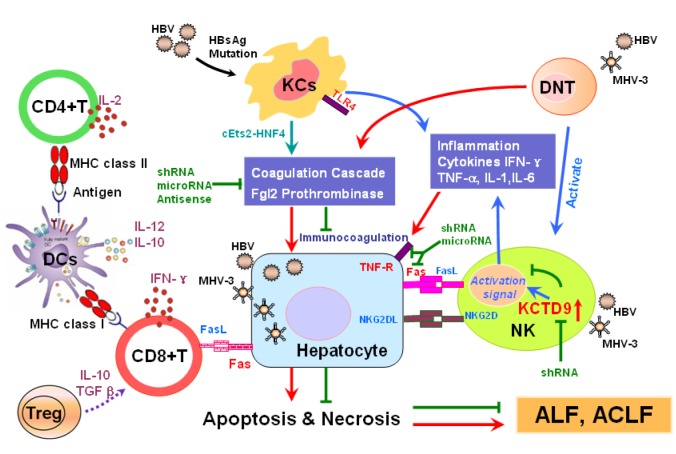
Liver failure is a clinical syndrome of various etiologies, manifesting as jaundice, encephalopathy, coagulopathy and circulatory dysfunction, which result in subsequent multiorgan failure. Clinically, liver failure is classified into four categories: acute, subacute, acute-on-chronic and chronic liver failure. Massive hepatocyte death is considered to be the core event in the development of liver failure, which occurs when the extent of hepatocyte death is beyond the liver regenerative capacity. Direct damage and immune-mediated liver injury are two major factors involved in this process. Increasing evidence has suggested the essential role of immune-mediated liver injury in the pathogenesis of liver failure. Here, we review the evolved concepts concerning the mechanisms of immune-mediated liver injury in liver failure from human and animal studies. Both innate and adaptive immunity, especially the interaction of various immune cells and molecules as well as death receptor signaling system are discussed. In addition, we highlight the concept of "immune coagulation", which has been shown to be related to the disease progression and liver injury exacerbation in HBV related acute-on-chronic liver failure.
肝衰竭是一种由多种病因引起的临床综合征,表现为黄疸、肝性脑病、凝血功能障碍和循环功能障碍,进而导致多器官功能衰竭。临床上,肝衰竭分为四类:急性、亚急性、慢加急性和慢性肝衰竭。大量肝细胞死亡被认为是肝衰竭发生发展的核心事件,当肝细胞死亡程度超过肝脏再生能力时就会发生。直接损伤和免疫介导的肝损伤是这一过程中的两个主要因素。越来越多的证据表明免疫介导的肝损伤在肝衰竭发病机制中起着重要作用。在此,我们回顾了来自人类和动物研究的关于肝衰竭中免疫介导肝损伤机制的演变概念。讨论了固有免疫和适应性免疫,特别是各种免疫细胞和分子的相互作用以及死亡受体信号系统。此外,我们强调了“免疫凝血”的概念,它已被证明与乙型肝炎病毒相关慢加急性肝衰竭的疾病进展和肝损伤加重有关。