Ziperstein Michelle J, Guzman Asja, Kaufman Laura J
Department of Chemistry, Columbia University, New York, New York, United States of America.
PLoS One. 2015 Sep 29;10(9):e0139523. doi: 10.1371/journal.pone.0139523. eCollection 2015.
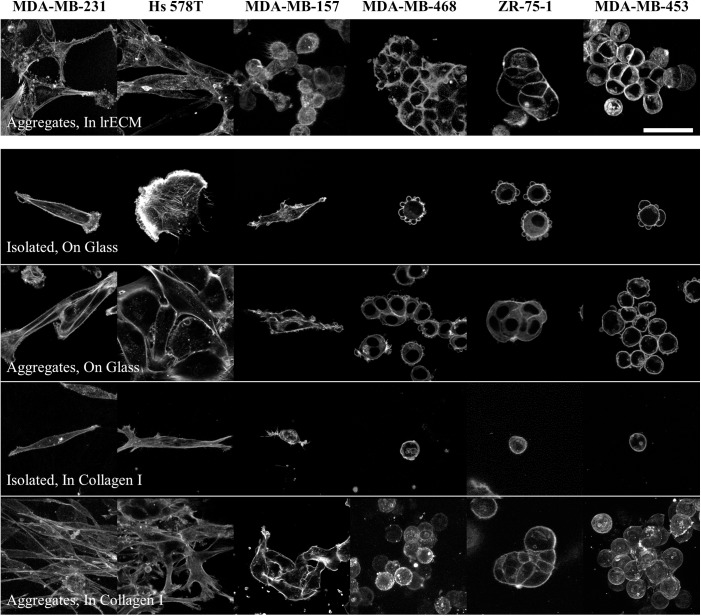
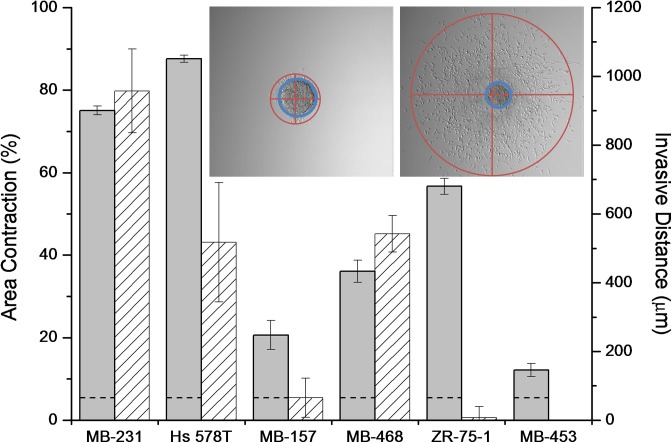
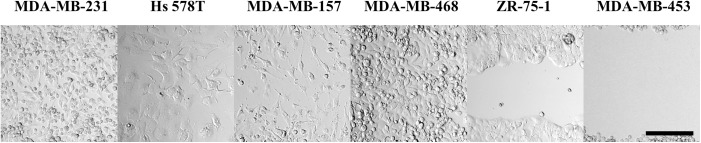
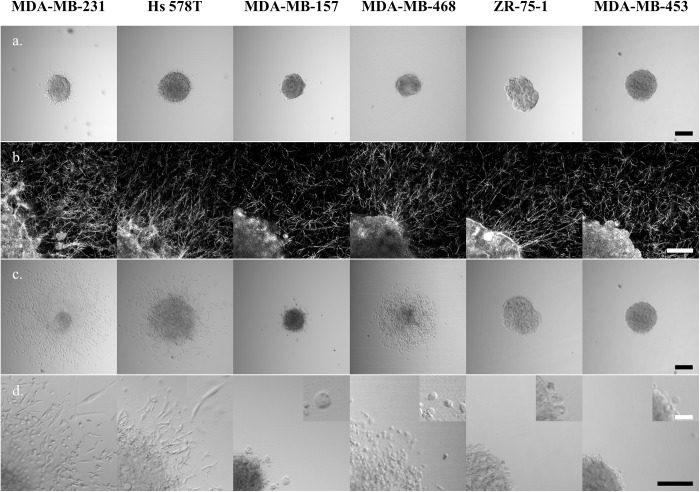
To invade and metastasize to distant loci, breast cancer cells must breach the layer of basement membrane surrounding the tumor and then invade through the dense collagen I-rich extracellular environment of breast tissue. Previous studies have shown that breast cancer cell aggregate morphology in basement membrane extract correlated with cell invasive capacity in some contexts. Moreover, cell lines from the same aggregate morphological class exhibited similarities in gene expression patterns. To further assess the capacity of cell and aggregate morphology to predict invasive capacity in physiologically relevant environments, six cell lines with varied cell aggregate morphologies were assessed in a variety of assays including a 3D multicellular invasion assay that recapitulates cell-cell and cell-environment contacts as they exist in vivo in the context of the primary breast tumor. Migratory and invasive capacities as measured through a 2D gap assay and a 3D spheroid invasion assay reveal that breast cancer cell aggregate morphology alone is insufficient to predict migratory speed in 2D or invasive capacity in 3D. Correlations between the 3D spheroid invasion assay and gene expression profiles suggest this assay as an inexpensive functional method to predict breast cancer invasive capacity.
为了侵袭并转移至远处位点,乳腺癌细胞必须突破肿瘤周围的基底膜层,然后穿过富含I型胶原蛋白的致密乳腺组织细胞外环境。先前的研究表明,在某些情况下,基底膜提取物中的乳腺癌细胞聚集体形态与细胞侵袭能力相关。此外,来自同一聚集体形态类别的细胞系在基因表达模式上表现出相似性。为了进一步评估细胞和聚集体形态在生理相关环境中预测侵袭能力的能力,在多种试验中评估了六种具有不同细胞聚集体形态的细胞系,包括一种三维多细胞侵袭试验,该试验概括了原发性乳腺肿瘤在体内存在时的细胞-细胞和细胞-环境接触。通过二维间隙试验和三维球体侵袭试验测量的迁移和侵袭能力表明,仅乳腺癌细胞聚集体形态不足以预测二维中的迁移速度或三维中的侵袭能力。三维球体侵袭试验与基因表达谱之间的相关性表明,该试验是一种预测乳腺癌侵袭能力的廉价功能方法。