Watson Deborah J, Ostroff Linnaea, Cao Guan, Parker Patrick H, Smith Heather, Harris Kristen M
Department of Neuroscience, Center for Learning and Memory, Institute for Neuroscience, University of Texas at Austin, Austin, Texas, 78731.
Allen Brain Institute, 551 N 34th St, Seattle, Washington, 98103.
Hippocampus. 2016 May;26(5):560-76. doi: 10.1002/hipo.22536. Epub 2015 Oct 23.
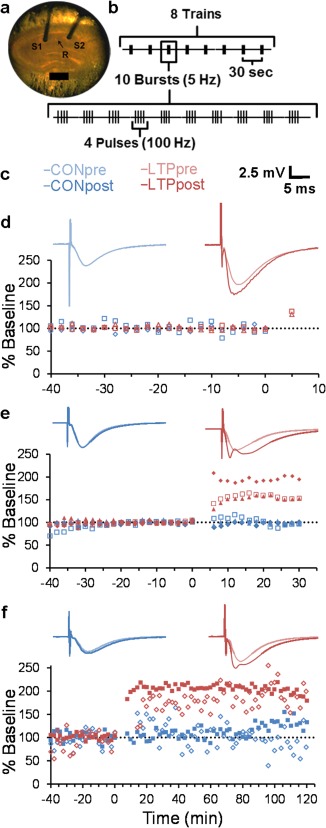
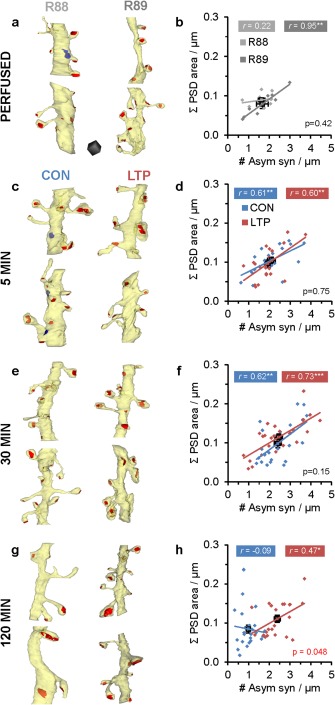
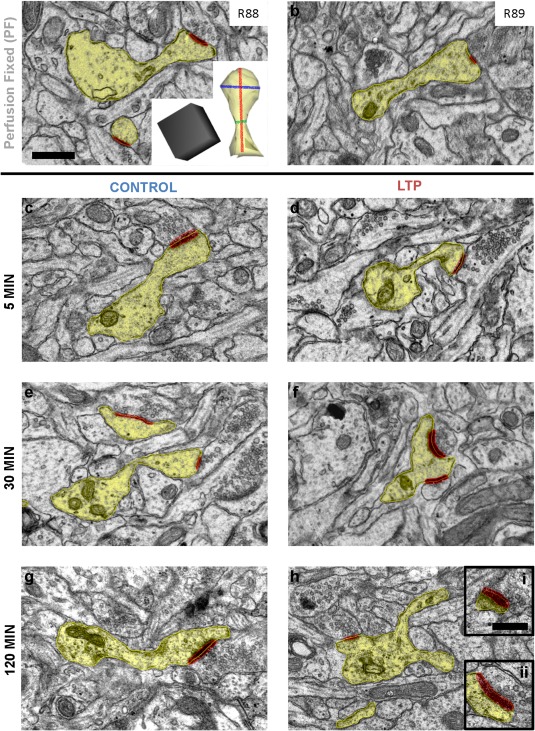
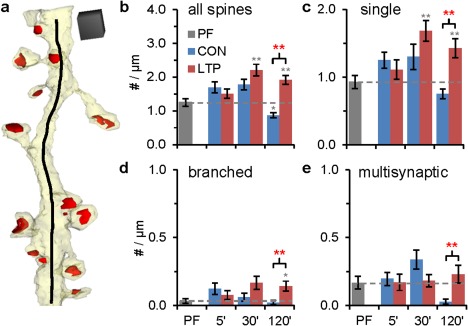
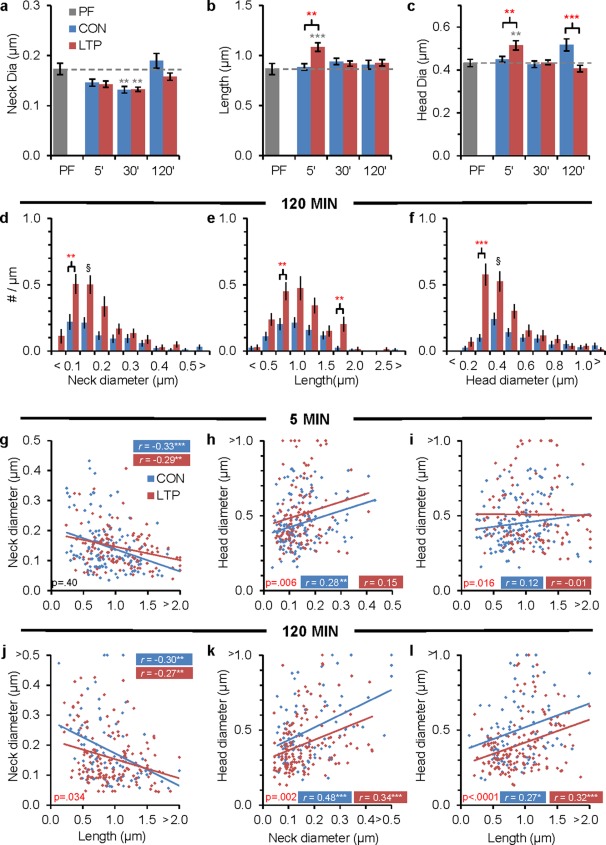
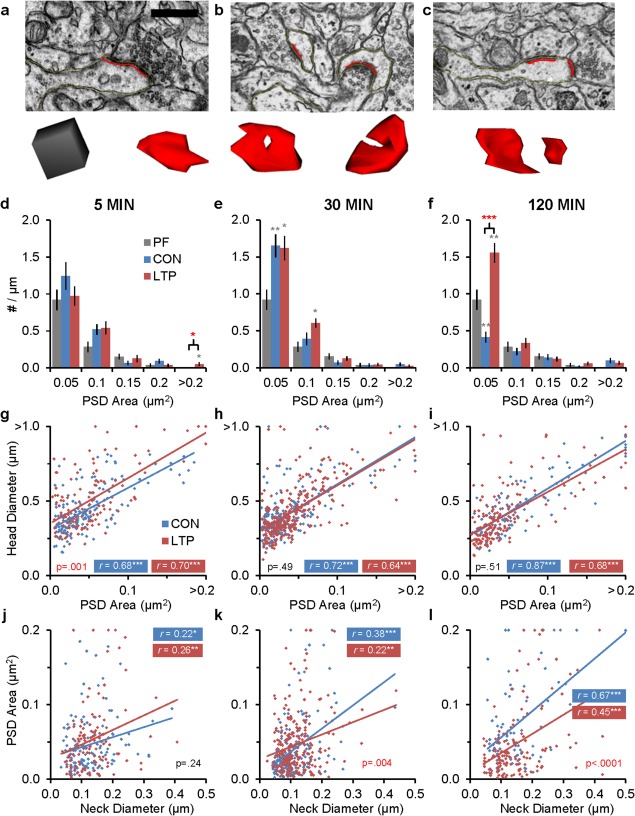
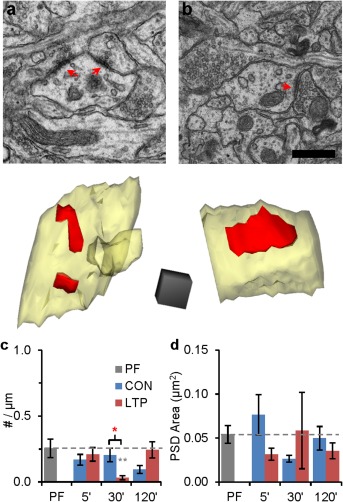
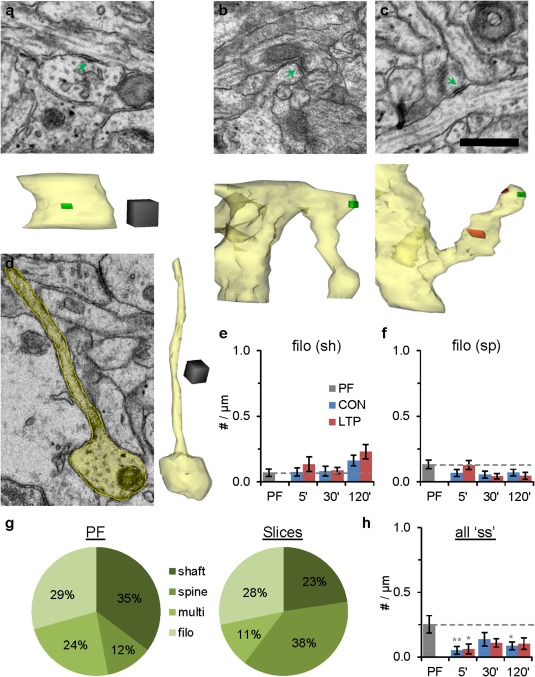
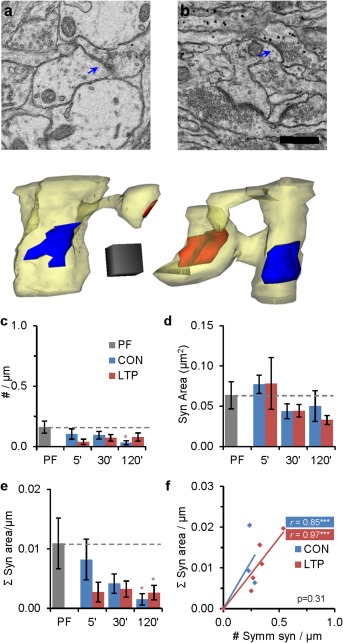
In adult hippocampus, long-term potentiation (LTP) produces synapse enlargement while preventing the formation of new small dendritic spines. Here, we tested how LTP affects structural synaptic plasticity in hippocampal area CA1 of Long-Evans rats at postnatal day 15 (P15). P15 is an age of robust synaptogenesis when less than 35% of dendritic spines have formed. We hypothesized that LTP might therefore have a different effect on synapse structure than in adults. Theta-burst stimulation (TBS) was used to induce LTP at one site and control stimulation was delivered at an independent site, both within s. radiatum of the same hippocampal slice. Slices were rapidly fixed at 5, 30, and 120 min after TBS, and processed for analysis by three-dimensional reconstruction from serial section electron microscopy (3DEM). All findings were compared to hippocampus that was perfusion-fixed (PF) in vivo at P15. Excitatory and inhibitory synapses on dendritic spines and shafts were distinguished from synaptic precursors, including filopodia and surface specializations. The potentiated response plateaued between 5 and 30 min and remained potentiated prior to fixation. TBS resulted in more small spines relative to PF by 30 min. This TBS-related spine increase lasted 120 min, hence, there were substantially more small spines with LTP than in the control or PF conditions. In contrast, control test pulses resulted in spine loss relative to PF by 120 min, but not earlier. The findings provide accurate new measurements of spine and synapse densities and sizes. The added or lost spines had small synapses, took time to form or disappear, and did not result in elevated potentiation or depression at 120 min. Thus, at P15 the spines formed following TBS, or lost with control stimulation, appear to be functionally silent. With TBS, existing synapses were awakened and then new spines formed as potential substrates for subsequent plasticity.
在成年海马体中,长时程增强(LTP)会使突触增大,同时阻止新的小树突棘形成。在此,我们测试了LTP如何影响出生后第15天(P15)的Long-Evans大鼠海马体CA1区的结构性突触可塑性。P15是一个突触大量生成的时期,此时不到35%的树突棘已经形成。我们推测,因此LTP对突触结构的影响可能与成年时不同。采用theta波爆发刺激(TBS)在同一切片的辐射层内的一个位点诱导LTP,并在一个独立位点给予对照刺激。在TBS后5、30和120分钟对切片进行快速固定,并通过连续切片电子显微镜三维重建(3DEM)进行分析处理。所有结果均与在P15时体内灌注固定(PF)的海马体进行比较。树突棘和树突干上的兴奋性和抑制性突触与包括丝状伪足和表面特化在内的突触前体区分开来。增强反应在5至30分钟之间达到平稳,并在固定前一直保持增强状态。到30分钟时,与PF相比,TBS导致更多的小树突棘。这种与TBS相关的树突棘增加持续了120分钟,因此,与对照或PF条件相比,LTP状态下的小树突棘要多得多。相比之下,对照测试脉冲在120分钟时导致相对于PF的树突棘减少,但在更早时间没有出现这种情况。这些发现提供了树突棘和突触密度及大小的准确新测量数据。新增或减少的树突棘具有小突触,形成或消失需要时间,并且在120分钟时不会导致增强或抑制作用升高。因此,在P15时,TBS后形成的或在对照刺激下减少的树突棘在功能上似乎是沉默的。通过TBS,现有的突触被激活,然后新的树突棘形成,作为后续可塑性的潜在底物。