von Spiczak Jochen, Crelier Gerard, Giese Daniel, Kozerke Sebastian, Maintz David, Bunck Alexander Christian
Department of Radiology and Neuroradiology, University Hospital of Cologne, Cologne, Germany.
Institute for Biomedical Engineering, University and ETH Zurich, Zurich, Switzerland.
PLoS One. 2015 Sep 29;10(9):e0139025. doi: 10.1371/journal.pone.0139025. eCollection 2015.
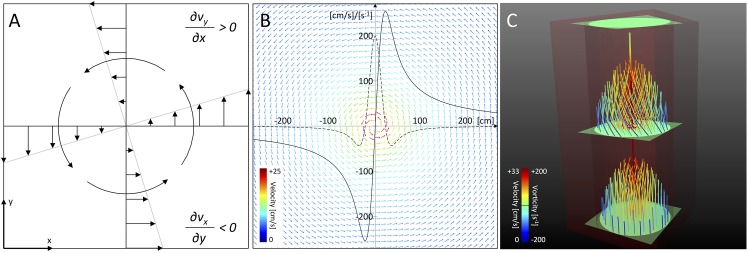
Phase contrast MRI allows for the examination of complex hemodynamics in the heart and adjacent great vessels. Vortex flow patterns seem to play an important role in certain vascular pathologies. We propose two- and three-dimensional metrics for the objective quantification of aortic vortex blood flow in 4D phase contrast MRI.
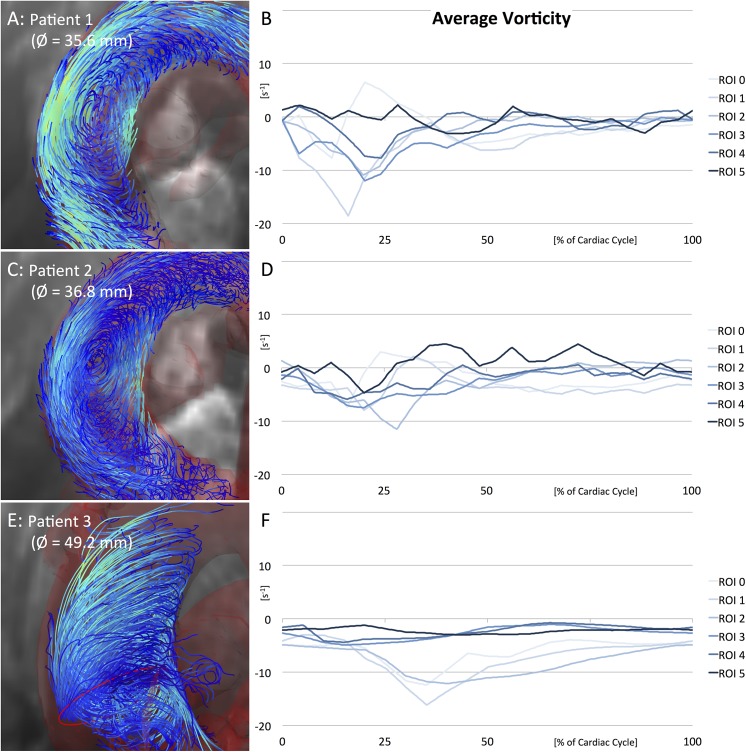
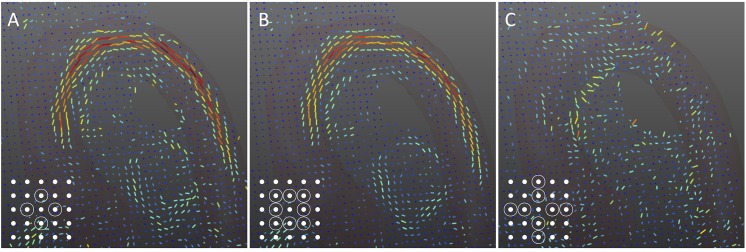
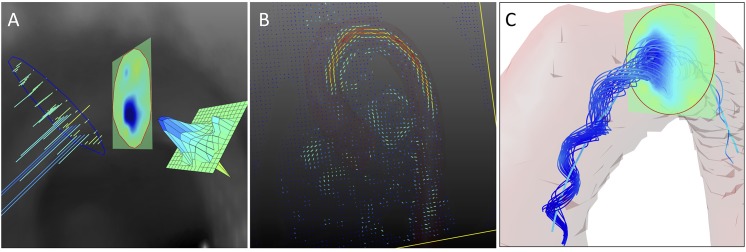
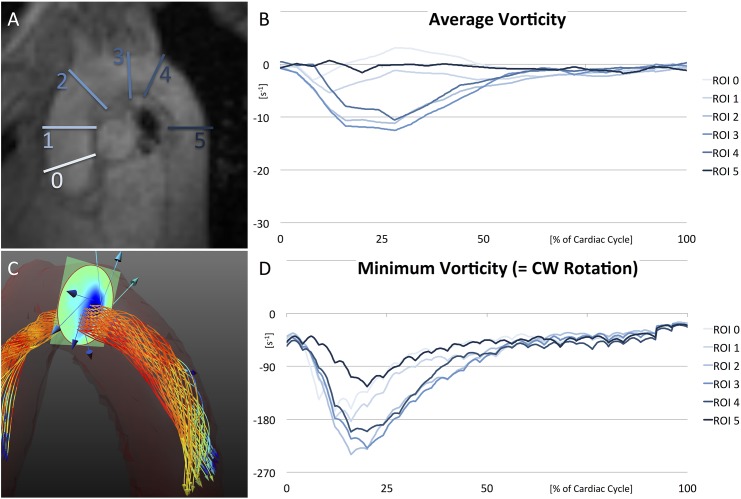
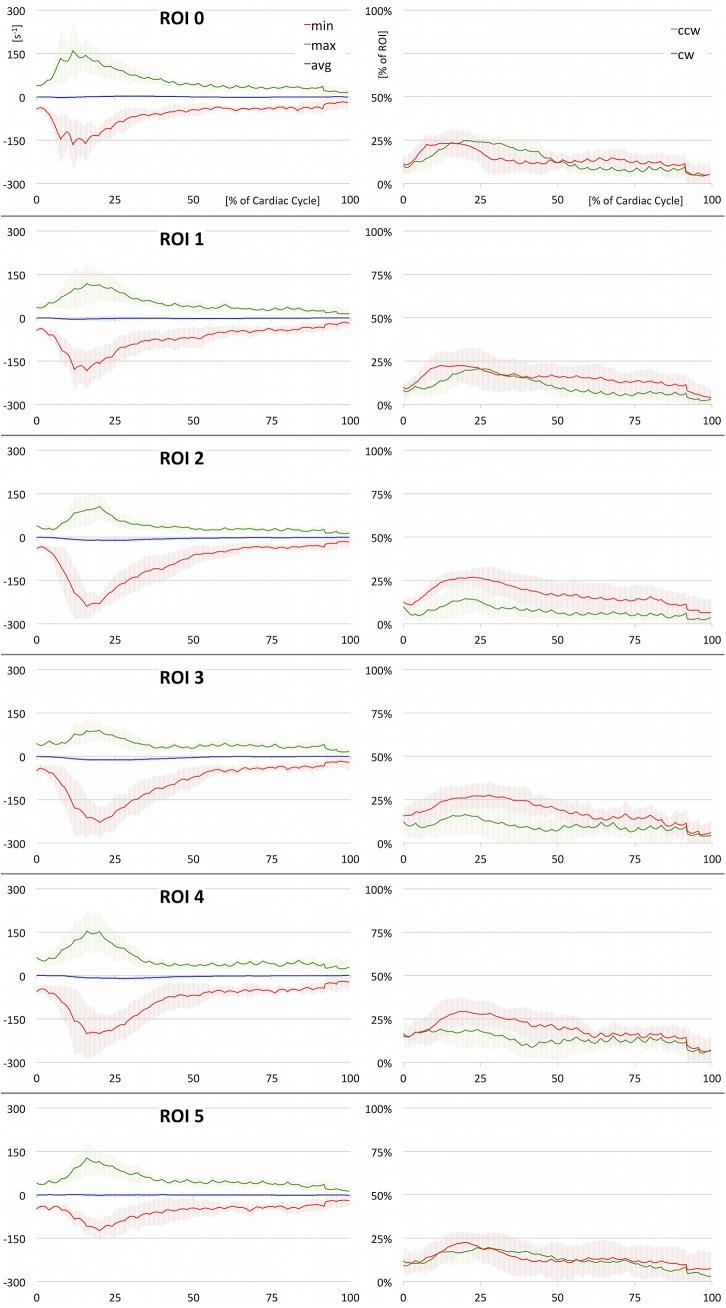
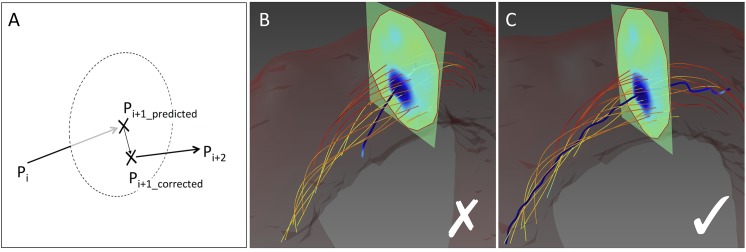
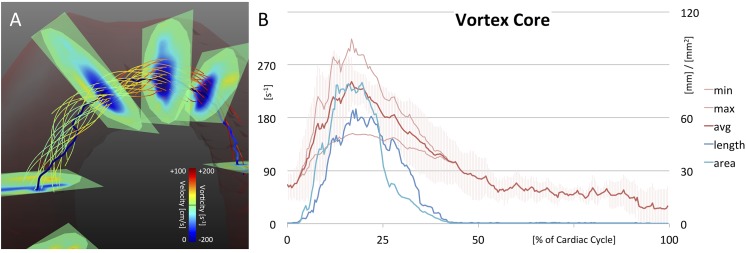
For two-dimensional vorticity assessment, a standardized set of 6 regions-of-interest (ROIs) was defined throughout the course of the aorta. For each ROI, a heatmap of time-resolved vorticity values [Formula: see text] was computed. Evolution of minimum, maximum, and average values as well as opposing rotational flow components were analyzed. For three-dimensional analysis, vortex core detection was implemented combining the predictor-corrector method with λ2 correction. Strength, elongation, and radial expansion of the detected vortex core were recorded over time. All methods were applied to 4D flow MRI datasets of 9 healthy subjects, 2 patients with mildly dilated aorta, and 1 patient with aortic aneurysm.
Vorticity quantification in the 6 standardized ROIs enabled the description of physiological vortex flow in the healthy aorta. Helical flow developed early in the ascending aorta (absolute vorticity = 166.4±86.4 s-1 at 12% of cardiac cycle) followed by maximum values in mid-systole in the aortic arch (240.1±45.2 s-1 at 16%). Strength, elongation, and radial expansion of 3D vortex cores escalated in early systole, reaching a peak in mid systole (strength = 241.2±30.7 s-1 at 17%, elongation = 65.1±34.6 mm at 18%, expansion = 80.1±48.8 mm2 at 20%), before all three parameters similarly decreased to overall low values in diastole. Flow patterns were considerably altered in patient data: Vortex flow developed late in mid/end-systole close to the aortic bulb and no physiological helix was found in the aortic arch.
We have introduced objective measures for quantification of vortical flow in 4D phase contrast MRI. Vortex blood flow in the thoracic aorta could be consistently described in all healthy volunteers. In patient data, pathologically altered vortex flow was observed.
相位对比磁共振成像(MRI)可用于检查心脏及相邻大血管中的复杂血流动力学。涡流模式似乎在某些血管病变中起重要作用。我们提出了二维和三维指标,用于在四维相位对比MRI中对主动脉涡流血流进行客观量化。
对于二维涡度评估,在整个主动脉行程中定义了一组标准化的6个感兴趣区域(ROI)。对于每个ROI,计算时间分辨涡度值的热图[公式:见原文]。分析最小值、最大值和平均值的演变以及相反的旋转流分量。对于三维分析,结合预测校正法和λ2校正实现涡核检测。记录检测到的涡核的强度、伸长率和径向扩展随时间的变化。所有方法均应用于9名健康受试者、2名轻度主动脉扩张患者和1名主动脉瘤患者的四维血流MRI数据集。
在6个标准化ROI中进行涡度量化能够描述健康主动脉中的生理性涡流。螺旋流在升主动脉早期形成(心动周期的12%时绝对涡度=166.4±86.4 s-1),随后在主动脉弓收缩中期达到最大值(16%时为240.1±45.2 s-1)。三维涡核的强度、伸长率和径向扩展在收缩早期升高,在收缩中期达到峰值(强度=17%时为241.2±30.7 s-1,伸长率=18%时为65.1±34.6 mm,扩展=20%时为80.1±48.8 mm2),然后这三个参数在舒张期均类似地降至总体低值。患者数据中的血流模式有显著改变:涡流在收缩中期/末期接近主动脉球处形成较晚,且在主动脉弓中未发现生理性螺旋。
我们引入了在四维相位对比MRI中量化涡流的客观测量方法。在所有健康志愿者中均可一致地描述胸主动脉中的涡流血流。在患者数据中,观察到了病理性改变的涡流。