De Pergola Giovanni, Campobasso Nicla, Nardecchia Adele, Triggiani Vincenzo, Caccavo Domenico, Gesualdo Loreto, Silvestris Franco, Manno Carlo
Clinical Nutrition Unit, Medical Oncology, Department of Biomedical Sciences and Human Oncology, Section of Clinical Oncology, University of Bari, School of Medicine, Policlinico, Piazza Giulio Cesare 11, 70124, Bari, Italy.
Department of Emergency and Organ Tranplantation (DETO), Section of Nephrology, University of Bari, School of Medicine, Policlinico, Piazza Giulio Cesare, 70124, Bari, Italy.
BMC Cardiovasc Disord. 2015 Sep 30;15:108. doi: 10.1186/s12872-015-0101-6.
Renal sinus fat (RSF) has been recognized as a risk factor for arterial hypertension. This study was addressed to examine whether also para- and perirenal fat accumulation is associated to higher 24-h mean systolic (SBP) and/or diastolic blood pressure (DBP) levels in overweight and obese subjects.
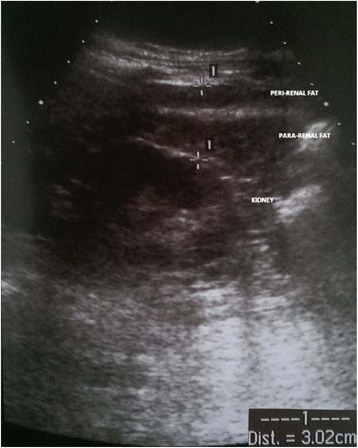
A cohort of 42 overweight and obese patients, 29 women and 13 men, aged 25-55 years, not treated with any kind of drug, was examined. Body mass index (BMI), waist circumference (WC), fasting insulin and glucose serum levels, insulin resistance (assessed by using the homeostasis model assessment [HOMAIR]), and 24-h aldosterone urine levels were measured. Ambulatory blood pressure monitoring (ABPM) was measured with 15 min intervals from 7.0 a.m. to 11.0 a.m. and with 30 min intervals from 23.0 to 7.0 for consecutive 24 h, starting from 8:30 AM. Measurement of para- and perirenal fat thickness was performed by ultrasounds by a duplex Doppler apparatus.
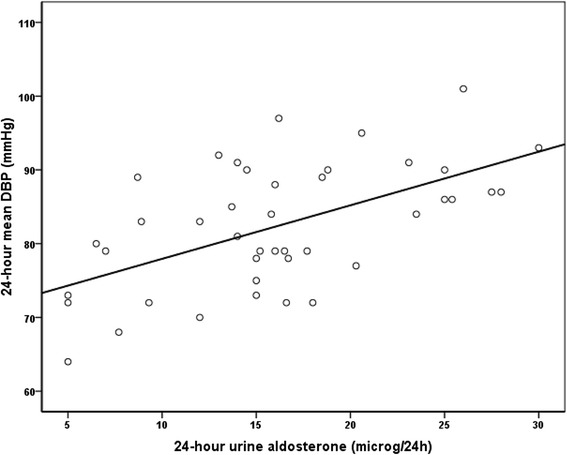
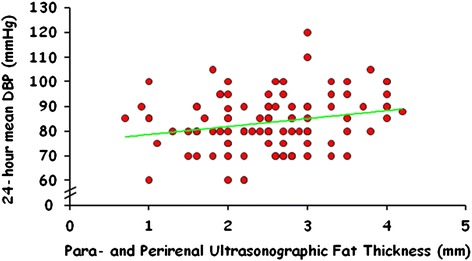
Para- and perirenal ultrasonographic fat thickness (PUFT) was significantly and positively correlated with WC (p < 0.01), insulin (p < 0.01), HOMAIR (p < 0.01), and 24-h mean DBP levels (p < 0.05). 24-h mean DBP was also significantly and positively correlated with 24-h aldosterone urine concentrations (p < 0.001). A multivariate analysis by multiple linear regression was performed; the final model showed that the association of 24-h mean DBP as dependent variable with PUFT (multiple R = 0.34; p = 0.026) and daily aldosterone production (multiple R = 0.59; p = 0.001) was independent of other anthropometric, hormone and metabolic parameters.
This study shows a positive independent association between PUFT and mean 24-h diastolic blood pressure levels in overweight and obese subjects, suggesting a possible direct role of PUFT in increasing daily diastolic blood pressure.
肾窦脂肪(RSF)已被确认为动脉高血压的一个危险因素。本研究旨在探讨超重和肥胖受试者的肾旁及肾周脂肪堆积是否也与24小时平均收缩压(SBP)和/或舒张压(DBP)水平升高有关。
对42名年龄在25 - 55岁、未接受任何药物治疗的超重和肥胖患者进行了研究,其中女性29名,男性13名。测量了体重指数(BMI)、腰围(WC)、空腹胰岛素和血糖血清水平、胰岛素抵抗(采用稳态模型评估[HOMAIR]进行评估)以及24小时尿醛固酮水平。从上午8:30开始,上午7:00至11:00每隔15分钟、23:00至次日7:00每隔30分钟进行动态血压监测(ABPM),连续监测24小时。使用双功多普勒超声仪通过超声测量肾旁及肾周脂肪厚度。
肾旁及肾周超声脂肪厚度(PUFT)与WC(p < 0.01)、胰岛素(p < 0.01)、HOMAIR(p < 0.01)以及24小时平均DBP水平(p < 0.05)呈显著正相关。24小时平均DBP也与24小时尿醛固酮浓度呈显著正相关(p < 0.001)。进行了多元线性回归的多变量分析;最终模型显示,以24小时平均DBP为因变量与PUFT(复相关系数R = 0.34;p = 0.026)和每日醛固酮生成量(复相关系数R = 0.59;p = 0.001)之间的关联独立于其他人体测量、激素和代谢参数。
本研究表明,超重和肥胖受试者的PUFT与24小时平均舒张压水平之间存在独立的正相关,提示PUFT在升高每日舒张压方面可能具有直接作用。