Takeuchi Hikaru, Taki Yasuyuki, Sekiguchi Atsushi, Nouchi Rui, Kotozaki Yuka, Nakagawa Seishu, Miyauchi Carlos Makoto, Iizuka Kunio, Yokoyama Ryoichi, Shinada Takamitsu, Yamamoto Yuki, Hanawa Sugiko, Araki Tsuyoshi, Hashizume Hiroshi, Kunitoki Keiko, Sassa Yuko, Kawashima Ryuta
Division of Developmental Cognitive Neuroscience, Institute of Development, Aging and Cancer, Tohoku University, Sendai, Japan.
Division of Medical Neuroimaging Analysis, Department of Community Medical Supports, Tohoku Medical Megabank Organization, Tohoku University, Sendai, Japan.
Sci Rep. 2015 Sep 30;5:14220. doi: 10.1038/srep14220.
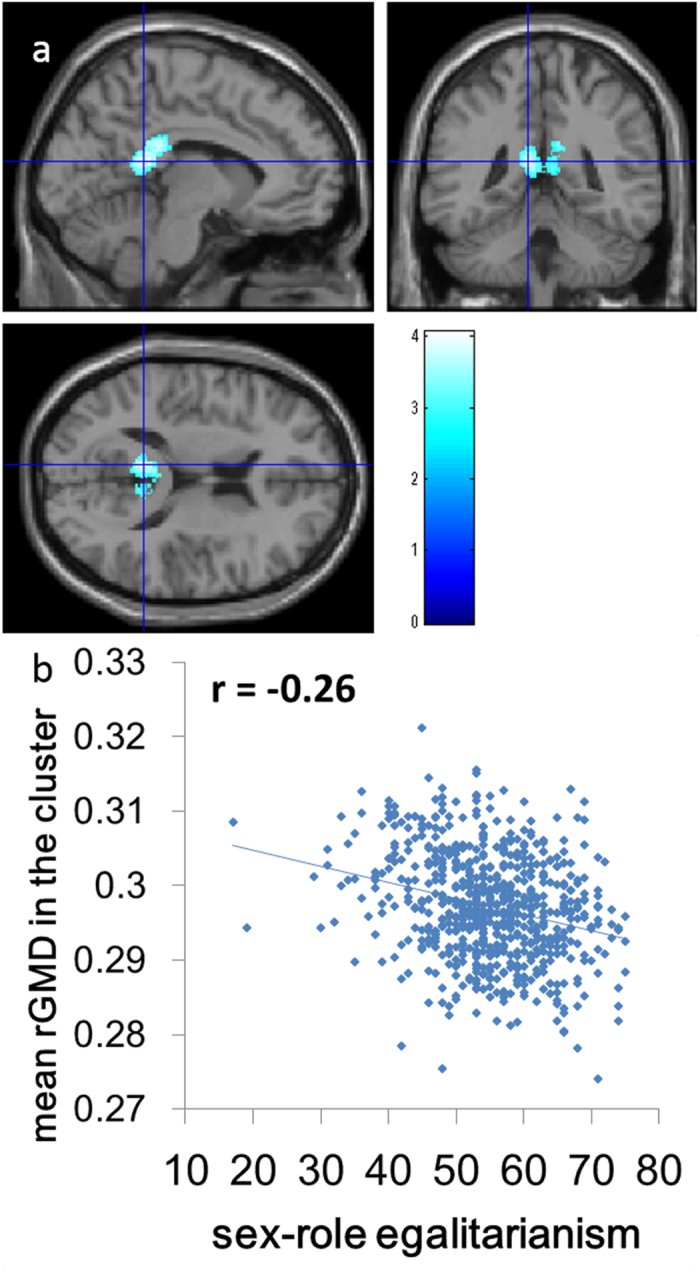
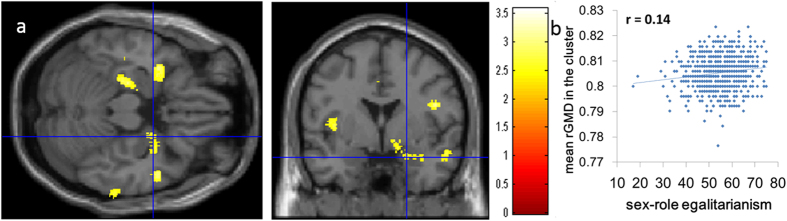
Sex-role egalitarianism (SRE) is the belief that the sex of an individual should not influence the perception of his or her rights, abilities, obligations, and opportunities. Thus, low SRE reflects a more conservative stereotypical view on sex-role. Here we investigated anatomical correlates of individual differences in SRE in the present study. We used voxel-based morphometry, a questionnaire to determine an individual's SRE and associated psychological measures, and determined the association of SRE with gray matter structures and their cognitive nature in healthy individuals (375 men and 306 women; age, 20.6 ± 1.8 years). We demonstrated that higher SRE was associated with smaller regional gray matter density (rGMD) in the anterior part of the posterior cingulate cortex (PCC) and higher rGMD in the right amygdala. Post-hoc analyses revealed psychological measures characterized by contentious interpersonal orientations, such as contentious achievement motivation, were associated with lower SRE and higher rGMD in the anterior part of PCC. Depressive tendencies were associated with lower SRE and higher rGMD in the right amygdala. These findings suggest that variations in stereotype on sex role have roots in the limbic brain structures linked to contentious interpersonal orientation (cingulate) and negative mood (amygdala).
性别角色平等主义(SRE)是指一种信念,即个人的性别不应影响对其权利、能力、义务和机会的认知。因此,低SRE反映了对性别角色更为保守的刻板观点。在本研究中,我们调查了SRE个体差异的解剖学相关性。我们使用基于体素的形态测量法、一份用于确定个体SRE及相关心理测量的问卷,并确定了SRE与健康个体(375名男性和306名女性;年龄,20.6±1.8岁)灰质结构及其认知性质之间的关联。我们证明,较高的SRE与后扣带回皮质(PCC)前部较小的区域灰质密度(rGMD)以及右侧杏仁核较高的rGMD相关。事后分析显示,以有争议的人际取向为特征的心理测量指标,如有争议的成就动机,与较低的SRE以及PCC前部较高的rGMD相关。抑郁倾向与较低的SRE以及右侧杏仁核较高的rGMD相关。这些发现表明,性别角色刻板印象的差异源于与有争议的人际取向(扣带回)和负面情绪(杏仁核)相关的边缘脑结构。