
两个大型社区队列中胰岛素抵抗和2型糖尿病风险的蛋白质生物标志物
Protein Biomarkers for Insulin Resistance and Type 2 Diabetes Risk in Two Large Community Cohorts.
作者信息
Nowak Christoph, Sundström Johan, Gustafsson Stefan, Giedraitis Vilmantas, Lind Lars, Ingelsson Erik, Fall Tove
机构信息
Department of Medical Sciences, Molecular Epidemiology and Science for Life Laboratory, Uppsala University, Uppsala, Sweden.
Department of Medical Sciences, Cardiovascular Epidemiology, Uppsala University, Uppsala, Sweden.
出版信息
Diabetes. 2016 Jan;65(1):276-84. doi: 10.2337/db15-0881. Epub 2015 Sep 29.
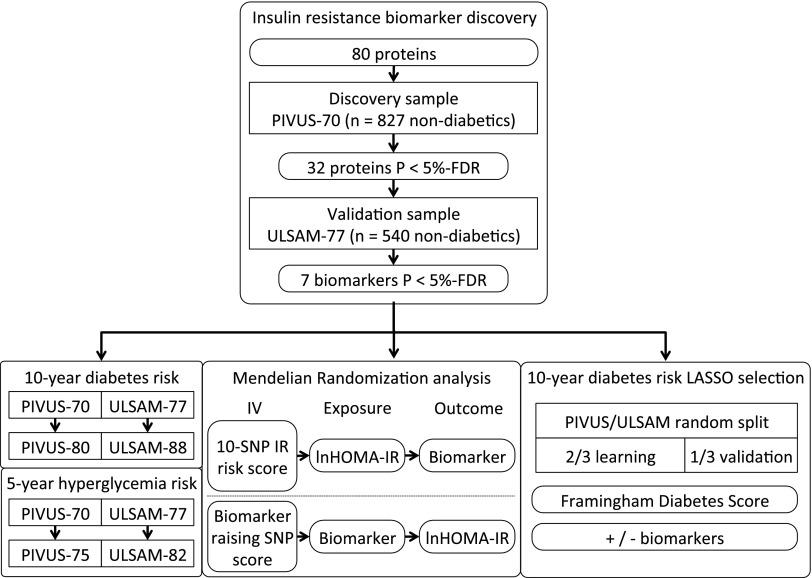
Insulin resistance (IR) is a precursor of type 2 diabetes (T2D), and improved risk prediction and understanding of the pathogenesis are needed. We used a novel high-throughput 92-protein assay to identify circulating biomarkers for HOMA of IR in two cohorts of community residents without diabetes (n = 1,367) (mean age 73 ± 3.6 years). Adjusted linear regression identified cathepsin D and confirmed six proteins (leptin, renin, interleukin-1 receptor antagonist [IL-1ra], hepatocyte growth factor, fatty acid-binding protein 4, and tissue plasminogen activator [t-PA]) as IR biomarkers. Mendelian randomization analysis indicated a positive causal effect of IR on t-PA concentrations. Two biomarkers, IL-1ra (hazard ratio [HR] 1.28, 95% CI 1.03-1.59) and t-PA (HR 1.30, 1.02-1.65) were associated with incident T2D, and t-PA predicted 5-year transition to hyperglycemia (odds ratio 1.30, 95% CI 1.02-1.65). Additional adjustment for fasting glucose rendered both coefficients insignificant and revealed an association between renin and T2D (HR 0.79, 0.62-0.99). LASSO regression suggested a risk model including IL-1ra, t-PA, and the Framingham Offspring Study T2D score, but prediction improvement was nonsignificant (difference in C-index 0.02, 95% CI -0.08 to 0.12) over the T2D score only. In conclusion, proteomic blood profiling indicated cathepsin D as a new IR biomarker and suggested a causal effect of IR on t-PA.
胰岛素抵抗(IR)是2型糖尿病(T2D)的先兆,因此需要改进风险预测并深入了解其发病机制。我们使用一种新型的高通量92蛋白检测方法,在两组无糖尿病的社区居民队列(n = 1367)(平均年龄73±3.6岁)中识别与IR的稳态模型评估(HOMA)相关的循环生物标志物。校正线性回归确定组织蛋白酶D,并确认六种蛋白质(瘦素、肾素、白细胞介素-1受体拮抗剂[IL-1ra]、肝细胞生长因子、脂肪酸结合蛋白4和组织纤溶酶原激活物[t-PA])为IR生物标志物。孟德尔随机化分析表明IR对t-PA浓度有正向因果效应。两种生物标志物,IL-1ra(风险比[HR]1.28,95%置信区间1.03 - 1.59)和t-PA(HR 1.30,1.02 - 1.65)与T2D发病相关,且t-PA可预测5年向高血糖的转变(优势比1.30,95%置信区间1.02 - 1.65)。对空腹血糖进行额外校正后,两个系数均无统计学意义,并揭示肾素与T2D之间存在关联(HR 0.79,0.62 - 0.99)。套索回归提出了一个风险模型,包括IL-1ra、t-PA和弗雷明翰后代研究T2D评分,但与仅使用T2D评分相比,预测改善不显著(C指数差异为0.02,95%置信区间 - 0.08至0.12)。总之,蛋白质组学血液分析表明组织蛋白酶D是一种新的IR生物标志物,并提示IR对t-PA有因果效应。
 Zotero 插件