Hilbert Anja, Braehler Elmar, Schmidt Ricarda, Löwe Bernd, Häuser Winfried, Zenger Markus
Integrated Research and Treatment Center Adiposity Diseases, University of Leipzig, Leipzig, Germany.
Obes Facts. 2015;8(5):293-301. doi: 10.1159/000438681. Epub 2015 Oct 1.
Self-stigma in overweight and obese individuals has strong associations with impairment in mental and global health. This study sought to explore self-compassion as a psychological resource in the self-stigma process.
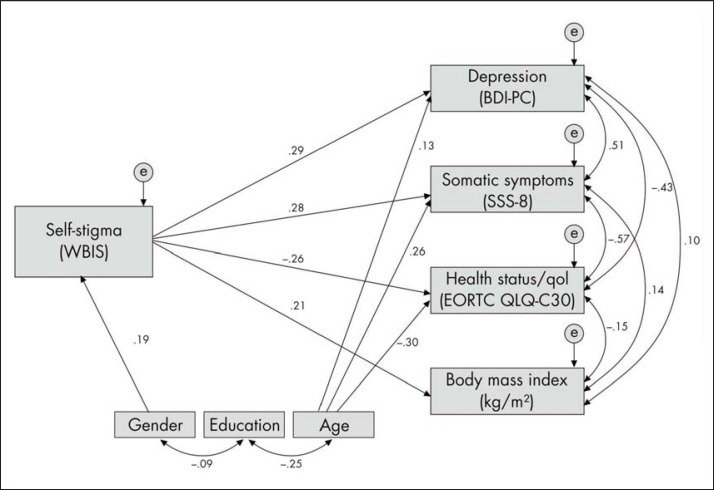
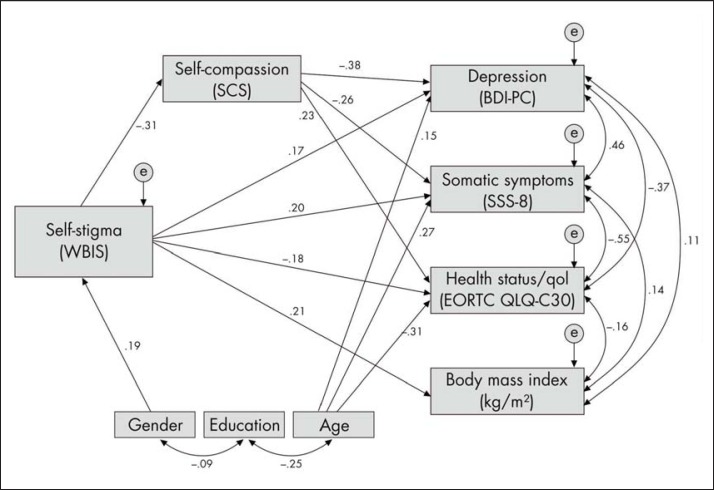
In a 2012 representative German population survey of N = 1,158 overweight and obese individuals, self-compassion was examined as a mediator between self-stigma and mental and physical health outcomes, including BMI (kg/m2), using structural equation modeling and controlling for sociodemographic factors.
Psychological variables were assessed using validated self-report questionnaires. Self-compassion partially mediated the relationships between self-stigma and depression, somatic symptoms, and health status/quality of life, lowering the predictive effect of self-stigma on the outcomes by approximately one-third. In contrast, self-compassion, because it was unrelated to BMI, did not mediate the association between self-stigma and BMI.
Self-compassion has the potential to act as a buffer against the mental and global health detriments of self-stigma in overweight and obesity and could thus represent a target for interventions to reduce self-stigma and prevent these health impairments. In order to influence the association between self-stigma and BMI, self-compassion should conceptually be linked to weight management.
超重和肥胖个体的自我污名与心理和整体健康受损密切相关。本研究旨在探讨自我同情作为自我污名过程中的一种心理资源。
在2012年对N = 1158名超重和肥胖个体进行的具有代表性的德国人群调查中,使用结构方程模型并控制社会人口学因素,将自我同情作为自我污名与心理和身体健康结果(包括体重指数(kg/m²))之间的中介进行检验。
使用经过验证的自我报告问卷评估心理变量。自我同情部分介导了自我污名与抑郁、躯体症状以及健康状况/生活质量之间的关系,将自我污名对结果的预测作用降低了约三分之一。相比之下,由于自我同情与体重指数无关,它并未介导自我污名与体重指数之间的关联。
自我同情有可能作为一种缓冲,抵御超重和肥胖个体中自我污名对心理和整体健康的损害,因此可能成为减少自我污名和预防这些健康损害的干预目标。为了影响自我污名与体重指数之间的关联,应在概念上将自我同情与体重管理联系起来。